Application
HDPE Pipe for Stormwater Detention, Retention & Infiltration Systems (2026)
Large-diameter HDPE stores most of its water inside the pipe — where it can't silt up — which is why the headline "95% void" chamber figure doesn't survive contact with a real installed bed.

Dr. Wei Liu, P.E.
Senior Engineering Manager · Primepoly
Published: Jun 8, 2026
Updated: Jun 8, 2026
14 min read
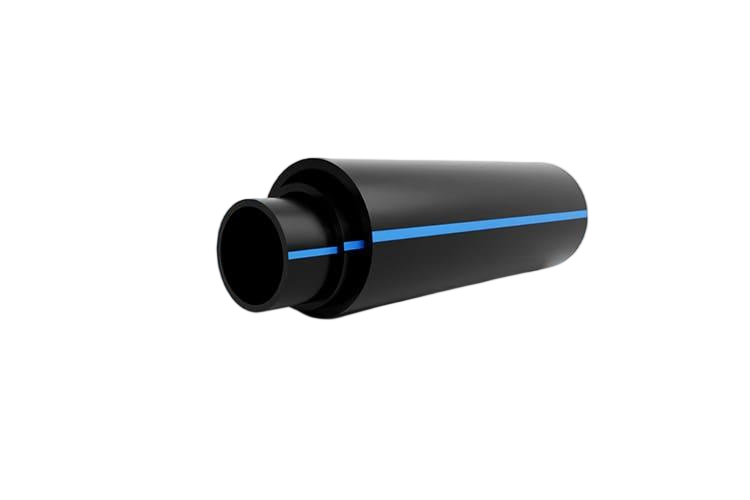
Underground stormwater storage is a market full of marketing math. You'll be told a chamber system is "95% void" and a pipe is only "30–40% void," and left to conclude pipe is the inefficient choice. That comparison is technically true and genuinely misleading — it pits a bare chamber unit against a pipe-plus-stone bed. On an honest, installed-bed basis, large-diameter HDPE pipe stores most of its water inside the pipe, where it stays clog-proof, while chambers lean far harder on the surrounding stone voids that silt up over time. This guide is the engineer's version: precise definitions, a real storage-per-foot table, the honest void comparison, and how to size and build it.
Detention vs retention vs infiltration — what each actually means
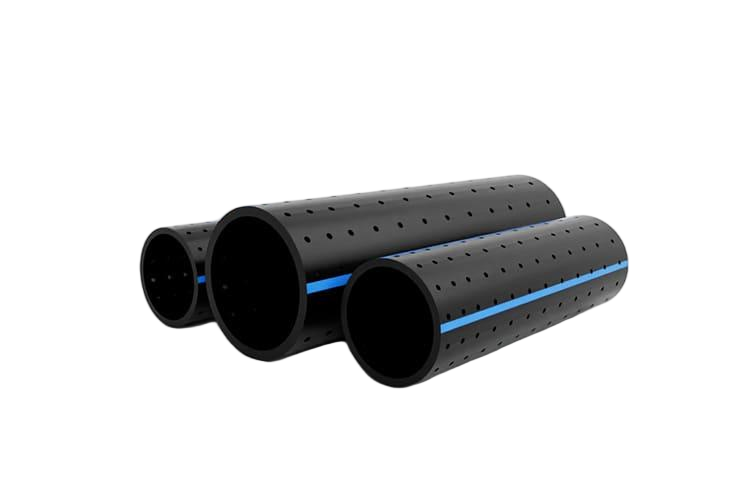
These three words are used loosely, and getting them right is an instant credibility signal. Detention is temporary storage: stormwater is held during a storm and let out at a controlled, reduced rate through a regulated outlet or orifice, so the same volume leaves the site — just more slowly — to protect downstream channels from peak-flow spikes. The system is normally dry between storms and uses non-perforated pipe with watertight joints. Retention means storing runoff without subsequent surface discharge — classically a permanent wet pool that leaves only by infiltration and evaporation. Infiltration is the mechanism of letting water soak into the subgrade to recharge groundwater, achieved underground with perforated pipe wrapped in stone and geotextile, with no positive outlet for the design storm. The rule of thumb: detention is temporary, retention is permanent.
Why large-diameter & corrugated HDPE works for underground storage
HDPE suits underground storage for a stack of reasons. Storage volume scales with the square of the diameter, so large-diameter pipe is a volume machine — and most of that volume is inside the pipe, which can't silt shut. Dual-wall corrugated HDPE (a smooth interior liner over a corrugated exterior, per AASHTO M294 / ASTM F2648 / F2306) gives high ring stiffness for buried loads with a smooth hydraulic bore; solid-wall and profile-wall HDPE (ASTM F714 / F894) and steel-reinforced PE extend the range to very large diameters and deep cover. Perforated pipe converts the same system to infiltration, parallel laterals tie into one or two headers, and the large interior allows man-entry inspection and easy jetting. It's corrosion- and abrasion-proof, light, fast to install, and good for a 50–100 year design life.
How much water does HDPE pipe store? (storage per foot)
The most persuasive — and least often published — number is the storage per foot of pipe, which most competitor pages never show. The table gives it by diameter, with a separate column for the stone-void storage around the pipe (at 40% porosity, not counting stone above the crown). The headline is in the arithmetic of diameter²: a 48-inch pipe stores about 12.6 ft³ per foot inside the pipe alone, roughly four times a 24-inch pipe, because doubling the diameter quadruples the area. That in-pipe volume is the clog-proof part of the system — which is the whole argument for going large-diameter.
| Nominal ID | Pipe storage (ft³/ft) | + Stone void (ft³/ft) | Total (ft³/ft) |
|---|---|---|---|
| 12 in | 0.8 | 0.7 | 1.5 |
| 18 in | 1.8 | 1.5 | 3.3 |
| 24 in | 3.1 | 2.5 | 5.6 |
| 36 in | 7.1 | 4.0 | 11.1 |
| 48 in | 12.6 | 6.5 | 19.1 |
| 60 in | 19.6 | 9.2 | 28.9 |
The void-ratio myth: pipe vs chambers vs crates vs stone
Now the honest comparison. Open-bottom arch chambers advertise ~90–95% void — but that's the chamber unit, not the installed bed. Count the embedment stone and 25–60% of a chamber system's storage actually lives in stone voids (about 58% for a 30-inch chamber) versus only ~25% for a large pipe. And stone voids aren't even a reliable 40%: a conservative design value is closer to 36%, and they permanently lose capacity if they silt up. So the real, installed-bed picture inverts the marketing: large HDPE pipe stores most of its water inside the pipe (clog-proof), while chambers and stone-and-pipe systems depend on the stone voids that clog. The table lays out the trade-offs honestly — pipe's cost is a larger excavation footprint for a given volume, not a hidden capacity loss.
| System | Pros | Cons |
|---|---|---|
| Large-diameter / corrugated HDPE pipe | Most storage inside the pipe (clog-proof); corrosion/abrasion-proof; man-entry & jettable; fast install; 50–100 yr | Lower installed-bed void efficiency → larger excavation footprint for a given volume |
| Reinforced concrete pipe (RCP) | Very high strength, rigid, long history | Heavy (crane), corrodes in acidic soils, more joints, slower, high freight |
| Open-bottom arch chambers | High unit void; small footprint; built-in infiltration | Leans on clog-prone stone voids; sensitive to siltation & stone quality |
| Crates / modular geocellular | Very high void (~90%+); flexible shapes; shallow | Hard to inspect/clean interior; long-term clog & structural concerns; QA-sensitive |
| Stone-and-pipe (perforated pipe in stone) | Simple, cheap at small scale; good infiltration | Stone is only ~36–40% void → inefficient at scale; storage lost when stone silts |
Sizing: from allowable release rate to required volume
Sizing usually starts from the allowable release rate — typically the pre-development peak flow that the local authority will let leave the site — and the required storage volume is what's needed to hold back the difference between the post-development inflow and that allowed outflow. Small sites (under ~5 acres) often use the Modified Rational Method, V ≈ (Q_in − Q_out) × t_d; larger or regulated sites use TR-55, hydrograph or LID methods, and the method is dictated by the jurisdiction. The design storm return period (2-, 10-, 25- or 100-year) is also set by local code, so don't assume a single number. Once you have the volume, the same storage can be hit with short runs of large pipe or long runs of small pipe — the choice trades footprint against excavation depth, groundwater table and outlet elevation.
Burial & structure: cover, loads & flexible-pipe design
HDPE is a flexible conduit, so it carries load by deflecting slightly and transferring it into the compacted soil envelope (soil-pipe interaction), not by resisting it rigidly like concrete pipe. Design limits ring deflection (commonly 5–7.5% of diameter) and follows AASHTO LRFD Section 12 for structure and ASTM D2321 for installation. Minimum cover for HS-25 traffic runs roughly 1–2 feet depending on diameter (about 12 inches up to 36-inch pipe, more above that), and flexible pavement isn't counted as cover; maximum cover depends on the backfill and compaction and is read from the manufacturer's tables, not a single universal figure. The soil envelope is doing the structural work — good bedding and side-fill compaction matter more than wall thickness.
Water quality, pretreatment & maintenance access
Two things keep an underground system alive: pretreatment and access. Pretreatment is effectively mandatory — sumped inlets, grit chambers, hydrodynamic separators and oil/grit units keep sediment, trash and hydrocarbons out of the storage, because grit that reaches the system occupies volume and seals perforations. Build in access from day one: manholes, 24-inch access risers, cleanout stubs on the headers, inspection ports on the laterals and observation wells at the stone-bed invert to track drawdown. HDPE's smooth bore makes jetting and vacuuming straightforward. Inspect at least twice a year, clean before sediment exceeds the code limit, and design for the system to drain down within about 72 hours of the design storm.
The design sequence
The pieces come together in a defined order, summarised in the path below. In practice you iterate it — a groundwater or cover constraint can send you back to re-trade diameter against length — but the sequence is the backbone, and it starts (always) with the local regulations.
5 costly mistakes
- No or undersized pretreatment — sediment fills the storage and seals the perforations, permanently losing volume.
- Over-crediting stone voids — designing to 40% when ~36% is the reliable number, or counting chamber 'void' that is really clog-prone stone void.
- Skipping the cover and load check — too little cover for traffic, or exceeding the maximum cover for the backfill type.
- Designing in no maintenance access — no risers, cleanouts or observation wells, so the system can't be inspected or cleaned and fails silently.
- Confusing the system type — building a perforated infiltration bed where the soils or seasonal high groundwater won't allow it (no infiltration test, inadequate separation to the water table).
Glossary
- Detention
- Temporary stormwater storage with a controlled, reduced release through a regulated outlet — normally dry between storms; uses watertight pipe.
- Retention
- Permanent storage of runoff without subsequent surface discharge — classically a permanent wet pool.
- Infiltration
- Letting stored water soak into the subgrade through perforated pipe in stone, with no positive outlet for the design storm.
- Storage per foot
- The volume stored per length of pipe (ft³/ft); scales with diameter², so large pipe stores far more — mostly inside the pipe (clog-proof).
- Void ratio
- The fraction of a system's footprint that is open storage; stone is ~36–40%, chamber units higher but lean on clog-prone stone voids at the bed level.
- Allowable release rate
- The peak outflow the authority permits (usually the pre-development peak) — the starting point that sets the required storage volume.
References & standards
- [1]Prinsco — Retention/Detention System Guide TN-2-030 (storage-per-foot table)
- [2]ADS — TN 2.01 — min/max cover heights for HDPE per AASHTO
- [3]Contech — What's the difference between detention and retention?
- [4]Contech — Examining stone void space — is 40% a reliable number?
- [5]Philadelphia Water — Stormwater manual §4.8 — subsurface detention (pretreatment & access)
- [6]Plastics Pipe Institute (PPI) — Stormwater management with corrugated HDPE
- [7]USDA NRCS — TR-55 — urban hydrology for small watersheds (runoff & storage)
- [8]ASTM International — ASTM D2321 — installation of flexible thermoplastic pipe
Frequently asked questions
Need expert advice on your project?
Our engineering team helps utilities, contractors and EPCs specify the right pipe material and SDR for their project. Get a no-obligation technical consultation.
Talk to an engineerRead next
13 min read
HDPE Corrugated & Double-Wall Pipe for Drainage, Stormwater & Culverts (2026)
13 min read
HDPE vs PVC for Drainage & Sewer: Which Pipe for Gravity, Non-Pressure Systems? (2026)
13 min read
HDPE Buried Pipe Design: Ring Deflection, Soil Support & Burial Depth (2026)
13 min read
HDPE Pipe Bedding, Backfill & Trench Design: Installing Flexible Pipe Correctly (2026)
13 min read
HDPE Pipe Hydraulic Design & Flow Capacity: Sizing, Head Loss & Velocity (2026)
Explore further
Related applications, material comparisons and country buying guides selected for this topic.