Guide
HDPE Pipe Hydraulic Design & Flow Capacity: Sizing, Head Loss & Velocity (2026)
A smooth bore that stays smooth — why inside diameter (not OD) drives flow, the head-loss formulas, velocity limits and HDPE's surge advantage.

Dr. Wei Liu, P.E.
Senior Engineering Manager · Primepoly
Published: Jun 7, 2026
Updated: Jun 7, 2026
13 min read
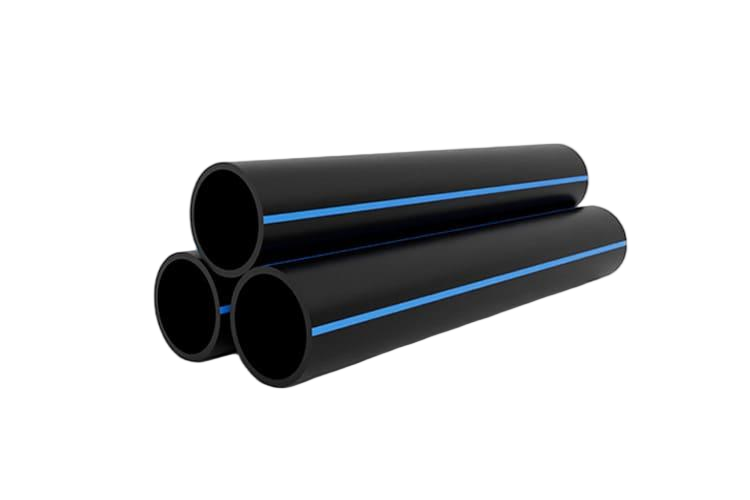
HDPE's hydraulic story has a twist that catches engineers out. Its bore is hydraulically smooth — and, unlike metal, it stays smooth for the life of the pipe — so its flow capacity is high and, more importantly, stable. But because HDPE is sized by its outside diameter, the wall thickness (set by SDR) eats into the bore, so two pipes of the same nominal size can carry quite different flows. This guide covers the roughness numbers, why inside diameter drives flow, the head-loss formulas, velocity limits, how to size for a target flow, and why HDPE generates lower surge than metal.
A smooth bore that stays smooth
The headline hydraulic advantage of HDPE is not just that its bore is smooth — many new pipes are — but that it stays smooth. Because polyethylene is inert, it doesn't corrode, tuberculate or grow the biofilm and mineral scale that roughen metal mains over decades. So its flow coefficient holds steady for the full service life, while a metal main's effective capacity quietly declines. That stability is the real lifecycle benefit, and it underpins everything below.
The key roughness numbers: C, n & ε
Three coefficients describe how smoothly a pipe carries water, and PE scores well on all of them. Its Hazen-Williams C is taken as 150 for design and, critically, does not change over the service life. Its Manning's n is about 0.009 for clear water (0.010 for sanitary sewer). And its Darcy-Weisbach absolute roughness is effectively that of a hydraulically smooth pipe. The table lists the values; the constant C=150 is the number to remember.
| Method | PE value | Note |
|---|---|---|
| Hazen-Williams C | 150 | Design value; constant for life (no tuberculation) |
| Manning's n | 0.009 (clear water) / 0.010 (sewer) | Smooth bore; gravity flow |
| Darcy-Weisbach roughness ε | ~smooth (≈0.0015 mm) | Hydraulically smooth; PPI-preferred method |
Inside diameter, not OD, drives flow — and why SDR matters
HDPE is outside-diameter controlled: a given nominal pipe is always the same OD, and the wall thickness — set by SDR — determines the inside diameter. So the bore is the dependent variable: ID = OD − 2 × wall, where the wall is OD/SDR. A lower SDR means a thicker wall, a smaller ID and less flow for the same OD — and because flow scales with the square of the diameter while head loss scales with about the fourth power, even a modest ID reduction cuts capacity sharply. The table shows the effect for a 250 mm pipe across three SDRs.
| SDR | Wall (mm) | Inside diameter (mm) | Relative area |
|---|---|---|---|
| SDR 17 (PN10) | ~14.7 | ~220.6 | 1.00 (baseline) |
| SDR 11 (PN16) | ~22.7 | ~204.5 | ~0.86 |
| SDR 7.4 (PN25) | ~33.8 | ~182.5 | ~0.68 |
Head-loss formulas: Hazen-Williams, Darcy-Weisbach & Manning
Three formulas cover HDPE hydraulics. Hazen-Williams is the common choice for pressurised water, using C=150 for PE. Darcy-Weisbach (with a friction factor from the Colebrook-White equation and PE's near-smooth roughness) is the most general and is the method the Plastics Pipe Institute prefers. Manning's equation handles gravity and partially-full flow, where PE's smooth bore gives roughly 44% more capacity than concrete or clay of the same inside diameter. Pick the method to the flow regime, and use the PE coefficients above.
Velocity guidelines: design, maximum & self-cleaning
Design velocity is usually around 1.0 to 2.5 m/s, with about 1.5 m/s (5 ft/s) a common upper design figure. HDPE can run faster — well above 3 m/s — if a surge check shows the transient pressures are acceptable, because the velocity ceiling is set by surge, not by the material. A minimum velocity of roughly 0.6 to 0.9 m/s keeps lines self-cleaning, with about 1.5 m/s sometimes targeted to scour biofilm. Remember that higher velocity means a larger velocity change on valve closure, and so a higher surge.
Sizing an HDPE pipe for a target flow
Sizing for a known flow is a short, repeatable procedure — pick a velocity, find the bore, then choose the dimensions and check.
- Choose a design velocity, typically 1.5–2.0 m/s.
- Compute the required cross-sectional area, A = Q ÷ V, then the required inside diameter, ID = √(4Q ÷ πV).
- Select an outside diameter and SDR whose minimum-wall inside diameter is at least the required ID — remembering that a lower SDR shrinks the bore.
- Check head loss (Hazen-Williams with C = 150, or Darcy-Weisbach) against the available hydraulic gradient.
- Check surge at the design velocity against the pipe's pressure class, and adjust velocity or SDR if needed.
HDPE vs ductile iron vs PVC: long-term flow
For the same nominal size, HDPE's thicker pressure wall gives it a smaller initial bore than ductile iron, so it starts with slightly less capacity. But the comparison changes over time: ductile iron's C declines as it tuberculates, while HDPE holds C=150 for life — so over a 30-to-50-year horizon HDPE's constant smooth bore can match or beat aged metal pipe, and it keeps pumping energy stable. The chart shows the C-factor story; note that the rate of metal decline is debated, but that metal C declines while HDPE's stays put is not.
Source: PPI; Uni-Bell field data
Surge & water hammer: HDPE's low wave speed
When a valve closes or a pump trips, the resulting pressure surge depends on the pipe's wave speed (Joukowsky's law: surge equals fluid density times wave speed times velocity change). HDPE's low elastic modulus gives it a wave speed of only about 250 to 300 m/s, versus over 1,000 m/s for steel — so for the same velocity change, HDPE produces roughly three to four times less surge pressure. It also tolerates transient pressures above its rating, commonly cited as occasional surge to about twice and recurring surge to about 1.5 times the pressure class. That low surge is a genuine HDPE advantage.
Hydraulic sizing check
5 common sizing mistakes
- Sizing on outside diameter or nominal size instead of the actual inside diameter — which overstates capacity.
- Ignoring SDR's effect on the bore — choosing a thicker wall (lower SDR) for pressure, then assuming the same flow.
- Using a new-pipe C factor for metal forever — ignoring ductile iron's decline and so under-sizing the real long-term loss.
- Pushing velocity high to downsize the pipe without a surge check — triggering water-hammer over-pressure.
- Comparing HDPE to metal on new-bore alone — missing the lifecycle economics of constant C, lower surge and no tuberculation.
Glossary
- Hazen-Williams C
- A roughness coefficient for pressurised water flow; higher is smoother. PE uses C = 150, held constant for life.
- Inside diameter (ID)
- The bore that carries flow: ID = OD − 2 × wall. For HDPE the wall (set by SDR) reduces the bore.
- Manning's n
- A roughness coefficient for gravity/open-channel flow; PE ≈ 0.009 (clear water).
- Head loss
- The pressure (expressed as head) lost to friction along a pipe; scales strongly with inside diameter.
- Wave speed (celerity)
- The speed a pressure wave travels in the pipe; low in HDPE (~250–300 m/s), giving low surge.
- Joukowsky surge
- The water-hammer pressure rise ΔP = ρ·a·ΔV from a sudden velocity change; smaller in low-wave-speed HDPE.
References & sources
- [1]Plastics Pipe Institute (PPI) — Handbook of PE Pipe, Ch. 6 — design of PE piping systems
- [2]Plastics Pipe Institute (PPI) — HDPE hydraulic design / flow capacity (ConduitCalc)
- [3]PE100+ Association — PE pressure pipe design for operating conditions
- [4]Wikipedia — Hazen-Williams equation (SI form & constant)
- [5]Uni-Bell PVC Pipe Association — Ductile iron's Hazen-Williams coefficient declines over time
- [6]Performance Pipe (Chevron Phillips) — Municipal FAQ (C=150 constant, velocity, surge)
- [7]Plastics Pipe Institute (PPI) — TN-27 — FAQs: HDPE pipe for water
- [8]Plastics Pipe Institute (PPI) — Occasional and recurring surge design considerations for HDPE
Frequently asked questions
Need expert advice on your project?
Our engineering team helps utilities, contractors and EPCs specify the right pipe material and SDR for their project. Get a no-obligation technical consultation.
Talk to an engineerRead next
Explore further
Related applications, material comparisons and country buying guides selected for this topic.