Guide
HDPE Pipe Size & Dimension Chart: OD, SDR, PN & Wall Thickness (2026)
One master reference for PE100 pipe dimensions — the SDR-to-PN formula, the OD-to-wall chart, the metric vs IPS vs DIPS trap, and how to specify without a mismatch.

Dr. Wei Liu, P.E.
Senior Engineering Manager · Primepoly
Published: Jun 6, 2026
Updated: Jun 6, 2026
12 min read
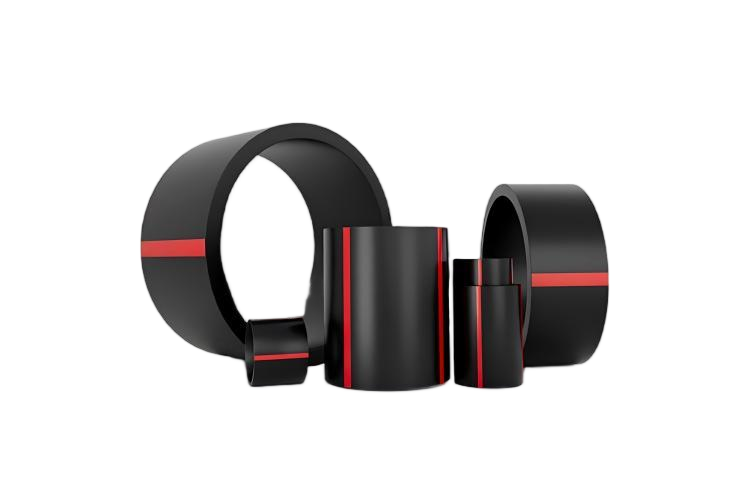
Almost every HDPE ordering mistake traces back to a dimension that was assumed instead of checked. A “6-inch” pipe can be three different outside diameters; the same SDR rating means different pressures for PE100 and PE80; and the wall thickness that controls both flow and pressure is rarely on the purchase order at all. This guide is the single reference that ties those numbers together — the formula that turns a wall thickness into a pressure rating, a master OD-to-wall chart for the two SDR classes you will buy most, and the sizing-system rules that keep your pipe and fittings compatible.
How HDPE pipe is dimensioned: OD-controlled, not NPS
Steel pipe is specified by Nominal Pipe Size (NPS) — a label that no longer matches any real dimension. HDPE is different: it is outside-diameter controlled, meaning the OD is the fixed reference and everything else is derived from it. A 110 mm PE100 pipe really is 110 mm across the outside, every time, regardless of wall thickness or pressure class. Fittings, fusion machines and tapping tools all register on that OD, which is why getting the OD system right matters more than any other single number.
Because the OD is fixed, raising the pressure rating means thickening the wall inward — which shrinks the bore. That is the trade-off behind every SDR decision: a thicker, higher-pressure wall buys you safety margin at the cost of internal diameter and flow. The next sections turn that trade-off into numbers you can specify.
What SDR means — and why it is constant across sizes
SDR (Standard Dimension Ratio) is simply the outside diameter divided by the minimum wall thickness: SDR = OD ÷ wall. Because it is a ratio, it is dimensionless — and that is the key insight. A DN63 SDR11 pipe and a DN630 SDR11 pipe carry the same pressure rating, because the geometry that resists internal pressure scales with size. Pick the SDR and you have fixed the pressure class for every diameter at once.
| SDR | Computed pressure (bar) | Designated class (PE100) |
|---|---|---|
| SDR 41 | 4.0 | PN4 |
| SDR 33 | 5.0 | PN5 |
| SDR 26 | 6.4 | PN6.3 |
| SDR 21 | 8.0 | PN8 |
| SDR 17 | 10.0 | PN10 |
| SDR 13.6 | 12.7 | PN12.5 |
| SDR 11 | 16.0 | PN16 |
| SDR 9 | 20.0 | PN20 |
| SDR 7.4 | 25.0 | PN25 |
| SDR 6 | 32.0 | PN32 |
PE100 OD-to-wall-thickness master chart
Below is the chart most buyers actually need: the minimum wall thickness (per ISO 4427-2 / ISO 161-1) for PE100 in the two pressure classes that dominate water and industrial work — SDR17 (PN10) and SDR11 (PN16). Read down to your OD, across to your pressure class, and you have the wall. Note the inside diameter for flow is the OD minus twice the wall.
| Outside diameter (mm) | SDR17 wall = PN10 | SDR11 wall = PN16 |
|---|---|---|
| 20 | — (below floor) | 2.0 |
| 25 | — (below floor) | 2.3 |
| 32 | — (below floor) | 3.0 |
| 40 | 2.4 | 3.7 |
| 50 | 3.0 | 4.6 |
| 63 | 3.8 | 5.8 |
| 75 | 4.5 | 6.8 |
| 90 | 5.4 | 8.2 |
| 110 | 6.6 | 10.0 |
| 160 | 9.5 | 14.6 |
| 200 | 11.9 | 18.2 |
| 250 | 14.8 | 22.7 |
| 315 | 18.7 | 28.6 |
| 400 | 23.7 | 36.3 |
| 500 | 29.7 | 45.4 |
| 630 | 37.4 | 57.2 |
Metric vs IPS vs DIPS: the three sizing worlds
Here is the trap that ruins more deliveries than any other: “6-inch” is not one outside diameter. HDPE is made in three OD systems, and they are not interchangeable. Metric (ISO 4427/161) names pipe by its mm OD and is the rest-of-world standard. IPS (Iron Pipe Size) is the North American default — its OD matches legacy steel pipe so it mates with existing fittings. DIPS (Ductile Iron Pipe Size) is larger again at the same nominal size, used for water transmission so HDPE can tie into ductile-iron mains.
| Nominal | Metric OD (closest) | IPS OD | DIPS OD |
|---|---|---|---|
| ~1/2″ | 20 mm | 21.3 mm (0.840″) | — |
| ~4″ | 110 mm | 114.3 mm (4.500″) | 121.9 mm (4.80″) |
| ~6″ | 160 mm | 168.3 mm (6.625″) | 175.3 mm (6.90″) |
| ~8″ | 225 mm | 219.1 mm (8.625″) | 229.9 mm (9.05″) |
| ~12″ | 315 mm | 323.9 mm (12.750″) | 335.3 mm (13.20″) |
The practical rule: pipe, fittings and fusion ends must all share one OD system. A 160 mm metric pipe will not properly butt-fuse to a 6-inch IPS (168.3 mm) pipe, and the “closest” metric equivalents in the table are approximations, not exact matches. State the system explicitly on every line of the order — “DN160 metric” or “6″ IPS,” never just “6 inch.”
PE100 vs PE80: same wall, different pressure
Dimensions alone do not tell you the pressure rating — the resin grade does. Because PE100 has a higher design stress (8.0 MPa) than PE80 (6.3 MPa), the same SDR carries about 25 % more pressure in PE100. So PE100 lets you hit a target pressure with a thinner wall (higher SDR), which also widens the bore and improves flow. The table shows the gap at common SDRs.
| SDR | PE100 (MRS 10) | PE80 (MRS 8) |
|---|---|---|
| SDR 9 | PN20 | PN16 |
| SDR 11 | PN16 | PN12.5 |
| SDR 17 | PN10 | PN8 |
| SDR 21 | PN8 | PN6.3 |
Pressure–temperature derating & surge allowance
Every PN rating assumes water at 20 °C. Run the line hotter and the safe working pressure falls — a step almost no “size chart” page mentions. Multiply the PN by the temperature derating factor below to get the real allowable pressure. The factors are indicative ranges; confirm against your manufacturer’s data for the exact resin.
| Operating temperature | Derating factor (× PN) |
|---|---|
| ≤ 20 °C | 1.00 |
| 25 °C | ~0.90 |
| 30 °C | ~0.80 |
| 40 °C | ~0.60–0.70 |
| 60 °C | ~0.50 |
Coils vs straight lengths: what is available at each size
How the pipe ships depends on diameter. Small sizes coil; large sizes do not. Coiling slashes the number of joints on a long small-bore run (fewer fusions, faster install) but is only practical up to a point before the bend stress becomes too high.
| Diameter band | Supply form | Typical lengths |
|---|---|---|
| ≤ 110–125 mm | Coils (or sticks) | 50 / 100 / 150 m coils |
| 90–180 mm | Coils or straight lengths | Coil up to ~180 mm (maker-dependent); 6 m / 12 m sticks |
| > 180 mm | Straight lengths only | 6 m and 12 m, field-fused |
Choosing your SDR: a quick decision path
Five questions take you from a duty requirement to a buildable spec — pressure first, then grade, then SDR, then temperature, then the OD system that keeps everything compatible.
How to specify HDPE pipe correctly: 5 mistakes to avoid
- Ordering by nominal size without naming the OD system. “6-inch” could be 160 mm metric, 168.3 mm IPS or 175.3 mm DIPS — specify which, or pipe and fittings will not mate.
- Assuming the same SDR gives the same pressure across grades. PE100 SDR11 is PN16; PE80 SDR11 is only PN12.5. Always pair the SDR with the resin grade.
- Sizing on OD when flow depends on inside diameter. A higher SDR (thinner wall) gives a larger bore — two pipes of the same OD can have meaningfully different flow capacity.
- Ignoring temperature derating. A PN16 pipe at 40 °C is no longer a 16-bar pipe; apply the derating factor before you finalise the class.
- Mixing standard families. Combining ISO metric pipe with ASTM/AWWA IPS fittings, or PE100 pipe with fittings rated to a different grade, leaves a joint that is the weakest link in the system.
Glossary
- OD (Outside Diameter)
- The controlling dimension for HDPE pipe. Fixed for a given size; the wall thickens inward to raise the pressure class.
- SDR (Standard Dimension Ratio)
- Outside diameter divided by minimum wall thickness. Lower SDR = thicker wall = higher pressure rating; constant across all diameters.
- PN (Nominal Pressure)
- Maximum continuous internal water pressure in bar at 20 °C over a 50-year service basis. PN16 = 16 bar continuous.
- MRS (Minimum Required Strength)
- The classified long-term hoop strength of the resin: 10 MPa for PE100, 8 MPa for PE80, per ISO 12162.
- IPS / DIPS
- Iron Pipe Size and Ductile Iron Pipe Size — North American OD systems sized to match legacy steel and ductile-iron pipe respectively. Not interchangeable with metric OD.
- Derating factor
- A multiplier (≤ 1.0) applied to the PN rating when the pipe operates above 20 °C, reducing the allowable working pressure.
References & standards
- [1]ISO — ISO 4427-2 — Plastics piping systems for water supply: PE pipes
- [2]ISO — ISO 161-1 — Thermoplastics pipes: nominal outside diameters and pressures (metric series)
- [3]PE100+ Association — Pressure rating, SDR and MOP — technical guidance
- [4]Plastics Pipe Institute (PPI) — Handbook of Polyethylene Pipe (2022 edition)
- [5]ASTM International — ASTM D3035 — PE pipe (DR-PR) based on controlled outside diameter
- [6]ASTM International — ASTM F714 — PE pipe (DR-PR) based on outside diameter (large diameter)
- [7]PE100+ Association — What range of pipe dimensions is available?
Frequently asked questions
Need expert advice on your project?
Our engineering team helps utilities, contractors and EPCs specify the right pipe material and SDR for their project. Get a no-obligation technical consultation.
Talk to an engineerRead next
Explore further
Related applications, material comparisons and country buying guides selected for this topic.