Application
HDPE Corrugated & Double-Wall Pipe for Drainage, Stormwater & Culverts (2026)
The non-pressure side of HDPE: corrugated and double-wall pipe that drains, culverts and carries stormwater — and why the backfill, not the wall, does the structural work.

Dr. Wei Liu, P.E.
Senior Engineering Manager · Primepoly
Published: Jun 8, 2026
Updated: Jun 8, 2026
13 min read
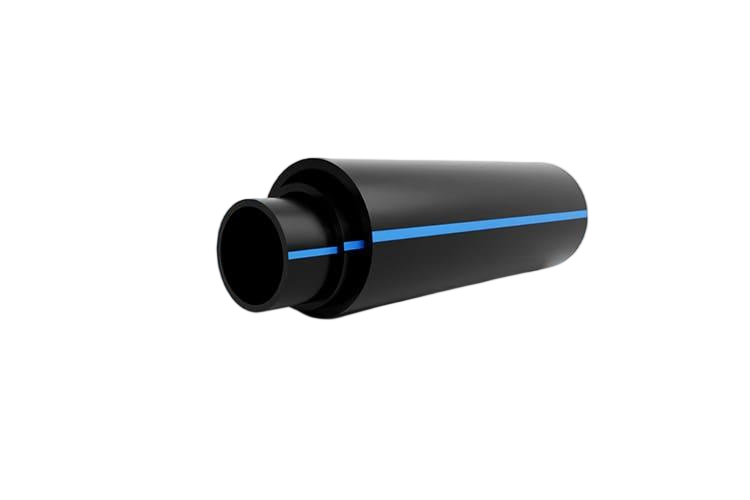
Not all HDPE pipe carries pressure. A whole family of corrugated and double-wall HDPE pipe exists for gravity drainage — draining fields, carrying stormwater, and culverting roads — and it works on a completely different principle from solid-wall PE100 pressure pipe. Its corrugated profile gives high stiffness with far less material, and its structural performance comes from the compacted soil around it as much as the pipe itself. This guide covers the product types, ring-stiffness classes, the standards, and the burial design that makes or breaks the installation.
What it is — and what it is NOT
HDPE corrugated and double-wall (structured-wall) pipe is designed for gravity flow — drainage, stormwater and sewers that run at atmospheric pressure. That makes it a fundamentally different product from the solid-wall PE100 pressure pipe used for water mains and gas, which is rated in PN and SDR for internal pressure. Corrugated pipe carries essentially no internal pressure; its job is to resist external soil and traffic loads while conveying water by gravity. Specifying one where you need the other is the single most consequential mistake in this category.
Product types
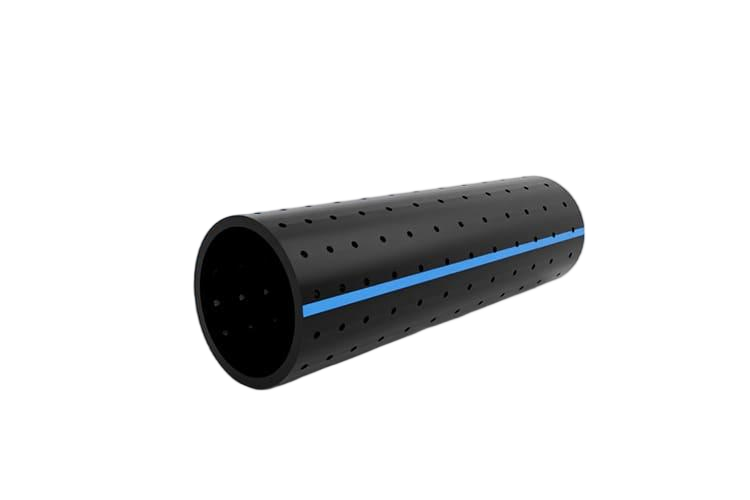
The family splits by wall construction and by whether it's perforated. Single-wall corrugated is the flexible, low-cost choice for agricultural and subsoil drainage. Double-wall — a smooth interior bore inside a corrugated exterior — is the workhorse for stormwater, culverts and non-pressure sewers, combining good flow with high stiffness. Large-diameter structured or spiral-wound pipe extends the range to very big trunk lines. And any of these can be perforated (to collect or infiltrate water) or solid (to convey it).
| Type | Wall | Typical size | Primary use |
|---|---|---|---|
| Single-wall corrugated | Corrugated in & out | 75–600 mm | Agricultural / subsoil & land drainage |
| Double-wall (the workhorse) | Smooth bore + corrugated exterior | 100–1500 mm | Stormwater, road culverts, non-pressure sewer |
| Structured / spiral large-diameter | Engineered profile wall, smooth bore | up to ~3000 mm | Large storm trunk lines, detention, culverts |
| Perforated vs solid | Either, with/without slots | — | Perforated = collect/infiltrate; solid = convey |
Why the corrugated profile: stiffness with less material
The corrugations are the whole point. By moving material away from the neutral axis, they give the pipe wall a high section modulus — so it resists ring deflection (soil and traffic load) using far less plastic than an equivalent solid wall would need. That makes the pipe lighter, cheaper and available in long lengths or coils. The smooth interior bore of double-wall pipe keeps the hydraulics good (a Manning's n around 0.012), and like all HDPE it's corrosion-free and flexible — it deflects under load rather than cracking.
Ring stiffness: SN classes vs pipe stiffness (two worlds)
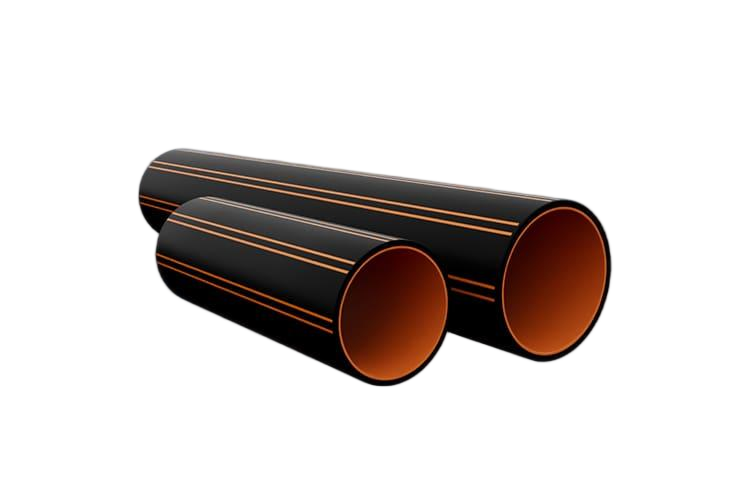
Ring stiffness is how corrugated pipe is rated for load, and there are two systems that must not be confused. Europe uses nominal stiffness classes — SN2, SN4, SN8, SN16 in kN/m² — measured per EN ISO 9969 at 3% deflection, with SN8 the common municipal and highway class. North America uses Pipe Stiffness (PS) in psi, measured per ASTM D2412 at 5% deflection. Because they're defined at different deflection points, you cannot numerically convert one to the other — treat them as parallel systems and spec to whichever your market uses.
| Stiffness class | Where it's used |
|---|---|
| SN2 / SN4 (kN/m²) | Light loads, shallow cover, low traffic |
| SN8 (kN/m²) | The common municipal / highway class |
| SN16 (kN/m²) | Heavy load, deep cover, heavy traffic |
| PS (psi, US side) | ASTM/AASHTO measure at 5% deflection — not interchangeable with SN |
Standards map
Which standard applies depends on region and size. The European EN 13476 family (with EN ISO 9969 for the stiffness test) governs structured-wall drainage pipe; in North America, AASHTO M294 and ASTM F2306 cover the large double-wall storm and culvert sizes, with AASHTO M252 and ASTM F667 for the smaller drainage pipe. Match the standard to the product type and the project's jurisdiction.
| Standard | Scope |
|---|---|
| EN 13476 | Thermoplastics structured-wall, non-pressure drainage/sewerage (Type A/B) |
| EN ISO 9969 | Ring-stiffness test method (defines SN) |
| AASHTO M294 | Corrugated PE pipe 300–1500 mm (storm / culvert / drainage) |
| AASHTO M252 | Corrugated PE pipe 75–250 mm (small drainage) |
| ASTM F2306 | 12–60 in corrugated PE for gravity storm sewer & drainage |
| ASTM F667 | 3–24 in corrugated PE pipe & fittings (land drainage) |
Applications
- Stormwater drainage and conveyance.
- Highway and road culverts.
- Subsoil and land drainage (perforated).
- Non-pressure storm sewers.
- Leachate collection (landfill).
- Retention and detention systems.
- Highway edge drains and French drains.
Installation: the soil does the structural work
This is the message that matters most. HDPE corrugated pipe is a flexible conduit, which means its structural performance is governed by the quality of the backfill and embedment, not by the pipe wall alone — the compacted soil envelope and the pipe act together as a composite system. Get the bedding, haunching and side-fill compaction right and the pipe performs for a century; get them wrong and it over-deflects. Keep deflection within the service limit (commonly 5–7.5%), respect minimum cover under traffic, and verify deflection after installation. Poor compaction is the number-one failure cause.
How to spec: selecting stiffness by cover & load
Confirm the duty is gravity (non-pressure), then choose the stiffness class for the cover depth and traffic load. The path below resolves most cases.
5 costly mistakes
- Under-specifying the stiffness class (SN/PS) for the actual cover depth and traffic load — leading to over-deflection or collapse.
- Poor compaction or the wrong embedment material — treating it like rigid pipe when the soil envelope is structural (the #1 failure cause).
- Exceeding the deflection limit (>5–7.5%) from inadequate side support or premature heavy loading, and skipping post-install deflection checks.
- Using non-pressure corrugated pipe where a pressure line is required — pressure duty needs solid-wall PE100 (PN/SDR).
- Wrong perforation choice — solid where infiltration is needed, or perforated where a sealed conveyance line is required (and omitting a filter sock in fine soils).
Glossary
- Double-wall pipe
- Corrugated HDPE pipe with a smooth interior bore and a corrugated exterior — the workhorse for stormwater and culverts.
- Ring stiffness (SN)
- A pipe's resistance to ring deflection under load; rated in kN/m² (SN2/4/8/16) per EN ISO 9969 at 3% deflection.
- Pipe stiffness (PS)
- The North American stiffness measure in psi per ASTM D2412 at 5% deflection — not numerically interchangeable with SN.
- Flexible conduit
- A pipe that carries load with the surrounding compacted soil as a composite system, deflecting rather than cracking (vs rigid concrete pipe).
- Deflection limit
- The maximum allowable reduction in vertical diameter (commonly 5–7.5%) for a buried flexible pipe, verified after backfill.
- Soil-tight vs watertight
- Joint tiers: soil-tight resists soil migration; watertight (per ASTM D3212) seals against water — specify watertight for sewer/leachate.
References & standards
- [1]Plastics Pipe Institute (PPI) — Corrugated HDPE pipe drainage handbook
- [2]Advanced Drainage Systems — ADS drainage handbook (full specifications)
- [3]Advanced Drainage Systems — N-12 dual-wall pipe — standards & joint tightness
- [4]ASTM International — New HDPE pipe specification for storm sewer (F2306)
- [5]ASTM International — ASTM F667 — 3–24 in corrugated PE pipe & fittings
- [6]AASHTO — AASHTO M294 — corrugated PE pipe 300–1500 mm
- [7]CEN — EN 13476-3 — structured-wall piping systems, Type B
- [8]KRAH — Stiffness of profile-wall pipes in two worlds (SN vs PS)
Frequently asked questions
Need expert advice on your project?
Our engineering team helps utilities, contractors and EPCs specify the right pipe material and SDR for their project. Get a no-obligation technical consultation.
Talk to an engineerRead next
Explore further
Related applications, material comparisons and country buying guides selected for this topic.