Comparison
HDPE vs Concrete Pipe for Drainage, Sewer & Culverts: An Honest Comparison (2026)
Rigid vs flexible, weight, H₂S corrosion, hydraulics, burial depth and cost — where lightweight HDPE wins and where reinforced concrete still earns its place.

Dr. Wei Liu, P.E.
Senior Engineering Manager · Primepoly
Published: Jun 7, 2026
Updated: Jun 7, 2026
13 min read
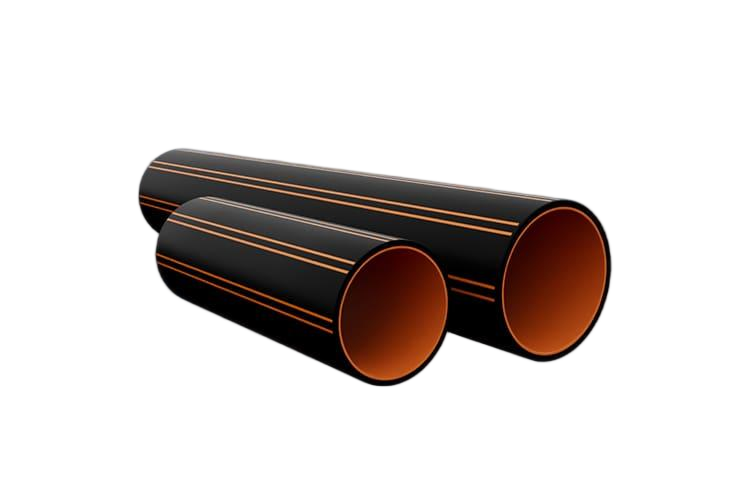
Reinforced concrete pipe has carried drainage and sewage for over a century; HDPE is the lightweight, corrosion-proof challenger that installs in a fraction of the time. Both are written about mostly by their own trade associations, so the “facts” you find are often advocacy. This comparison lays out the real engineering trade-offs — the rigid-versus-flexible design difference, H₂S corrosion, weight, hydraulics, burial depth and cost — and is honest about where each pipe genuinely wins.
HDPE vs concrete pipe at a glance
| Factor | HDPE (corrugated / structured) | Reinforced concrete (RCP) |
|---|---|---|
| Design type | Flexible — soil envelope is the structure | Rigid — self-supporting wall (D-load) |
| Weight (54-in) | ~220 lb/ft (light) | ~1,100 lb/ft (~5× heavier) |
| H₂S / sewer corrosion | Immune (inert) | Crown / MIC corrosion — needs lining |
| Joints | Gasketed or fused (leak-free) | Gasketed bell-spigot; many joints |
| Hydraulics (design n) | ~0.012, stays smooth | ~0.012, roughens over time |
| Deep burial / high load | Bedding-dependent; dia/cover limits | Excellent — deep fill, shallow cover |
| Buoyancy (high water table) | Can float empty — needs cover/anchor | Heavy — no flotation |
| Freight / export | Light — ships far cheaply | Heavy — costly long-distance |
The fundamental difference: rigid vs flexible pipe
Reinforced concrete pipe is a rigid pipe: it carries the soil and traffic load through the strength of its own wall (concrete plus steel reinforcement), classified by D-load and the three-edge-bearing test (ASTM C76 Classes I–V). It arrives at roughly 90% of its installed strength and is largely self-supporting. HDPE is a flexible pipe: it deflects slightly under load and transfers that load into the surrounding compacted soil, which provides most of the structural support — the pipe arrives at only about 10% of the installed-system strength.
That difference drives everything else. For HDPE the bedding and backfill are not optional — they are the structure, with deflection typically limited to about 5% of diameter and verified by a mandrel/ovality test a month after installation. For concrete, the pipe itself does the work and bedding matters less. Specify HDPE like rigid pipe — “drop it in and backfill” — and you get deflection failures; engineer the soil envelope and it performs for decades.
Standards & pipe types
| HDPE | Concrete (RCP) | |
|---|---|---|
| US / AASHTO | ASTM F2306; AASHTO M294 | ASTM C76 (reinforced), C14 (non-reinf.) |
| Europe (EN) | EN 13476 (structured-wall) | EN 1916 (concrete pipe) |
| Joints | ASTM D3212 (gasketed) / butt fusion | ASTM C443 (gasketed bell-spigot) |
| Box culverts | Round / arch profiles | ASTM C1433 / AASHTO M259, M273 |
| Strength basis | Deflection (pipe–soil) | D-load class I–V (three-edge bearing) |
Weight, handling & freight
The weight gap is dramatic and shapes the whole installation. At large diameter, reinforced concrete pipe runs around four-to-six times heavier than equivalent HDPE — a 54-inch RCP section weighs roughly 1,100 lb per foot against about 220 lb per foot for HDPE. Concrete needs cranes and excavators to place its short (~2.4 m) sections; HDPE comes in long 6–12 m lengths handled by light equipment, fits far more pipe per truck, and is dramatically cheaper to ship — a decisive advantage for export and remote sites.
Source: Industry data (54-in)
Corrosion & H₂S: why concrete sewers corrode and HDPE doesn't
This is the decisive issue for sanitary sewers. Hydrogen-sulfide sewer gas is oxidised by bacteria in the moist crown of the pipe into sulfuric acid, which dissolves the cement matrix and attacks the reinforcing steel — crown corrosion, or microbially-induced corrosion (MIC) — a major long-term failure mode that can turn a “100-year” concrete sewer into a premature replacement. HDPE is chemically inert and immune to this attack. Concrete sewers in aggressive service need acid-resistant linings or coatings, which add cost; for clean storm drainage with no septic H₂S, the advantage largely disappears — and an honest spec says so.
Hydraulics: Manning's n & flow capacity
On paper the two are close — a Manning's n of roughly 0.012 is a defensible design value for both concrete and smooth-bore dual-wall HDPE (plastics sources cite lower lab values for HDPE, but 0.012 keeps the comparison fair). The difference shows over time: concrete can roughen as it spalls, scales or corrodes, so its effective roughness rises, while HDPE's smooth bore stays stable. Corrugated metal pipe, by contrast, is far rougher (n ≈ 0.024) — a useful reminder that interior smoothness, not material per se, drives capacity.
Structural capacity, burial depth & cover
Reinforced concrete excels where loads and burial depths are extreme. Its inherent strength suits very high fill heights, heavy axle loads, shallow cover under traffic (some DOTs allow as little as ~1.5 ft over RCP versus ~3 ft minimum over HDPE under mainline pavement), and trenchless installation by jacking or microtunnelling. HDPE's load and cover capacity is entirely a function of its bedding — done right it handles highway loading, but many agencies cap HDPE diameter and set minimum-cover limits that concrete doesn't need.
Buoyancy, seismic & difficult ground
Lightness cuts both ways. An empty HDPE pipe is lighter than water, so in a high water table it can float unless it has adequate cover or anchoring — a real design item in wet ground, where heavy concrete simply stays put. But HDPE's flexibility and fused, continuous joints let it strain with ground movement, making it the better choice in seismic zones, settling soils and mining-subsidence ground, where rigid concrete with bell-and-spigot joints is prone to joint separation and cracking.
Service life — what the numbers really mean
Service life is the most disputed claim in this comparison, and both camps overreach. The concrete industry (ACPA) caps HDPE's defensible design life at the 50-year material basis in the design codes and points to concrete's century-long record; the plastics industry (PPI) publishes HDPE extrapolations running well past 100 years. The honest reading: HDPE's 50-year figure is code-backed and longer claims are extrapolation, while concrete's 70–100-year life is real in non-corrosive service but corrosion-limited in H₂S sewers. Design HDPE to its 50-year basis and concrete for its actual corrosion environment.
Cost: material vs installed vs lifecycle
Concrete pipe is often cheaper per foot of material where local supply is strong (it's heavy, so it's made locally), but its installed cost is higher because of the cranes, larger crews and many joints. HDPE frequently wins on installed cost — light handling, long lengths, fewer joints — though that gap narrows on jobs that demand engineered backfill and deflection testing. For export and remote projects, HDPE's freight advantage is decisive. As always, compare total installed and lifecycle cost for your specific site, not the per-foot material price.
When to choose concrete, when to choose HDPE
Run the questions below in order — corrosion environment and load/depth usually decide it.
5 common specification mistakes
- Treating HDPE bedding/backfill as optional. For a flexible pipe the compacted soil envelope is the structure — skimp on it and you get deflection failure and failed ovality tests.
- Specifying concrete in an H₂S sanitary sewer without corrosion protection — turning a “100-year” pipe into a premature-failure liability. Add acid-resistant linings, which changes the cost comparison.
- Comparing material price instead of installed-plus-lifecycle cost — concrete's cheaper foot can lose to handling/equipment; HDPE's can lose to engineered backfill and testing.
- Ignoring buoyancy in a high water table — a lightweight, empty HDPE pipe floats without adequate cover or anchoring; plan it up front.
- Believing one camp's headline service-life number. Design HDPE to its 50-year code basis and concrete for its real corrosion environment, not to marketing claims.
Glossary
- Rigid pipe (RCP)
- Pipe that carries load through the strength of its own wall (concrete + steel), classified by D-load / ASTM C76 class; largely self-supporting.
- Flexible pipe (HDPE)
- Pipe that carries load through pipe–soil interaction; it deflects and the compacted soil envelope provides the structure.
- D-load
- The load classification for reinforced concrete pipe, measured by the three-edge-bearing test (load to first 0.01-inch crack and ultimate).
- Crown corrosion / MIC
- Microbially-induced corrosion of concrete sewers: H₂S is oxidised to sulfuric acid in the moist crown, dissolving cement and attacking steel.
- Deflection limit
- The allowable ovalisation of a flexible pipe (typically ≤5% of diameter), verified by a mandrel/ovality test after installation.
- Three-edge-bearing test
- The ASTM C76 lab test that establishes a concrete pipe's D-load strength class.
References & standards
- [1]FHWA — HDS-5 — Hydraulic Design of Highway Culverts (3rd ed.)
- [2]Plastics Pipe Institute (PPI) — Corrugated PE Drainage Handbook, Ch. 8 — Durability
- [3]Plastics Pipe Institute (PPI) — Drainage Handbook, Ch. 11 — Economics
- [4]ACPA — HDPE pipe service life: facts and conclusions (concrete-industry view)
- [5]CCPPA — Rigid and flexible pipe systems (design primer)
- [6]NPCA / Precast — Comparing reinforced concrete pipe (RCP) with plastic pipe
- [7]ADS — Technical Note TN 5.05 — pipe flotation (buoyancy)
- [8]Water Research (ScienceDirect) — Chemically induced corrosion of concrete sewers at high H₂S
Frequently asked questions
Need expert advice on your project?
Our engineering team helps utilities, contractors and EPCs specify the right pipe material and SDR for their project. Get a no-obligation technical consultation.
Talk to an engineerRead next
Explore further
Related applications, material comparisons and country buying guides selected for this topic.