Comparison
HDPE vs PVC for Drainage & Sewer: Which Pipe for Gravity, Non-Pressure Systems? (2026)
Storm drainage, sanitary sewer and culverts — ring stiffness, joints, abrasion, hydraulics and cost for gravity pipe, not pressure pipe.

Dr. Wei Liu, P.E.
Senior Engineering Manager · Primepoly
Published: Jun 7, 2026
Updated: Jun 7, 2026
13 min read
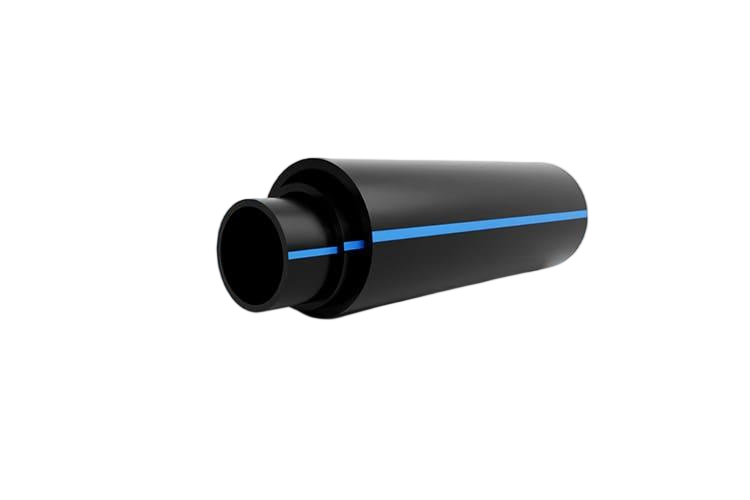
Almost every “HDPE vs PVC” comparison is written for pressure water — pressure ratings, SDR, fusion, surge. Gravity drainage and sewer is a different problem: the pipe carries no internal pressure, so it's specified by ring stiffness, joint watertightness and how it behaves as a flexible pipe in soil. This guide compares HDPE and PVC for storm drainage, sanitary sewer and culverts on the terms that actually govern gravity systems, and ends with a clear decision guide.
HDPE vs PVC for gravity drainage at a glance
| Factor | HDPE (corrugated / structured) | PVC-U sewer |
|---|---|---|
| Governing spec | SN ring stiffness; F2306 / EN 13476 | SN ring stiffness; D3034 / EN 1401 |
| Joints | Gasketed, or fused/welded (leak-free string) | Gasketed bell-and-spigot push-fit |
| Abrasion / grit | Excellent | Good |
| Impact / cold handling | Ductile, forgiving | Can crack when cold |
| Flow (smooth bore) | Dual-wall n ≈ 0.010–0.012 | n ≈ 0.009 lab (0.010–0.013 design) |
| Large diameter / culverts | Strong (to ~3000 mm structured) | To ~600 mm (D3034:2024) |
| Trenchless rehab | Ideal (slipline / burst) | Limited |
| Material cost (common sizes) | Higher | Usually lower |
Gravity vs pressure: why non-pressure pipe is specified differently
A gravity sewer or storm drain flows part-full under gravity, so the pipe doesn't need a pressure (PN/DR) rating at all — it needs to resist the external load of soil and traffic without over-deflecting, and to stay watertight at the joints. The governing spec is therefore the ring-stiffness class (SN), the dimensional standard (D3034 / F2306 / EN 13476) and the bedding design — not SDR or pressure class. Specifying pressure pipe for a gravity job simply wastes money.
Pipe types compared
Both materials come in several constructions for gravity service. HDPE is most common as dual-wall corrugated pipe (corrugated outside for stiffness, smooth inside for flow), with structured-wall and solid-wall variants for large diameters and sliplining. PVC gravity pipe is usually solid-wall (the workhorse for sanitary sewer), with ribbed/structured-wall versions for larger sizes.
| Family | Construction | Typical use |
|---|---|---|
| HDPE dual-wall corrugated | Corrugated exterior + smooth interior | Storm drainage, culverts, gravity sewer |
| HDPE structured-wall | Profiled / wound wall (EN 13476) | Large-diameter gravity sewer |
| HDPE solid-wall | DR-series solid wall (F714) | Sliplining; where some pressure also needed |
| PVC-U solid-wall | Solid wall, SDR 35/26 (D3034) | Sanitary & storm gravity sewer |
| PVC ribbed / structured | Profiled wall (F794 / EN 13476) | Larger-diameter gravity sewer |
Standards side-by-side
The standards split cleanly by material and region. Note a recent change worth flagging: ASTM F679 (large-diameter PVC gravity sewer, 18–60 in) was withdrawn in 2024 and its sizes folded into a revised ASTM D3034 — citing the up-to-date position is a quick credibility win over competitor pages that still list F679 as current.
| Material | US / AASHTO | Europe (EN) |
|---|---|---|
| HDPE corrugated | ASTM F2306; AASHTO M294 | EN 13476 |
| HDPE structured / solid-wall | ASTM F714 (solid-wall) | EN 13476 |
| PVC gravity sewer | ASTM D3034 (SDR 35/26) | EN 1401 |
| PVC large-diameter sewer | D3034:2024 (former F679, withdrawn 2024) | EN 1401 / EN 13476 |
| Installation / bedding | ASTM D2321 | EN 1610 |
Ring stiffness & SN classes — and the 'false equivalency' trap
Ring stiffness is the headline gravity-pipe spec. In the EN world it's the SN class in kN/m² (SN2, SN4, SN8, SN16); in the US it's reported in psi via the ASTM D2412 parallel-plate test, where PVC SDR 35 carries the historic 46 psi minimum. SN4 and SN8 are the workhorse classes for adopted sewers.
The trap to avoid: the industry routinely uses PVC's 46 psi as a universal pass/fail bar for every material — a “false equivalency.” Pipe stiffness describes a property but does not by itself predict buried structural performance, and it can fall by up to half at elevated temperature. Both HDPE and PVC are flexible pipe: they carry load through pipe–soil interaction, so bedding and compaction matter as much as the pipe's own stiffness number.
| SN class | Ring stiffness (kN/m²) |
|---|---|
| SN2 | 2 (large dia / low cover) |
| SN4 | 4 (common workhorse) |
| SN8 | 8 (common workhorse / higher load) |
| SN16 | 16 (heavy load / shallow cover) |
| US note | PVC SDR 35 ≈ 46 psi min (ASTM D2412) |
Joints, watertightness & root intrusion
PVC gravity sewer uses gasketed bell-and-spigot push-fit joints — fast, standardised and reliable, with a joint every laying length (~3–6 m). HDPE offers gasketed joints too, but also heat fusion, electrofusion and welded couplers that produce a leak-free monolithic string with no infiltration, exfiltration or root-entry path. On high-water-table or root-prone routes, fused HDPE's joint integrity is a decisive advantage; on ordinary sewer in stable ground, gasketed PVC is perfectly sound and quicker to lay.
Hydraulics: Manning's n (mind dual-wall vs single-wall)
For flow capacity, both smooth-bore materials are close: PVC solid-wall has a lab Manning's n around 0.009 (designers commonly use 0.010–0.013 for in-service slime), and dual-wall corrugated HDPE — smooth on the inside — runs about 0.010–0.012. The smooth interior bore is the point of dual-wall pipe.
Durability in sewer service: abrasion, H₂S, cold
In real sewer and storm service HDPE has the edge on abrasion — it handles grit, sand and high-velocity slurry better, which matters for storm drains and mining/dredge flows. Both materials resist domestic sewage and H₂S sewer gas well and don't corrode like concrete or metal. HDPE is also more ductile and forgiving in cold-weather handling and impact, whereas PVC can become brittle and crack in cold during installation.
Structural design: deflection, bedding & cover
Because both are flexible pipe, their load capacity comes from the surrounding soil, not the pipe wall alone — proper haunching and compacted bedding (to ASTM D2321 / EN 1610) govern performance, with deflection typically limited to about 5% of diameter. Both are light enough to float in a wet trench, so empty pipe in a high water table needs anchoring or staged backfill. Get the bedding right and either material performs; get it wrong and the stiffest pipe still over-deflects.
Trenchless: where HDPE pulls ahead
For rehabilitation, HDPE dominates: fused into continuous strings, it's ideal for sliplining an old sewer or pipe bursting to replace one in place, with no open trench and no joints to leak. PVC is used in segmental and spiral-wound lining but isn't suited to long continuous pulls. If your project is rehab rather than new-lay, that often settles the choice.
Cost & installed cost
In common gravity sizes (≤24 in), PVC sewer pipe is usually the cheaper material and installs fast with standard gasketed crews. HDPE tends to win on total installed cost where large diameter, trenchless methods, abrasive flow, high water tables (leak-free fused joints) or cold-weather handling dominate. As always, compare delivered-plus-installed cost for your specific site, not the per-metre material price alone.
Which pipe should you specify?
Run the five questions below in order — the first clear answer usually settles it. In every case, specify the SN ring-stiffness class and design the bedding.
5 common mistakes specifying gravity drainage/sewer pipe
- Speccing pressure pipe for a gravity job (or vice versa). Gravity sewer is governed by SN ring stiffness and D3034/F2306/EN 13476 — not by SDR or pressure class.
- Ignoring the SN class, or copy-pasting PVC's 46 psi as a universal bar for every material (the 'false equivalency').
- Treating flexible pipe like rigid pipe — under-designing the bedding. Both HDPE and PVC rely on compacted soil support; poor haunching causes excess deflection regardless of pipe class.
- Using single-wall corrugated HDPE where dual-wall hydraulics are needed — single-wall runs n ≈ 0.021–0.030 and undersizes capacity.
- Specifying gasketed joints on high-water-table or root-prone routes where fused HDPE (zero infiltration/exfiltration) would prevent groundwater ingress and root intrusion.
Glossary
- Gravity / non-pressure pipe
- Pipe that conveys flow under gravity, part-full, with no internal pressure rating — specified by ring stiffness, not SDR/PN.
- SN class (ring stiffness)
- Nominal ring stiffness in kN/m² (SN2/4/8/16) per EN; the key external-load spec for gravity pipe. US equivalent is reported in psi via ASTM D2412.
- Dual-wall corrugated HDPE
- Pipe with a corrugated exterior (stiffness) and smooth interior bore (flow). Distinct from single-wall, which is hydraulically much rougher.
- Flexible pipe
- Pipe (HDPE and PVC) that carries external load through pipe–soil interaction; bedding and compaction govern performance.
- Infiltration / exfiltration
- Groundwater entering, or sewage leaking out of, a gravity line through joints. Fused HDPE eliminates the joint path; gasketed joints rely on the seal.
- Sliplining / pipe bursting
- Trenchless rehab methods that insert or replace pipe without open excavation — HDPE's fused strings are ideally suited to both.
References & standards
- [1]ASTM International — ASTM D3034 — Type PSM PVC sewer pipe and fittings
- [2]ASTM International — ASTM F679 — large-diameter PVC gravity sewer pipe (withdrawn 2024; folded into D3034)
- [3]Uni-Bell PVC Pipe Association — Update on ASTM standards for large-diameter PVC sewer pipe (D3034 / F679 merge)
- [4]Uni-Bell PVC Pipe Association — Manning's n for PVC gravity sewer pipe
- [5]Plastics Pipe Institute (PPI) — HDPE hydraulic design / flow capacity (ConduitCalc)
- [6]Engineering ToolBox — EN 1401 — PVC-U pipes for non-pressure underground drainage & sewerage
- [7]Contech Engineered Solutions — False equivalency when using pipe stiffness to compare flexible sewer pipe
- [8]Trenchless Technology — Stating their case: PVC vs HDPE (Uni-Bell / PPI debate)
Frequently asked questions
Need expert advice on your project?
Our engineering team helps utilities, contractors and EPCs specify the right pipe material and SDR for their project. Get a no-obligation technical consultation.
Talk to an engineerRead next
Explore further
Related applications, material comparisons and country buying guides selected for this topic.