Guide
HDPE Buried Pipe Design: Ring Deflection, Soil Support & Burial Depth (2026)
A buried HDPE pipe doesn't carry the load — the compacted soil around it does. Understand that, and ring deflection, soil modulus and cover depth all fall into place.

Dr. Wei Liu, P.E.
Senior Engineering Manager · Primepoly
Published: Jun 8, 2026
Updated: Jun 8, 2026
13 min read
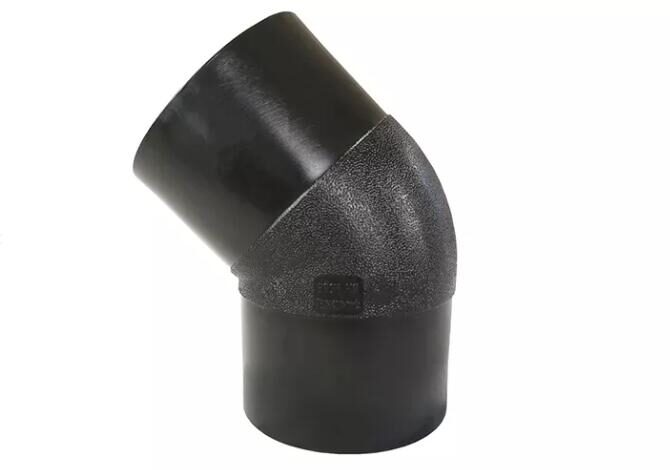
The most important thing to understand about a buried HDPE pipe is counter-intuitive: the pipe doesn't carry the earth load — the compacted soil around it does. HDPE is a flexible pipe, so under load it ovalises slightly and sheds the vertical load sideways into the soil, which then carries most of it. Get that one idea, and the rest of buried-pipe design follows: ring deflection, the soil modulus E' that controls it, the allowable deflection limit, and the burial-depth bounds. This guide walks the structural design of buried HDPE — formula, soil, limits and the three checks.
Why HDPE is a flexible pipe — and why that changes everything
Buried pipe comes in two structural families. A rigid pipe, like concrete, carries the earth load in its own wall and can crack if overloaded. A flexible pipe, like HDPE, deflects slightly under load instead — it ovalises, pushing outward at the sides against the soil, which resists and carries the load. The pipe and the compacted soil envelope around it act as one composite structure, and in a well-installed flexible pipe the soil carries most of the load. That single fact — the soil does the work — governs everything else in the design.
The soil-structure composite: how load transfers to the embedment
When earth or traffic load presses down on a flexible pipe, the pipe tries to ovalise — its vertical diameter shortens and its horizontal diameter grows. As it pushes outward at the springline, the compacted soil beside the pipe resists with passive pressure, and soil arching diverts load around the pipe. The result is that the embedment carries most of the vertical load and the pipe just has to deflect within limits while it does. This is why the quality of the bedding and side-fill — not the pipe alone — decides how a buried HDPE line performs.
Ring deflection & the Modified Iowa (Spangler) formula
Ring deflection is the decrease in the pipe's vertical diameter under load, expressed as a percentage of the diameter, and it's predicted by the Modified Iowa (Spangler) formula: deflection is the load, times a bedding constant and a deflection-lag factor, divided by the sum of the pipe's own stiffness (E·I) and a soil-stiffness term (0.061·E'·r³). The decisive point is in that denominator: for any reasonably large flexible pipe the soil term dwarfs the pipe-stiffness term — which is the mathematical proof that the soil, through E', controls the deflection, not the pipe wall.
E': the modulus of soil reaction decides everything
E', the modulus of soil reaction, is the stiffness of the embedment soil — and it's the single most important number in buried-pipe design. It ranges enormously with soil type and compaction: from essentially zero for uncompacted fine clay or silt (which gives almost no support) up to several thousand psi for well-compacted crushed rock. Because E' dominates the deflection formula, improving compaction does far more to limit deflection than thickening the pipe wall. The table gives the classic design range; note the updated methods rate uncompacted fine soil at effectively zero, underscoring how much compaction matters.
| Soil & compaction | E' (modulus of soil reaction) |
|---|---|
| Uncompacted fine soil (clay / silt) | ~0–100 psi (≈ 0–0.7 MPa) — minimal support |
| Sandy / gravelly, moderate compaction | ~200–700 psi (≈ 1.4–5 MPa) |
| Well-compacted granular (≥ 90%) | ~1,000–3,000 psi (≈ 7–20 MPa) |
| Crushed rock, well compacted | up to ~3,000–6,000 psi (updated USBR method) |
| Takeaway | Higher compaction → higher E' → less deflection |
Source: Howard / USBR E′ design values
How much deflection is allowed? The 5–7.5% limit
The allowable long-term ring deflection is conservative on purpose: 5% for pressure pipe (per AWWA M55) and up to 7.5% for gravity and non-pressure pipe (per ASTM practice). These are serviceability limits, not failure points — actual structural collapse by reverse curvature doesn't occur until around 30% deflection, so the 5–7.5% limits carry a large safety margin built in. The table sets them out. Pressure pipe uses the lower limit; gravity pipe the higher.
| Application | Allowable long-term ring deflection |
|---|---|
| Pressure pipe (AWWA M55) | 5% (conservative) |
| Gravity / non-pressure (ASTM) | 7.5% (maximum) |
| Structural reverse-curvature (collapse) | ~30% — the 5–7.5% limits carry a large safety margin |
Loads on a buried HDPE pipe
Two loads matter. The earth load is usually taken as the prism load — the weight of the full soil column above the pipe — which is the conservative choice modern flexible-pipe design uses (the older Marston trench theory credits soil-friction arching and gives a lower load). The live load is surface traffic, typically the AASHTO H-20/HS-20 truck, and it attenuates with depth — dominating at shallow cover and becoming negligible once the cover exceeds roughly the pipe diameter. Add any surcharge from stockpiles or structures.
Burial depth: minimum cover (live load) & maximum cover
Burial depth is bounded at both ends. There's a minimum cover — to protect the pipe from concentrated live load — with the AASHTO absolute minimum around one foot (0.3 m) over the crown under traffic, though practical design often uses more (and flexible pavement isn't counted as cover). And there's a maximum cover, governed by deep-fill effects: at great depth you have to check the wall against crushing and buckling. Between those bounds, ring deflection governs; outside them, the live-load or the deep-fill checks take over.
The three structural checks every design must pass
Buried flexible-pipe design comes down to three checks, in order. The path below is the sequence — and the recurring answer when a check fails is better compaction, not a thicker wall.
Pressure vs gravity: internal pressure re-rounds the pipe
There's a helpful nuance for pressure pipe: internal pressure pushes the pipe back toward round, offsetting the earth-load deflection. So for a pressurised HDPE main, the ring-deflection check is most critical at low or zero pressure and during and just after installation — before the line is pressurised and before the soil has fully consolidated. For gravity and non-pressure pipe, which never gets that re-rounding help, the deflection check governs throughout its life, which is why the gravity deflection limit is the one to watch most closely.
5 common design mistakes
- Assuming the pipe carries the load — it's the soil; thickening the wall instead of improving compaction is inefficient.
- Poor compaction → low E' → over-deflection — the number-one field failure cause (uncompacted fine soil gives almost no support).
- Ignoring live load at shallow cover — AASHTO H-20 traffic governs above the minimum cover, and flexible pavement doesn't count.
- Ignoring buckling at deep cover, under vacuum, or with high groundwater — the external-pressure check gets skipped.
- Applying rigid-pipe thinking to flexible pipe — designing by wall strength alone and ignoring the soil-structure composite.
Glossary
- Flexible pipe
- A pipe (like HDPE) that deflects under load and transfers it to the surrounding soil, rather than carrying it in its own wall like rigid concrete pipe.
- Ring deflection
- The decrease in a buried pipe's vertical diameter under load, as a percentage of diameter; the key serviceability measure.
- Modified Iowa (Spangler) formula
- The standard equation predicting ring deflection from load, bedding, pipe stiffness and the soil modulus E'.
- E' (modulus of soil reaction)
- The stiffness of the embedment soil — the dominant term in the deflection formula, set mostly by compaction.
- Prism load
- The weight of the full soil column above the pipe — the conservative earth load used in modern flexible-pipe design.
- Buckling
- Collapse of the pipe wall under external pressure (groundwater, vacuum or deep cover) — one of the three buried-pipe checks.
References & standards
- [1]Plastics Pipe Institute (PPI) — Handbook of PE Pipe, Ch. 6 — design of PE piping systems
- [2]Plastics Pipe Institute (PPI) — Drainage handbook, Ch. 7 — structures
- [3]US Bureau of Reclamation — M-25 — prediction of flexible pipe deflection (E' tables)
- [4]ASTM International — ASTM D2321 — underground installation of thermoplastic pipe
- [5]ASTM International — ASTM F1962 — maxi-HDD placement of PE pipe under obstacles
- [6]JM Eagle — What is flexible conduit deflection & how is it calculated?
- [7]Advanced Drainage Systems — TN 2.01 — minimum/maximum cover heights per AASHTO
- [8]PE100+ Association — The Reclamation E' table (Howard)
Frequently asked questions
Need expert advice on your project?
Our engineering team helps utilities, contractors and EPCs specify the right pipe material and SDR for their project. Get a no-obligation technical consultation.
Talk to an engineerRead next
Explore further
Related applications, material comparisons and country buying guides selected for this topic.