Guide
Controlling HDPE Pipe Flotation: Anti-Buoyancy Design for Wet Trenches & High Groundwater (2026)
An empty HDPE pipe in a flooded trench is a boat. The same low weight that makes it easy to handle makes it float up out of the ground — so you fill it, weight it, and don't stop pumping too soon.

Dr. Wei Liu, P.E.
Senior Engineering Manager · Primepoly
Published: Jun 8, 2026
Updated: Jun 8, 2026
14 min read
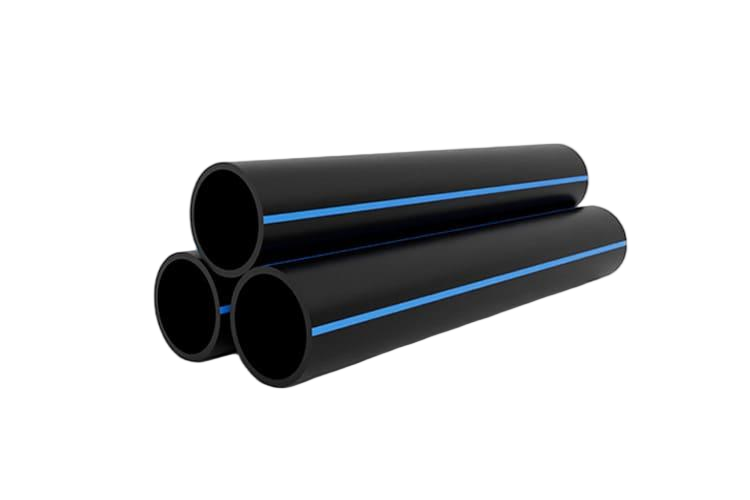
HDPE's light weight is one of its best features — until the pipe is sitting empty in a wet trench, where that same low weight turns it into a boat. Polyethylene is slightly less dense than water, and an empty, air-filled pipe displaces a large volume of it, so in a flooded trench or below the water table the pipe wants to float straight up out of the ground before it's backfilled. It's a routine, preventable problem, but it ruins an installation when it's ignored. This guide covers the physics, the numbers, and the field procedure — scoped to buried and wet-trench work (the marine float-and-sink of a sea outfall is a separate topic).
Why HDPE floats — and why an empty pipe is the worst case
Two effects combine. First, the material: HDPE's specific gravity is about 0.95 (modern pressure grades land around 0.94–0.96), just under water's 1.0, so the pipe wall itself is marginally buoyant. That's the small effect. The big one is the air-filled bore: an empty pipe displaces a volume of water equal to its full outside cross-section, which is an enormous upward push for a large-diameter pipe. Fill the same pipe with water and most of that buoyancy disappears, because the contents now weigh roughly what the displaced water weighs. So the worst-case condition is always the empty pipe in a flooded trench before backfill — which is exactly the state a pipe is in during installation.
The buoyancy math: uplift vs resisting weight
The calculation is Archimedes. The hydrostatic uplift per unit length of a submerged pipe is U = (π/4) · D² · γ_w, where D is the outside diameter and γ_w is the unit weight of water (62.4 lb/ft³, or 1000 kg/m³). The pipe stays put when that uplift is less than the resisting weight: the pipe's own weight, plus the weight of the saturated soil cover above it (using the soil's submerged unit weight below the water table), with the contents usually neglected to stay conservative. Two things make uplift worse: a larger diameter (uplift grows with D²) and a thinner wall (a higher DR means less self-weight to resist). A worked example: a 48-inch pipe with the water table at grade needs about 33 inches of cover to resist flotation.
How much cover do you need? Minimum cover by diameter
Because uplift scales with diameter, the minimum cover needed to hold a pipe down rises steadily with size. The table and chart give representative values for the worst case (empty pipe, water table at grade, saturated soil) — from about 9 inches over a 12-inch pipe to about 40 inches over a 60-inch pipe. Apply a flotation safety factor (resisting weight ÷ uplift) of roughly 1.2–1.5 for pipe — 1.1 is a bare floor, and structures like manholes use 2.0. And note the structural minimum cover for traffic loads is a separate check that may govern instead; take the larger of the two.
Source: ADS TN 5.05 (in. of cover)
| Nominal diameter | Min cover to prevent flotation |
|---|---|
| 12 in (300 mm) | ≈ 9 in (228 mm) |
| 18 in (450 mm) | ≈ 13 in (330 mm) |
| 24 in (600 mm) | ≈ 17 in (432 mm) |
| 30 in (750 mm) | ≈ 22 in (559 mm) |
| 36 in (900 mm) | ≈ 25 in (635 mm) |
| 48 in (1200 mm) | ≈ 33 in (838 mm) |
| 60 in (1500 mm) | ≈ 40 in (1016 mm) |
When flotation is a real risk
Flotation is a risk wherever water can surround an under-ballasted pipe: a flooded or wet trench, a high or seasonally high water table, marsh, swamp, river and subaqueous crossings, and any time before the backfill is complete and compacted. Heavy rain that fills an open trench overnight is a classic trigger, as is stopping the dewatering pumps too early. Two special cases deserve a flag: flowable fill (CLSM) backfill is denser than water and produces more than twice the hydrostatic uplift, so a CLSM-backfilled pipe must be anchored even with no free water present; and liquefiable soil under seismic shaking can float an empty pipe much like liquefaction floats any buried structure.
Anti-flotation methods compared
There's a toolkit of methods, and most installations combine two or three. The table compares them. The cheapest and most common is simply adequate compacted soil cover — the weight of saturated backfill above the pipe resists the uplift, provided it's placed and compacted before the groundwater returns. Beyond that: continuous concrete encasement for maximum permanent restraint, discrete concrete collars or swamp weights at intervals (≤ 10 ft spacing) for crossings, screw or duckbill anchors with straps into firm soil, geotextile-wrapped gravel ballast, and — the simplest field trick — filling the pipe with water during installation to remove the empty-bore buoyancy while you backfill.
| Method | How it works | Pros / watch-outs |
|---|---|---|
| Adequate compacted soil cover | Saturated backfill weight above the pipe resists uplift | Cheapest, most common; needs depth & compaction before dewatering stops |
| Continuous concrete encasement | Heavy continuous ballast | Maximum permanent restraint; costly, rigid, slow |
| Concrete collars / swamp weights | Discrete ballast straddling the pipe at intervals | Good for marsh/river crossings; spacing ≤ 10 ft; point loads |
| Screw / duckbill anchors + straps | Mechanical hold-down into firm soil below | Fast, no concrete cure; needs adequate anchoring soil |
| Fill pipe with water during install | Removes the empty-bore buoyancy while backfilling | Cheap, dramatic; temporary; standard in HDD (ASTM F1962) |
| Staged backfill + keep dewatering | Build resisting weight before water returns | No materials cost; discipline-dependent — don't stop pumps early |
Field procedure: dewatering, staged backfill & water-fill
The methods come together as a sequence on a wet job, summarised in the path below. The discipline that matters most is timing: build enough resisting weight before you let the water back in. Stopping the pumps too soon — before the backfill provides cover — is the single most common way pipe floats.
5 mistakes that float pipe out of the trench
- Leaving the pipe empty in a wet or flooded trench — the worst-case buoyancy — instead of filling it with water.
- Insufficient cover, or under-compacted backfill, for the diameter and water table.
- Stopping the dewatering pumps too soon — before the backfill provides resisting weight.
- Ignoring the buoyancy of fittings, valves and entrapped air pockets (submerged lines may need pigging to flush trapped air).
- No ballast or anchors on a submerged, marsh/river, or CLSM-backfilled crossing — where flowable fill alone gives over twice the hydrostatic uplift.
Glossary
- Buoyant (uplift) force
- The upward force on a submerged pipe equal to the weight of water it displaces: U = (π/4)·D²·γ_w per unit length.
- Specific gravity (HDPE ≈ 0.95)
- The pipe material's density relative to water; just under 1.0, so the wall is marginally buoyant — the air-filled bore does the rest.
- Resisting weight
- The downward forces holding a pipe down — its own weight plus the saturated soil cover (submerged unit weight) above it.
- Flotation safety factor
- Resisting weight ÷ uplift; ~1.2–1.5 for pipe (1.1 floor, 2.0 for structures).
- Flowable fill (CLSM)
- Controlled low-strength material backfill, denser than water — it produces > 2× hydrostatic uplift, so the pipe must be anchored even with no free water.
- Dewatering
- Pumping groundwater out of the trench; it must continue until backfill provides enough resisting weight.
References & standards
- [1]ADS — TN 5.05 — pipe flotation (uplift equations & minimum-cover table)
- [2]Plastics Pipe Institute (PPI) — Handbook of PE Pipe, Ch. 6 — design (shallow-cover & groundwater flotation)
- [3]CCPPA — Flotation of buried pipe (Archimedes + safety-factor framing)
- [4]Plastics Pipe Institute (PPI) — ASTM F1962 or the PRCI method — HDD water-ballast buoyancy control
- [5]AWWA — M55 — PE pipe: design and installation (trenching, dewatering)
- [6]ASTM International — ASTM D2321 — underground installation of thermoplastic pipe (backfill, compaction)
- [7]McWane Ductile — Will my buried pipe float? (Archimedes; plastic is most float-prone)
Frequently asked questions
Need expert advice on your project?
Our engineering team helps utilities, contractors and EPCs specify the right pipe material and SDR for their project. Get a no-obligation technical consultation.
Talk to an engineerRead next
13 min read
HDPE Pipe Bedding, Backfill & Trench Design: Installing Flexible Pipe Correctly (2026)
13 min read
HDPE Buried Pipe Design: Ring Deflection, Soil Support & Burial Depth (2026)
15 min read
HDPE Pipe for Marine & Sewage Outfalls and Seawater Intakes: Float-and-Sink, Ballast & Diffusers (2026)
13 min read
HDPE Trenchless Installation: HDD, Pipe Bursting & Sliplining (2026)
12 min read
Installing & Fusing HDPE Pipe in Cold Weather (2026)
Explore further
Related applications, material comparisons and country buying guides selected for this topic.