Guide
HDPE Pipe Pullback in Directional Drilling (HDD): Safe Pull Force, Mud Drag & Design (2026)
Pullback is the moment an HDPE string takes its highest stress of a lifetime. The design comes down to two numbers: how much tension the pipe can take, and how much the bore will demand — and the gap between them is where strings get wrecked.

Dr. Wei Liu, P.E.
Senior Engineering Manager · Primepoly
Published: Jun 8, 2026
Updated: Jun 8, 2026
15 min read
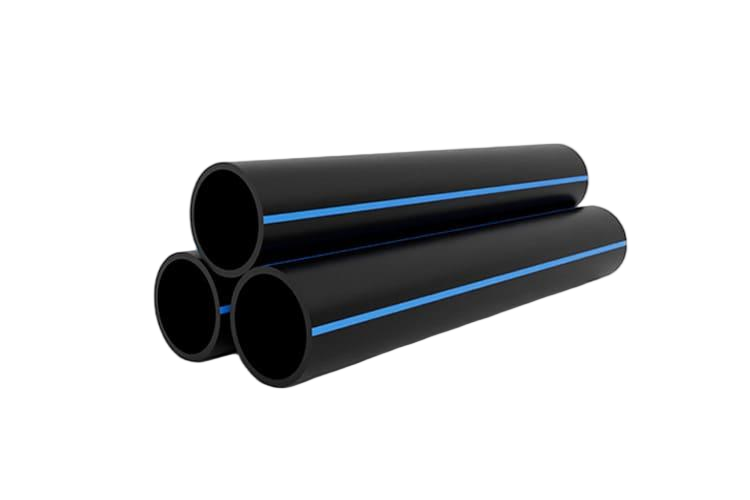
Horizontal directional drilling is where HDPE earns its reputation — a fused string pulled through a bore under a road, river or town with no trench. But pullback is also the single most stressful event in the pipe's life, and the design has to answer two questions cleanly: how much tension can the pipe safely take, and how much tension will the pullback actually demand? Get the first wrong and you over-stress the string; get the second wrong and the rig pulls harder than you planned. This guide covers both sides — capacity and demand — plus the ballast and relaxation discipline that separate a clean pull from a wrecked one.
HDD in 60 seconds: pilot, ream, pullback
An HDD crossing is made in three moves. First the pilot bore — a steerable drill head is pushed along the designed path from entry to exit. Then one or more pre-reaming passes enlarge the hole to roughly 1.2–1.5 times the pipe's outside diameter, leaving a mud-filled annulus. Finally the pullback: the pre-fused HDPE string, waiting on the exit side, is attached behind a back-reamer through a swivel and pull-head, and drawn back through the bore to the entry rig. Everything in this article is about that last move — pullback — because it's when the pipe sees its peak axial tension, and it's the step a pipe design has to protect against.
Two questions: capacity vs demand
A pullback design is really just a comparison of two numbers. The capacity is the safe pull force — the maximum tension the HDPE string can take without over-straining. The demand is the actual pullback load — the tension the bore, the mud and the pipe's own buoyant weight will impose as it's drawn through. The whole job is to make sure the demand stays comfortably below the capacity, with margin, for the duration of the pull. The next sections work out each number, and the flowchart at the end ties them together. Keep them separate in your head: a pipe doesn't fail because it's 'weak,' it fails because the demand was underestimated or the capacity was overestimated.
Safe pull force: how much tension HDPE can take
The safe pull force is the allowable tensile stress multiplied by the pipe wall's cross-sectional area — and the wall area is (π/4)(OD² − ID²), which grows as the pipe gets bigger and the wall gets thicker. The allowable stress comes from a table (below) that depends on the PE grade and how long the pipe is under tension, because polyethylene creeps: the longer the pull, the lower the stress it can safely carry. For a PE4710 string, the safe pull stress runs from about 1,500 psi for a quick half-hour pull down to about 1,150 psi for a twelve-hour pull. Multiply that by the wall area and you have the string's capacity in pounds.
| Pull duration | PE2xxx | PE3xxx | PE4710 |
|---|---|---|---|
| 0.5 hour | 1,100 | 1,400 | 1,500 |
| 1 hour | 1,050 | 1,350 | 1,400 |
| 12 hours | 850 | 1,100 | 1,150 |
| 24 hours | 800 | 1,050 | 1,100 |
Why it's not full yield: the strain limit
The allowable pull stress is well below the material's tensile yield (around 3,500 psi for PE4710) for a good reason: the pull must not stretch the pipe so far that it doesn't recover. The PPI Handbook sets the safe pull stress as the stress at 3% strain — a strain the pipe recovers from — reduced by a factor to account for the high stress during pullback. ASTM F1804 frames the same idea differently, capping the tensile stress at 40% of yield for full strain recovery. The two methods give slightly different headline numbers (about 1,150 psi from the Handbook's 3%-strain basis, about 1,330 psi from F1804's 40%-of-yield basis at a 12-hour pull), and both are legitimate — the Handbook value is simply the more conservative.
Safe pull force by size and DR
Because the safe pull force is the allowable stress times the wall area, it rises with both diameter and wall thickness — so a thicker-wall (lower-DR) pipe of the same diameter can take a much bigger pull. The chart shows it for a 12-inch IPS PE4710 string on a 12-hour pull: the capacity climbs from roughly 32,500 lb at DR17 to about 58,000 lb at DR9. The practical implication is that DR isn't only an internal-pressure decision on an HDD crossing — a thicker wall buys pull-capacity margin (and, separately, collapse resistance against the mud pressure). On long, bendy or high-friction bores, that extra margin is often what makes the pull feasible.
Source: PPI Handbook Ch. 12 (lb)
What actually loads the pipe: the four ASTM F1962 forces
The pullback load is the sum of four forces, set out in ASTM F1962 and the table below. Frictional drag is the pipe sliding against the borehole and the lay-down area. The capstan effect multiplies that drag every time the path bends — exponentially. Hydrokinetic drag is the resistance of the pipe moving through the drilling mud (a fluid pressure of roughly 4–8 psi on the leading area). And the buoyant weight of the pipe sets how hard it presses on the bore wall, which drives the friction. The table also gives the lever for reducing each. Adding these up along the bore — applying the capstan multiplier at each bend — gives the demand you compare against the safe pull force.
| Force | What it is | How to reduce it |
|---|---|---|
| Frictional drag | Pipe sliding against the borehole & lay-down area (μ·W·L) | Water-ballast to cut buoyant weight; lubricate; reduce length |
| Capstan effect | Drag multiplied exponentially through each bend (e^μθ) | Straighter path, gentler bends, larger bend radius |
| Hydrokinetic drag | Pipe moving through the mud (~4–8 psi on the leading area) | Adequate over-ream; manage mud properties / annulus size |
| Buoyant weight | Net up/down force setting how hard the pipe loads the bore | Pull 'wet' (water ballast) toward near-neutral buoyancy |
The capstan effect: why bends multiply tension
The capstan effect deserves its own note because it's the force people most often underestimate. It's the same physics as a rope wrapped around a bollard: the tension on the high side is multiplied by e raised to the friction coefficient times the wrap angle, so even a few degrees of bend can increase the pull tension substantially, and the effect compounds through every curve in the path. This is why a long but straight bore can pull more easily than a shorter one with sharp bends, and why the drill-path bend radius (which also has to respect the pipe's own minimum bend radius) feeds directly into the pull load. Keep the path as straight and gently-curved as the crossing allows.
Buoyancy & water ballast: pulling 'wet'
An empty, air-filled HDPE string is highly buoyant in dense drilling mud, so it floats up against the crown of the bore and presses hard on the wall — increasing the friction, and risking high start-up friction if the pull ever stops. The standard fix is to pull 'wet': the pipe is filled with water as it descends past the breakover point into the bore, which cuts its net buoyant weight and therefore the frictional and capstan drag. ASTM F1962's force model explicitly accommodates this anti-buoyancy ballast. There's one operating rule that matters: keep the internal water level below the slurry level in the borehole — overfill it and the pipe becomes net-heavy, which drags on the invert instead and makes things worse.
After the pull: relaxation, over-pull & safe tie-in
The pull isn't finished when the pipe emerges. A pulled HDPE string is stretched, and it needs time to recover before it's tied in — typically about as long as the pull itself took, on the order of 8–24 hours, for the viscoelastic stretch to relax and the pipe to reach thermal equilibrium with the soil. So you over-pull the string 3–5% past the exit and leave 3–5% extra at the entry, so the nose stays exposed for connection after it shrinks back (the recovery can be on the order of tens of feet per thousand feet). Tying in a still-stretched string is a real mistake: as it relaxes it pulls back on the connection, stressing the joint or dragging the nose out of reach. Let it relax, then connect.
Putting it together: the pullback design check
The design check runs capacity against demand, summarised in the path below. The two recurring levers are the DR (which sets capacity and collapse resistance) and the bore path (which, through the capstan effect and ballast, sets demand).
5 mistakes that wreck HDPE strings
- Exceeding the safe pull force — judging the pull by the rig's pull pressure (which includes reamer/drill-string drag); use a break-away swivel set to the pipe's safe pull force.
- Pulling 'dry' with no water ballast — the buoyant pipe floats to the crown, loads the bore wall and risks high start-up friction.
- Ignoring the capstan effect at bends — underestimating tension because the bend multiplier compounds through every curve.
- Tying in before the string has relaxed — connecting a still-stretched pipe that then pulls back on the joint.
- Choosing DR for internal pressure only — not checking the pull tension and the external mud-pressure collapse (which axial pull further reduces).
Glossary
- Safe pull force
- The maximum tension an HDPE string can take during pullback — allowable tensile stress × wall area (π/4)(OD²−ID²).
- Safe pull stress
- The allowable tensile stress for pullback, set by a recoverable-strain limit (3% strain / 40% of yield); ≈1,150 psi for PE4710 at a 12-hour pull.
- Capstan effect
- The exponential multiplication of pull tension at every bend in the bore path — the force most often underestimated.
- Hydrokinetic drag
- The resistance of the pipe moving through the drilling mud (a fluid pressure of ~4–8 psi on the leading area).
- Water ballast ('wet' pull)
- Filling the string with water during pullback to cut buoyancy and drag — kept below the borehole slurry level.
- Relaxation / over-pull
- Letting the stretched string recover (≈ the pull duration, 8–24 h) before tie-in, with 3–5% over-pull so the nose stays exposed.
References & standards
- [1]Plastics Pipe Institute (PPI) — Handbook of PE Pipe, Ch. 12 — horizontal directional drilling (safe-pull table, force model)
- [2]ASTM International — ASTM F1962 — maxi-HDD placement of PE pipe (incl. river crossings)
- [3]ASTM International — ASTM F1804 — allowable tensile load (ATL) for PE pipe pull-in
- [4]Chevron Phillips (Performance Pipe) — PP-803-TN — pull-in applications (F1804 ATL, relaxation, weak-link)
- [5]Plastics Pipe Institute (PPI) — MAB — HDD: estimating pipe pulling tensions
- [6]Plastics Pipe Institute (PPI) — ASTM F1962 or the PRCI method?
- [7]Underground Infrastructure — HDD and HDPE — the perfect match (PE4710 in F1962)
Frequently asked questions
Need expert advice on your project?
Our engineering team helps utilities, contractors and EPCs specify the right pipe material and SDR for their project. Get a no-obligation technical consultation.
Talk to an engineerRead next
13 min read
HDPE Trenchless Installation: HDD, Pipe Bursting & Sliplining (2026)
14 min read
HDPE Pipe Bending Radius & Cold Bending: Directional Changes Without Fittings (2026)
14 min read
Controlling HDPE Pipe Flotation: Anti-Buoyancy Design for Wet Trenches & High Groundwater (2026)
15 min read
HDPE Pipe & External Pressure: Vacuum Collapse, Buckling Resistance & DR Selection (2026)
13 min read
HDPE Butt Fusion Parameters & Procedure: The DVS 2207 / ISO 21307 / ASTM F2620 Guide (2026)
Explore further
Related applications, material comparisons and country buying guides selected for this topic.