Guide
HDPE Pipe & External Pressure: Vacuum Collapse, Buckling Resistance & DR Selection (2026)
Internal pressure isn't the only thing that can fail an HDPE pipe — a vacuum, deep groundwater or a sliplining grout can collapse it inward. And because collapse resistance follows a cube law, the DR you chose for pressure may not survive the suck.

Dr. Wei Liu, P.E.
Senior Engineering Manager · Primepoly
Published: Jun 8, 2026
Updated: Jun 8, 2026
15 min read
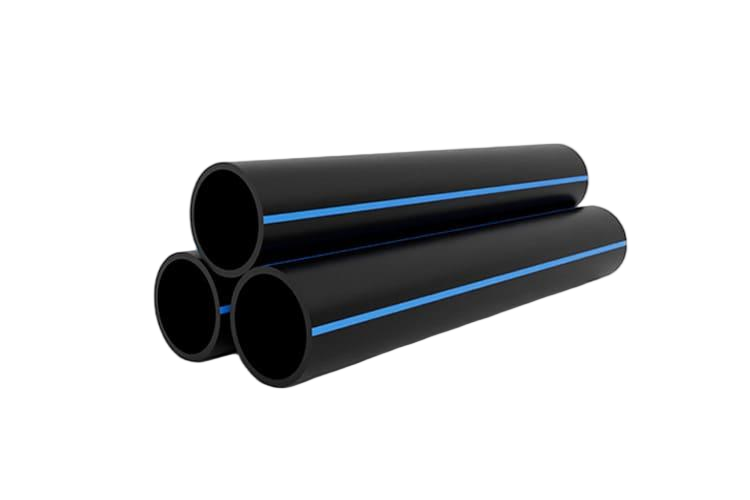
Most pipe design worries about pressure pushing outward. But an HDPE pipe can also fail the other way — collapsing inward when the pressure outside exceeds the pressure inside. A pump pulling a vacuum, deep groundwater over an empty buried line, a subaqueous crossing, or the grout pressure in a sliplining annulus can all buckle the wall. The catch is that collapse resistance follows a cube law in the wall-to-diameter ratio, so a high-DR pipe that's perfectly fine for its internal pressure rating can implode under a modest vacuum. This guide covers the physics, the verified numbers, and the one detail almost everyone gets wrong: which modulus to use.
What puts a pipe under external pressure?
External (or net-external) pressure has several sources, and the table lists them. The most under-appreciated is internal vacuum: a pump pulling suction, column separation during a surge or water-hammer event, fast valve closure, draining or dewatering a line, or a siphon leg can all pull the inside below atmospheric — and a dead vacuum even shows up during some pressure tests. Then there's external hydrostatic head: deep submergence on a subaqueous crossing, or high (or seasonally high) groundwater over a buried pipe, which is worst when the pipe is empty and has no internal pressure to push back. And there's construction load: the grout pressure in the annulus during sliplining before the grout sets. Buckling only needs checking when the pipe isn't internally pressurised — during and after construction, shutdowns, draining and surge.
| Source | Typical situation |
|---|---|
| Internal vacuum | Pump suction, surge column-separation, fast valve closure, draining/dewatering, siphon, vacuum test |
| Deep submergence | Subaqueous outfalls/intakes, lake & river crossings — sustained external head |
| High groundwater | Empty buried pipe below a high/seasonal water table (no internal pressure to resist) |
| Sliplining grout | Grout pressure in the annulus during sliplining, before the grout sets |
| Process / test vacuum | Negative pressure in a process line, or a dead vacuum during pressure testing |
The collapse formula for free pipe — and why it's a cube law
For an unconstrained pipe — above ground, submerged, in a casing before grouting, or shallow-buried with no real soil support — the critical collapse pressure is Pc = 2E/(1−ν²) × (1/(DR−1))³, where E is the modulus, ν is Poisson's ratio and DR is the dimension ratio. The decisive feature is that exponent of three: collapse resistance scales with the cube of the wall-to-diameter ratio, so halving (DR−1) gives about eight times the resistance. The chart shows what that means for a transient full-vacuum scenario. The punchline is stark — a free DR32.5 pipe has a critical pressure of only about 8 psi, below a full vacuum of 14.7 psi, while DR9 is around 490 psi. The full design equation also multiplies in an ovality factor and divides by a safety factor, so these are critical (not allowable) values.
Source: PPI Handbook Ch. 6, Eq. 2-39 (psi)
Buried pipe: soil support changes everything
A properly buried pipe is far more collapse-resistant than the same pipe free, because the compacted soil envelope restrains it — the constrained-buckling (Luscher) equation brings in the modulus of soil reaction E', the cover depth and a groundwater buoyancy factor, and the result can be many times the free-pipe value. A well-supported DR21 line can take a full-vacuum surge that would collapse it unsupported. But — and this is the nuance most pages miss — a buried pipe only counts as constrained when there's enough cover, roughly 4 feet (or about one diameter, up to 1.5 diameters for large pipe). With shallow cover, before or just after backfill, with an empty pipe under high groundwater, or in a not-yet-grouted casing, the pipe behaves as unconstrained and you must use the free-pipe formula with no soil credit.
The detail everyone gets wrong: which modulus (and Poisson's ratio)
HDPE is viscoelastic, so its modulus depends on how long the load lasts — and the single most common collapse-design error is using the wrong one. A transient load — a vacuum from surge or draining, a momentary water-hammer event — is resisted by the short-term modulus, about 110,000 psi, paired with a Poisson's ratio of 0.35. A sustained load — permanent groundwater, continuous submergence, long-term grout head — is resisted by the 50-year modulus, about 28,200 psi, paired with a Poisson's ratio of 0.45. That long-term modulus is roughly four times lower, which means a wall that easily shrugs off a momentary vacuum can slowly buckle under permanent submergence at the very same pressure. The table puts numbers on it.
| DR | Transient (E≈110,000, ν=0.35) | Sustained (E≈28,200, ν=0.45) |
|---|---|---|
| 9 | ≈ 490 psi | ≈ 138 psi |
| 11 | ≈ 251 psi | ≈ 71 psi |
| 17 | ≈ 61 psi | ≈ 17 psi |
| 21 | ≈ 31 psi | ≈ 8.8 psi |
| 26 | ≈ 16 psi | ≈ 4.5 psi |
| 32.5 | ≈ 8 psi | ≈ 2.3 psi |
Ovality & safety factor: from critical to allowable
Two adjustments turn the critical collapse pressure into a real allowable design pressure. First, ovality: any out-of-roundness from shipping, handling or installation flattens the wall and lowers its resistance, so the result is multiplied by an ovality compensation factor (fO ≤ 1.0) — even a modest 2–3% ovality costs roughly 20–25% of the theoretical resistance, which is part of why real pipe collapses below the ideal-ring formula. Second, a safety factor: about 2.0 for buried (constrained) pipe and about 2.5 for free/unconstrained pipe (some standards allow a lower factor for a very temporary full-vacuum surge in a well-supported buried line). Apply both and the allowable pressure can be roughly a third of the bare critical value.
Choosing a DR for vacuum, submerged & sliplining service
The practical upshot is that the external-pressure check can govern the DR — and demand a thicker wall (lower DR) than the internal-pressure rating alone would. A line that will see vacuum, sit submerged or under permanent high groundwater while empty, or be slipliner-grouted, must pass the buckling check at the right modulus, with ovality and the safety factor applied. So always run both checks — the internal pressure-class check and the external buckling check — and design to whichever is more demanding. For a low-pressure or gravity line that happens to see vacuum or deep groundwater, it's common for the collapse check, not the pressure rating, to set the wall.
The external-pressure design check
The check follows a clear sequence, summarised in the path below. The two decisions that drive it are whether the pipe is truly constrained (enough soil cover) and whether the load is transient or sustained (which modulus and Poisson's ratio to use).
5 costly mistakes
- Sizing only for internal pressure and skipping the external/vacuum check on a submerged, grouted, draining or vacuum line — the buckling check may govern.
- Using the short-term modulus (and ν = 0.35) for permanent submergence or groundwater — you must use the ~28,200 psi 50-year modulus with ν = 0.45.
- Ignoring ovality — 2–3% out-of-roundness from handling already removes ~20–25% of the theoretical collapse resistance.
- Forgetting transient vacuum — column separation, water hammer, fast valve closure, draining and siphons can pull a full vacuum on a line never 'under vacuum' by design.
- Assuming 'buried = safe' — an empty buried pipe under high groundwater, with < 4 ft cover, or in an un-grouted casing behaves as unconstrained (no soil credit).
Glossary
- Critical collapse (buckling) pressure
- The net external pressure at which a pipe buckles inward; for free pipe Pc = 2E/(1−ν²)·(1/(DR−1))³ — a cube law in (DR−1).
- Unconstrained vs constrained
- Free pipe (no soil credit) uses the cube-law formula; a buried pipe with ≥4 ft cover is 'constrained' and resists far more via the Luscher (soil-support) equation.
- Short-term vs long-term modulus
- ≈110,000 psi (ν=0.35) for transient vacuum/surge; ≈28,200 psi (ν=0.45) for sustained submergence/groundwater — about 4× lower.
- Ovality factor (fO)
- A ≤1.0 multiplier reducing collapse resistance for out-of-roundness; 2–3% ovality costs ~20–25%.
- Net external pressure
- External pressure minus internal — worst when the pipe is empty or under vacuum; that's when buckling is checked.
- DR (dimension ratio)
- Outside diameter ÷ wall thickness; lower DR (thicker wall) gives cube-law higher collapse resistance.
References & standards
- [1]Plastics Pipe Institute (PPI) — Handbook of PE Pipe, Ch. 6 — design (Eq. 2-39 unconstrained, Eq. 2-15 Luscher, ovality factor)
- [2]Plastics Pipe Institute (PPI) — Handbook of PE Pipe, Ch. 3 — material properties (apparent modulus, Poisson's ratio)
- [3]Vinidex — PE buckling — the Levy form, the 0.45/0.35 Poisson split, safety factor 2.5
- [4]AWWA — M55 — PE pipe: design and installation (constrained buckling, cover rule)
- [5]Chevron Phillips (Performance Pipe) — Field handbook PP-901 (modulus & ovality reference)
- [6]ASTM International — ASTM F1962 — maxi-HDD placement of PE pipe (external loads)
- [7]Plastics Pipe Institute (PPI) — Handbook of PE Pipe, Ch. 11 — sliplining (annular grout pressure)
Frequently asked questions
Need expert advice on your project?
Our engineering team helps utilities, contractors and EPCs specify the right pipe material and SDR for their project. Get a no-obligation technical consultation.
Talk to an engineerRead next
13 min read
HDPE Buried Pipe Design: Ring Deflection, Soil Support & Burial Depth (2026)
14 min read
Controlling HDPE Pipe Flotation: Anti-Buoyancy Design for Wet Trenches & High Groundwater (2026)
12 min read
Water Hammer & Surge in HDPE Pipe: Why Polyethylene Handles It Better (2026)
14 min read
HDPE Sliplining: Trenchless Rehabilitation of Aging Pipelines & Sewers (2026)
9 min read
How to Select the Right HDPE Pipe SDR / PN for Your Application
Explore further
Related applications, material comparisons and country buying guides selected for this topic.