Guide
Water Hammer & Surge in HDPE Pipe: Why Polyethylene Handles It Better (2026)
The physics of transient pressure — and why HDPE's low modulus, low wave speed and fatigue immunity make surge far less of a problem than in rigid pipe.

Dr. Wei Liu, P.E.
Senior Engineering Manager · Primepoly
Published: Jun 8, 2026
Updated: Jun 8, 2026
12 min read
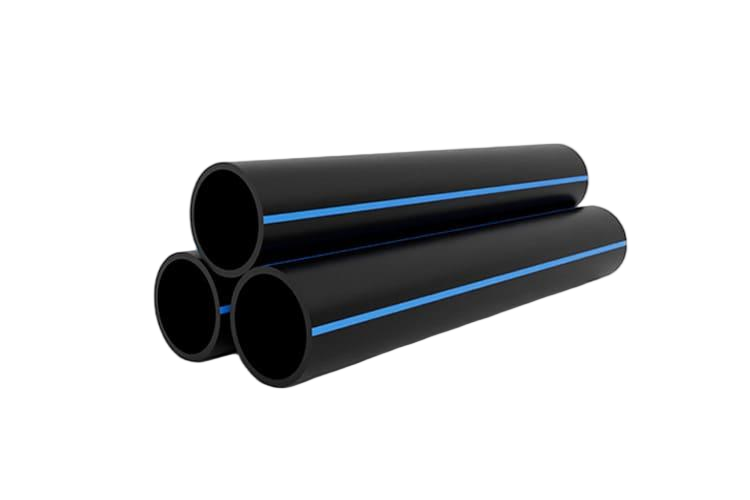
Water hammer — the bang and pressure spike when a valve slams or a pump trips — is a transient that every pressure pipeline has to survive. It's also where HDPE quietly outperforms rigid pipe. Because polyethylene has a low elastic modulus, pressure waves travel slowly through it, so the surge they create is proportionally smaller; and PE's ductility makes it almost immune to the cyclic fatigue that ages PVC under repeated surges. This guide explains the physics, the surge allowance PE standards build in, and how to design a system that keeps surge in check.
What water hammer & surge are
Water hammer is a transient pressure wave caused by a rapid change in fluid velocity — a valve closing, a pump tripping or starting, air venting, or column separation. The kinetic energy of the moving water column converts to pressure energy; the wave travels along the pipe at its celerity, reflects at boundaries, and the reflected waves can reinforce into peaks and troughs larger than the initial spike. It's a short event, on the order of seconds, but the pressures can far exceed the steady operating pressure.
The Joukowsky equation: how big is the surge?
The first-order estimate of an instantaneous surge is the Joukowsky equation: the pressure rise equals fluid density times wave speed times the change in velocity (ΔP = ρ·a·ΔV). The single most important term for material choice is the wave speed, a — and that's exactly where HDPE differs from metal. The Joukowsky value is a maximum instantaneous estimate for a sudden change; reflections and column separation can exceed it, so it's a first cut, not a design substitute.
Wave speed is the whole story — and HDPE's is low
The pressure-wave speed depends on the fluid's bulk modulus and the pipe wall's elasticity — and HDPE's low (viscoelastic) modulus makes its wave speed far lower than rigid materials. A typical DR17 PE line carries a wave at roughly 255 m/s, versus around 1,000–1,200 m/s in ductile iron and 900–1,400 m/s in steel. Since Joukowsky surge is directly proportional to wave speed, HDPE's celerity — about a quarter to a fifth of metal's — yields a proportionally lower surge pressure for the same velocity change. The chart compares the materials.
Why HDPE's low modulus dampens surge
It comes down to the material being soft and viscoelastic. A rigid pipe transmits a velocity change as a sharp, fast, high-pressure wave; HDPE's low modulus slows that wave and lets the wall flex slightly, absorbing and attenuating the transient rather than transmitting a hard spike. The same property that makes HDPE feel "forgiving" — its ductility and low stiffness — is precisely what makes surge milder. It's an inherent material advantage, not something added on.
Surge allowance built into PE design: 1.5× and 2.0× pressure class
PE pressure standards don't just tolerate surge — they build allowance for it above the rating. Under AWWA C901/C906, a PE pipe may see recurring (frequent) surge taking total pressure to 1.5× its pressure class, and occasional surge taking it to 2.0× the pressure class, while staying within elastic limits. That's the opposite of rigid-pipe practice, which typically subtracts recurring surge from the rating. (These are the AWWA multipliers; ISO 4427/EN 12201 work in terms of PFA, with the UK IGN 4-37-02 as the surge-and-fatigue design reference — don't attribute the multipliers to ISO itself.)
Fatigue: why HDPE outlasts PVC under recurring surge
Repeated surges fatigue a pipe, and here the gap between materials is dramatic. Under the same recurring surge, a DR18 PVC line can be estimated to fail in under a million cycles — less than half a 50-year design life — while a DR17 HDPE line reaches ten million cycles, well over a century. Test specimens of PE4710, some with fused joints, have been cycled ten million times to 1.5× pressure class without failure. The industry conclusion is that PE's cyclic-fatigue resistance is essentially unlimited under water-system conditions — so PVC's fatigue-design rules must not be applied to PE.
HDPE vs PVC vs ductile iron vs steel
The table summarises how the four common pressure-pipe materials behave under surge. HDPE leads on the three things that matter — lowest wave speed, lowest surge magnitude, and the best fatigue resistance — and is the only one whose standards add surge allowance above the rating rather than subtracting it.
| Property | HDPE (PE100) | PVC | Ductile iron | Steel |
|---|---|---|---|---|
| Wave speed (celerity) | ~150–430 m/s (lowest) | ~300–600 m/s | ~1,000–1,200 m/s | ~900–1,400 m/s |
| Surge magnitude (same ΔV) | Lowest | Low–moderate | High | High |
| Cyclic-fatigue resistance | Excellent (~10M cycles) | Fatigue-sensitive (<1M possible) | High | High |
| Surge-allowance treatment | Added (1.5×/2.0× PC) | Recurring surge subtracted | Metal-pipe practice | Metal-pipe practice |
| Governing surge standards | AWWA C901/C906; IGN 4-37-02 | AWWA C900 | AWWA C150/C151 | AWWA M11 |
Designing to limit surge: velocity, 2L/a, valves & protection
Good surge design controls how fast velocity changes. Keep design velocity reasonable (often cited around 2–3 m/s for normal flow), and — crucially — make valve closures slower than the critical reflection time, 2L/a (twice the pipe length divided by the wave speed); a closure faster than that develops the full Joukowsky surge. Beyond that, use slow-closing or non-slam check valves, controlled pump start/stop (soft starters, VFDs), air/vacuum valves to guard against downsurge and collapse, and surge tanks or relief valves on critical mains.
Standards that govern surge in PE pipe
Several documents cover surge for PE. AWWA C906 and C901 define the pressure class and the recurring/occasional surge allowances; AWWA M55 is the design manual carrying the methodology; the PPI Handbook (Chapter 6) gives the celerity and surge equations; ISO 4427 and EN 12201 set the steady pressure rating (PN/PFA) that surge sits relative to; and the UK IGN 4-37-02 is the dedicated surge-and-fatigue design reference. Note that ISO 13477 is a rapid-crack-propagation test, not a surge standard.
| Standard | Role |
|---|---|
| AWWA C906 / C901 | PE pipe; define pressure class & surge allowance (1.5×/2.0× PC) |
| AWWA M55 | PE pipe design & installation manual (surge methodology) |
| PPI Handbook, Ch. 6 | Surge / celerity equations & transient guidance |
| ISO 4427 / EN 12201 | PE pipe; define PN/PFA the surge sits relative to |
| IGN 4-37-02 (UK) | Design against surge & fatigue for thermoplastic pipes |
5 common surge-design mistakes
- Skipping a transient analysis on long, pumped or force-main systems where pump trips and 2L/a dominate.
- Closing valves faster than the critical time 2L/a, generating the full Joukowsky surge instead of a controlled closure.
- Not crediting PE's surge allowance — over-conservatively sizing as if no 1.5×/2.0× pressure-class headroom exists, inflating cost.
- Applying PVC fatigue rules to PE — subtracting recurring surge from the rating, when PE has essentially unlimited fatigue life here.
- Tripping a pump with no protection — no non-slam check valves, air/vacuum valves or surge vessels, risking downsurge, column separation and collapse.
Glossary
- Water hammer / surge
- A transient pressure wave from a rapid velocity change (valve closure, pump trip), travelling and reflecting along the pipe.
- Celerity (wave speed)
- The speed a pressure wave travels in the pipe; low in HDPE (~150–430 m/s) because of PE's low modulus, which lowers surge.
- Joukowsky equation
- ΔP = ρ·a·ΔV — the first-order maximum instantaneous surge pressure for a sudden velocity change.
- Critical time (2L/a)
- Twice the pipe length divided by wave speed; closures faster than this develop the full surge.
- Surge allowance
- Headroom above the rating that PE standards permit for surge — up to 1.5× pressure class recurring, 2.0× occasional (AWWA).
- Pressure class (PC)
- The rated steady operating pressure of the pipe, against which surge allowances are applied.
References & standards
- [1]Plastics Pipe Institute (PPI) — Handbook of PE Pipe, Ch. 6 — design (surge & celerity)
- [2]PPI / Petroff — Occasional & recurring surge design for HDPE pipe
- [3]PPI / Jana Laboratories — Fatigue of plastic water pipe (PE4710)
- [4]Plastics Pipe Institute (PPI) — TN-27 — HDPE pipe for water FAQs (fatigue)
- [5]AWWA — M55 — PE pipe design and installation
- [6]PE100+ Association — Surge & fatigue loading design
- [7]Vinidex — Water hammer — celerity tables & mitigation
- [8]PPCA — Surge & fatigue resistance of PVC and PE (UK study)
Frequently asked questions
Need expert advice on your project?
Our engineering team helps utilities, contractors and EPCs specify the right pipe material and SDR for their project. Get a no-obligation technical consultation.
Talk to an engineerRead next
Explore further
Related applications, material comparisons and country buying guides selected for this topic.
Applications
HDPE pipe for water supply — trunk mains & distribution
Applications
HDPE & PVC pipe for irrigation — drip, sprinkler, buried mains
Comparisons
HDPE vs PVC for Water Supply Mains — Which Should You Specify?
Comparisons
HDPE vs Ductile Iron for Water Mains — The Procurement Decision
Markets
Egypt
Markets