Guide
HDPE Pipe Pressure Testing (Hydrostatic Leak Test): Procedure & Standards (2026)
Why a steel-pipe test fails a sound PE line — the make-up and pressure-rebound methods, test pressure, air removal, acceptance and safety.

Dr. Wei Liu, P.E.
Senior Engineering Manager · Primepoly
Published: Jun 7, 2026
Updated: Jun 7, 2026
12 min read
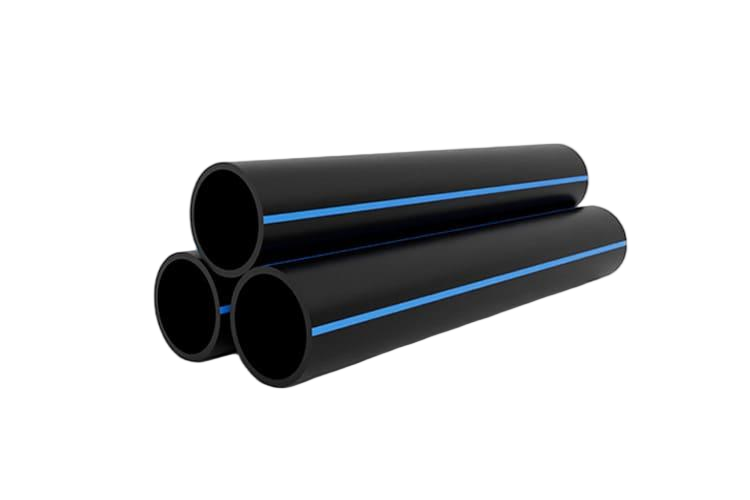
A hydrostatic leak test is how a polyethylene pipeline is commissioned — and it's the test most often done wrong, because operators apply a steel-pipe procedure to a plastic pipe. HDPE expands and creeps under pressure, so the gauge falls even when there is no leak; read that as a failure and you'll cut out and re-fuse perfectly sound joints. This guide explains why PE is different, the two accepted test methods, the pressures and acceptance criteria, and the safety rules that keep a stored-energy test from becoming an incident.
Why HDPE testing differs from steel
Polyethylene is a low-modulus, viscoelastic material: under sustained pressure its molecular chains stretch and the pipe diameter dilates slightly over the first few hours. With a fixed volume of water in the line, that expansion makes the pressure decline — and that decline is not a leak. A rigid-pipe test (pressurise, isolate, watch the gauge for any drop) will therefore fail a perfectly sound PE line, and the effect is larger on big-diameter pipe. The two valid PE methods both work around this: let the pipe expand and add water, or measure how the pressure rebounds.
Governing standards
In North America, field leak testing of PE pipe is covered by ASTM F2164 (essentially a pressure-rebound method) with owner guidance in AWWA M55 Chapter 9 and PPI TN-46. In Europe and the Commonwealth, EN 805 (and national specs derived from it) uses a pressure-loss / water-loss approach with a preliminary air check. The legacy PPI TR-31 constant-pressure / make-up method still underlies many distributor procedures. Whichever you use, the project specification and the governing standard override the typical values here.
| Standard | Region / role |
|---|---|
| ASTM F2164 | USA — field leak test (pressure-rebound method) |
| AWWA M55 (Ch. 9) | USA — owner guidance, based on ASTM F2164 |
| EN 805 | Europe — pressure-loss / water-loss method |
| PPI TN-46 | Planning, procedure & safety guidance |
| PPI TR-31 (legacy) | Constant-pressure / make-up-water method |
Before you test: the pre-test checklist
Most test failures are set up before the pump even runs. Confirm the following before pressurising:
- Every joint — especially the last fusion joint — has cooled fully to ambient; concrete thrust blocks have cured (typically ≥7 days).
- The pipe is restrained, backfilled or sandbagged against lateral movement and axial contraction, and the test section is isolated (not against closed valves that can't take the pressure).
- All air can be vented — high points and dead-legs have vents; the line will be filled slowly from the low point.
- Test water and a disposal/de-watering plan are ready, and the weather is suitable (dry, stable temperature).
- Two calibrated gauges, a relief valve set just above the test pressure, restrained test heads/blind flanges, and an exclusion zone are in place.
The hydrostatic test procedure, step by step
The core procedure is six steps. Fill and de-air carefully, pressurise, let the pipe expand, then test — by make-up water or pressure rebound — and document.
- Fill the line slowly from the low point (axial velocity under ~10 ft/min), venting every high point, until water flows air-free — purge trapped air to below about 4% by volume.
- Let the water temperature stabilise (a few hours to a day, depending on volume) so thermal change doesn't masquerade as a leak.
- Pressurise to the selected test pressure (commonly 1.5× the design rating), capped at 1.5× the lowest-rated component, corrected for elevation and temperature.
- Hold through the initial expansion phase, adding make-up water to maintain pressure while the pipe dilates — expansion is essentially complete after about four hours.
- Run the test phase: either measure the make-up water needed to restore pressure and compare to the allowance, or use the pressure-rebound method (reduce pressure, then confirm it rebounds and stabilises within tolerance).
- Depressurise in a controlled way, record the pressure-time chart and make-up volume, and de-water safely — keeping the total time under pressure within the 8-hour limit.
Two accepted methods: make-up vs pressure-rebound
There are two standard ways to separate viscoelastic expansion from a real leak. The make-up (add-water) method holds a constant pressure and measures the small volume of water you must add over the test period, comparing it to a published allowance per length and diameter. The pressure-rebound method (the basis of ASTM F2164) pressurises, briefly reduces the pressure, then confirms that it rebounds — a sound line's stretched molecules elastically push the pressure back up and hold it within tolerance.
| Make-up (add-water) | Pressure-rebound (ASTM F2164) | |
|---|---|---|
| Principle | Hold pressure, add water to compensate expansion | Reduce pressure, confirm it rebounds elastically |
| Measure | Volume of make-up water vs allowance | Pressure recovery (P90 > 70% STP; ±5% stable) |
| Time | Expansion ~4 h + test ≤3 h | Faster (~90 min core sequence) |
| Basis | Legacy PPI TR-31 | Current ASTM F2164 / TN-46 |
Test pressure & acceptance
Test pressure is normally 1.5× the system design pressure, but the ceiling is 1.5× the rating of the lowest-rated component in the section (often a fitting or valve), measured at the lowest elevation and temperature-corrected. Acceptance depends on the method: for the make-up method, the water added must be within the allowance for the pipe length and diameter; for the rebound method, the pressure 90 minutes in must stay above 70% of the test pressure and then stabilise within about ±5% after the controlled drop.
Safety: stored energy & never air-test
A pressurised pipeline stores energy. Establish an exclusion zone, restrain every blind flange and test head, fit a relief valve set just above the maximum test pressure, and use two calibrated gauges cross-checked against each other. De-watering a long line is itself a documented hazard, so anchor temporary lines. Above all, never pressure-test PE pneumatically (with air or gas) for acceptance — compressed gas stores enormous energy and can rupture the pipe violently; use water or another non-hazardous liquid.
Pressure-test go / no-go
5 common pressure-testing mistakes
- Using the steel-pipe "hold and watch the gauge" test — the normal viscoelastic pressure decay gets misread as a leak, and sound joints are needlessly cut out and re-fused.
- Not removing all the air — trapped air both masks small leaks and mimics a leak, and it adds dangerous stored energy. Fill slowly from the low point and vent every high point.
- Testing too soon — before the last fusion joint has cooled to ambient or before concrete thrust blocks have cured, causing false failures or real ruptures.
- Over-pressurising — exceeding 1.5× the lowest-rated component, or ignoring elevation and temperature correction, overstresses fittings.
- Pneumatic (air) testing for acceptance, or leaving the line under pressure past the 8-hour limit — both are unsafe and not permitted.
Glossary
- Hydrostatic leak test
- A field test that fills a pipeline with water and pressurises it to confirm it holds pressure without leaking, before commissioning.
- Viscoelastic creep
- PE's tendency to stretch and dilate under sustained pressure, causing the test pressure to fall even with no leak — the reason PE testing differs from steel.
- Make-up water method
- Holding constant test pressure and measuring the water added over the test period, compared to a published allowance.
- Pressure-rebound method
- The ASTM F2164 approach: pressurise, briefly reduce pressure, then confirm the pressure rebounds and stabilises within tolerance (P90 > 70% of test pressure).
- Test pressure (STP)
- The hydrostatic test pressure, typically 1.5× design pressure, capped at 1.5× the lowest-rated component's rating.
- Stored energy
- The energy held in a pressurised line; far higher with gas than water, which is why PE is never air-tested for acceptance.
References & standards
- [1]ASTM International — ASTM F2164 — field leak testing of PE/PEX pressure piping (hydrostatic)
- [2]Plastics Pipe Institute (PPI) — TN-46 — guidance for field hydrostatic testing of HDPE pressure pipelines
- [3]Plastics Pipe Institute (PPI) — Hydrotesting HDPE water lines (NETA article)
- [4]PPI Municipal Advisory Board — Pressure testing / field testing of PE pipe
- [5]EJ Prescott (per PPI TR-31) — Recommended testing procedures for HDPE pipe (make-up allowance table)
- [6]PE100+ Association — Special factors when commissioning PE pipe (EN 805 orientation)
- [7]PIPA (Australia) — TN005 — notes on hydrostatic field pressure testing of PE pipes
- [8]AWWA — M55 — PE pipe: design and installation (Ch. 9 field testing)
Frequently asked questions
Need expert advice on your project?
Our engineering team helps utilities, contractors and EPCs specify the right pipe material and SDR for their project. Get a no-obligation technical consultation.
Talk to an engineerRead next
Explore further
Related applications, material comparisons and country buying guides selected for this topic.