Guide
HDPE Pipe Bending Radius & Cold Bending: Directional Changes Without Fittings (2026)
A fused HDPE string bends like a long flexible beam — so you can sweep it around obstacles and into a cul-de-sac with no elbows. The one rule: never go below the minimum radius, and that radius depends on the wall in a way most people guess wrong.

Dr. Wei Liu, P.E.
Senior Engineering Manager · Primepoly
Published: Jun 8, 2026
Updated: Jun 8, 2026
14 min read
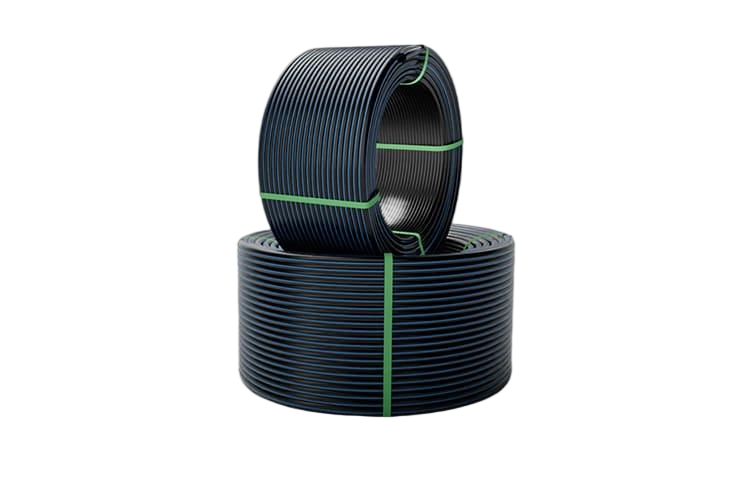
One of HDPE's quiet superpowers is that a fused string behaves like a long, continuous flexible beam — so you can cold-bend it in the trench to follow terrain, sweep around an obstacle, or curve into a cul-de-sac without a single elbow. Fewer fittings means fewer joints and fewer leak paths. But there's one hard rule: you must never bend tighter than the minimum radius, and that radius is set by the wall thickness in a way that surprises people — thinner-wall pipe needs a larger radius, not a smaller one. This guide gives the verified numbers, the physics, the field technique and the decision logic.
Why HDPE bends when other pipes need fittings
Rigid pipe — concrete, ductile iron, PVC — changes direction only with fittings, because it can't flex. A heat-fused HDPE line is different: it's one continuous, ductile, monolithic string that behaves like a flexible beam, so it can be curved to follow the trench. The benefits compound: every directional change you make by bending is an elbow you don't buy, a pair of joints you don't fuse, and a couple of leak paths you don't create. Crews routinely sweep HDPE around boulders and structures, into curved streets and bore paths, and along undulating terrain. The catch is that this flexibility has a defined limit — the minimum bend radius — and respecting it is the whole discipline of field bending.
The core concept: minimum bend radius = α × OD
The minimum bend radius is expressed as a multiple of the pipe's outside diameter: R = α × OD, where α is the bend ratio. The longitudinal strain in the wall is proportional to the bend ratio, but the limit that actually governs is ovalisation: bend too tight and the pipe's cross-section flattens, then locally buckles into a kink. So the rule is to keep the installed radius at or above α × OD. A quick worked example: a 12-inch IPS DR17 pipe has α = 27 and an OD of 12.75 inches, so the minimum radius is 27 × 12.75 ≈ 344 inches, about 28.7 feet. The bar chart and table below give α for every DR.
Source: Performance Pipe PP 819-TN / PPI Handbook Ch. 7
Long-term allowable bend radius by DR
The table gives the long-term (permanently installed) minimum bend ratio for each DR, from the Performance Pipe/PPI data. This is the figure to design to — it's conservative because PE's modulus relaxes under sustained load, and it's also the right number when a pipe will sit curved in the sun for hours during HDD stringing. Note the bottom row: wherever a fitting or flange sits in the curve, the minimum ratio leaps to 100.
| DR (dimension ratio) | Min bend ratio α (× OD) |
|---|---|
| 7, 7.3, 9 (thick wall) | 20 |
| 11, 13.5 | 25 |
| 17, 21 | 27 |
| 26 | 34 |
| 32.5 | 42 |
| 41 (thin wall) | 52 |
| Any fitting / flange in the bend | 100 |
Why thinner wall (higher DR) needs a larger radius
This is the counter-intuitive part, and it's worth stating plainly because most people guess the opposite. A thicker-wall, lower-DR pipe (say DR9) resists ovalisation and kinking better, so it tolerates a tighter bend — 20×OD. A thinner-wall, higher-DR pipe (say DR26 or DR41) has less ring stiffness, ovalises more easily under bending, and therefore needs a larger radius — 34 or even 52×OD — to stay safely round. So the relationship is: more wall, tighter bend allowed; less wall, gentler bend required. If you remember one thing beyond the numbers, remember the direction.
The stricter rule: 100×OD near any fitting or flange
A fused fitting, flange or mechanical connection is a rigid, stiff element in an otherwise flexible line, which makes it a stress concentration. So the rule changes near one: within about five pipe diameters either side of a fitting or flange, the minimum bend ratio jumps to 100×OD — far gentler than the plain-pipe value. In practice this means you keep your sweeping bends well away from fused flanges and fittings, and you never bend a pipe right up against a fitting. Forgetting this is one of the most common ways crews crack an otherwise sound joint.
Long-term vs short-term: two different limits
There are two regimes. The long-term ratios above govern the permanently installed pipe. A separate, tighter short-term ratio applies to momentary curvature as the pipe passes through equipment during installation (for example, the bending that happens during plowing-in of smaller pipe) — roughly 10×OD for DR7.3–9, 13×OD for DR11–13.5 and 17×OD for DR17–21. The table sets them out. The key point: don't confuse the two. A radius that's acceptable for a split second going through a plow shoe is not acceptable for the pipe to live at for fifty years.
| DR | Short-term ratio α (× OD) |
|---|---|
| 7.3, 9 | 10 |
| 11, 13.5 | 13 |
| 17, 21 | 17 |
How to cold-bend in the field (and cold-weather care)
Good field bending is about distributing the curvature, not forcing it. Excavate the trench to the target radius first, then draw the fused string evenly over the entire length of the curve — pulling against a short section instead kinks thin-wall and small-diameter pipe. Restrain the bend with temporary blocking, place the initial backfill to hold the curve, then remove the temporary restraints before final backfill and compact around the pipe. Never use pegs or stakes against the pipe to hold a bend — that's a point load and a stress raiser. Two safety notes: bending a large pipe takes real force, and a restrained bend springs back hard if a block slips. And temperature matters — PE is more pliable when warm and stiffer and more kink-prone when cold, so in cold weather use a larger radius and more care.
Cold bend vs elbow vs HDD: a decision path
Not every directional change should be a cold bend. The path below sorts it out: sharp turns need a fitting, gradual sweeps can be cold-bent, and trenchless changes go to HDD with its own (larger) radius rule.
Coiled pipe: bending before it ever reaches site
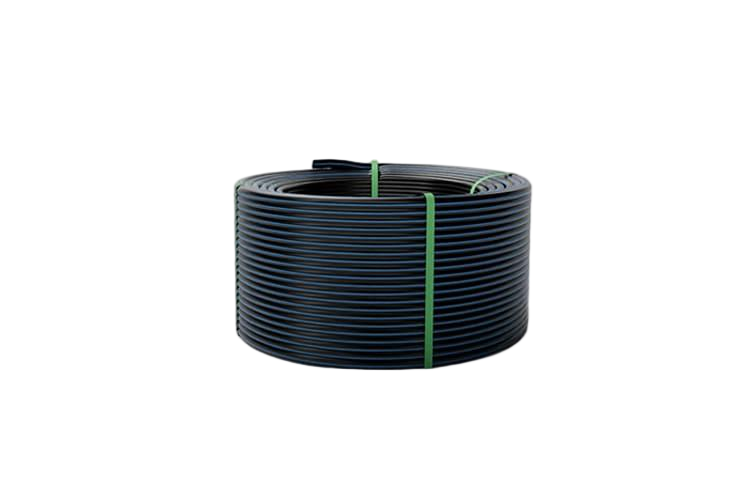
Worth noting that small-diameter HDPE (commonly up to 6 inches) ships in coils — and coiling is simply bending within the allowable radius. That's why coiled product is such an advantage on small lines: a service connection or a long small-diameter run can be laid from a single continuous coil with almost no fittings or joints, the pipe paying off the reel and following the trench. The same material property — controlled flexibility within a minimum radius — underlies both the coil on the truck and the sweep in the trench.
5 mistakes that cause kinks, ovalisation & cracks
- Using a single '25×OD' rule for every DR — DR26, 32.5 and 41 actually need 34, 42 and 52×OD.
- Forgetting the 100×OD rule — bending right up to a fused flange or fitting and cracking it.
- Confusing cold (field) bending with thermal/heat bending — heat-forming is a shop process, not field practice.
- Point-loading the bend with stakes or pulling over a short section instead of drawing the pipe evenly over the whole curve.
- Bending in cold weather to the warm-weather radius, or leaving temporary restraints in during final backfill (spring-back and locked-in stress).
Glossary
- Bend ratio (α)
- The minimum bend radius expressed as a multiple of the outside diameter (R = α × OD); 20–52 for plain pipe by DR, 100 near a fitting.
- DR / SDR
- Dimension Ratio = OD ÷ wall thickness; higher DR = thinner wall = larger required bend radius.
- Cold (field) bending
- Curving the pipe in the trench using its natural flexibility at ambient temperature — distinct from shop heat-forming.
- Ovalisation
- Flattening of the round cross-section under bending; the effect that limits how tight HDPE can be bent before it kinks.
- Kink / local buckling
- A sharp local collapse of the wall when the bend exceeds the minimum radius — a permanent defect.
- Spring-back
- The forceful tendency of a restrained cold bend to straighten if a temporary block or restraint is released — a safety hazard.
References & standards
- [1]Performance Pipe (Chevron Phillips) — PP 819-TN — field bending of PE pipe (the per-DR bend table)
- [2]Dura-Line — Info Brief 19-4.1 — recommended minimum bend radius (100×OD near fittings)
- [3]WL Plastics — How to calculate the bend radius of HDPE pipe
- [4]Plastics Pipe Institute (PPI) — Handbook of PE Pipe, Ch. 12 — horizontal directional drilling (bore bend radius)
- [5]Vinidex — PE allowable bending radius — field technique & AS/NZS values
- [6]ISCO Industries — Flexibility and bend radius of HDPE pipe
- [7]AWWA — M55 — PE pipe: design and installation
- [8]JM Eagle — HDPE water & sewer installation guide
Frequently asked questions
Need expert advice on your project?
Our engineering team helps utilities, contractors and EPCs specify the right pipe material and SDR for their project. Get a no-obligation technical consultation.
Talk to an engineerRead next
13 min read
HDPE Trenchless Installation: HDD, Pipe Bursting & Sliplining (2026)
14 min read
HDPE Pipe Installation Methods: Open-Cut vs HDD vs Pipe Bursting vs Sliplining (2026 Guide)
9 min read
How to Select the Right HDPE Pipe SDR / PN for Your Application
12 min read
HDPE Pipe Handling, Storage & Transport: Best Practices (2026)
13 min read
HDPE Pipe Bedding, Backfill & Trench Design: Installing Flexible Pipe Correctly (2026)
Explore further
Related applications, material comparisons and country buying guides selected for this topic.