Application
HDPE Pipe for Landfills: Leachate Collection, Gas & Containment (2026)
Why landfills run on polyethylene — the leachate pipe that survives crushing waste loads and decades of settlement, the gas collection, and the matching geomembrane liner.

Dr. Wei Liu, P.E.
Senior Engineering Manager · Primepoly
Published: Jun 8, 2026
Updated: Jun 8, 2026
13 min read
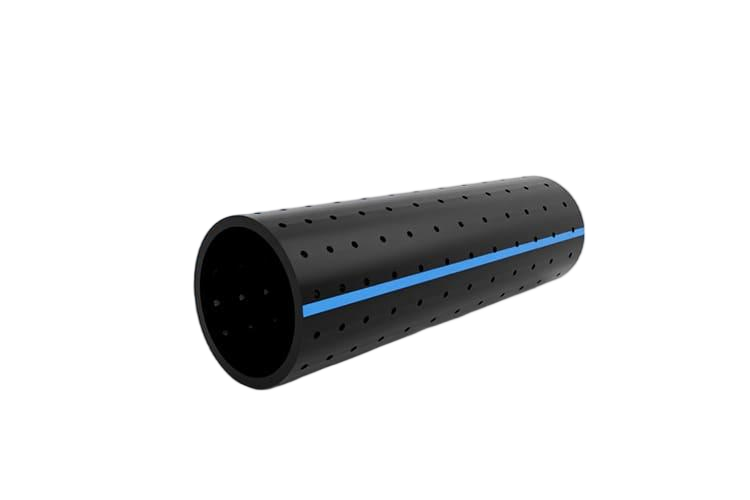
A modern landfill is an engineered containment system, and polyethylene runs through all of it: perforated HDPE collects leachate above the liner, more HDPE collects the methane-rich landfill gas, and an HDPE geomembrane is the barrier liner itself. The reasons are consistent — HDPE shrugs off aggressive leachate chemistry, its fused joints don't leak into groundwater, and, crucially, it flexes with the massive, uneven settlement as waste decomposes, where rigid pipe would crack. This guide maps the whole system and the two design parameters that govern it: crush load and settlement.
Where HDPE fits in a landfill
HDPE appears at several points in a landfill, each with different demands. Perforated pipe collects leachate in the drainage layer above the liner; solid pipe pumps it onward as a force main. Perforated HDPE wells and headers collect landfill gas under vacuum. Condensate lines drain the gas system, and the geomembrane liner provides the containment barrier. The table maps them.
| Location | Function | Pipe form |
|---|---|---|
| Leachate collection | Perforated pipe above the liner gathering leachate to sumps | Perforated / slotted HDPE |
| Leachate force main | Pumps leachate from sump to treatment/storage | Solid-wall fused HDPE |
| LFG vertical wells | Perforated casing in waste, gravel-packed & sealed | Perforated HDPE casing |
| LFG headers | Carry methane-rich gas under vacuum to flare/energy | Solid HDPE |
| Condensate | Drain liquid from gas lines at low points | Solid HDPE + traps |
| Double-containment | Pipe-in-pipe for sensitive crossings | HDPE carrier + HDPE containment |
| Containment liner | The barrier sheet under the waste | HDPE geomembrane (GRI-GM13) |
Why HDPE dominates landfill piping
Four properties make HDPE the default. Its chemical resistance handles aggressive leachate — acids, alkalis, organics, dissolved metals and ammonia — and landfill gas and condensate, with no corrosion. Its butt- and electrofused joints are monolithic, eliminating the gasketed leak paths that would let contaminants reach groundwater. Its flexibility lets it accommodate settlement (more on that next). And because the standard barrier liner is HDPE geomembrane, the pipe and the liner are the same material family — weldable penetrations, matched chemistry.
The settlement problem — and why flexible fused HDPE solves it
This is the headline. As buried waste decomposes, a landfill settles enormously and unevenly over its life — differential settlement that would crack rigid concrete or clay pipe and shear their gasketed joints. Flexible HDPE, fused into a continuous monolithic line, simply flexes and stretches with the moving waste mass. That ability to deform without leaking is the single biggest reason HDPE dominates landfill leachate and gas collection, where joint integrity over decades is non-negotiable.
Leachate collection pipe: perforation, drainage layer & geotextile
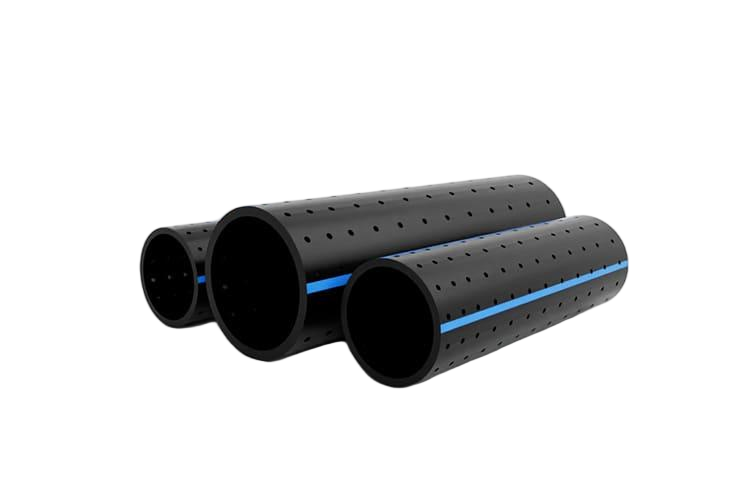
Leachate collection pipe is perforated or slotted HDPE laid in a graded gravel drainage blanket directly above the liner, wrapped or bedded with a non-woven geotextile filter so fines don't clog it, and sloped (typically at least 1%) to drain toward sumps. The perforations are often oriented to drain effectively, and the whole system is designed to keep the leachate head over the liner within the regulatory limit (commonly 30 cm). Above all, the pipe has to survive the crushing load of the waste piled on top of it.
Designing for deep-waste crush load: SDR selection
Leachate pipe can end up beneath tens of metres of waste, so crush load governs the wall. The counterintuitive part, well explained by landfill engineers, is that you evaluate three separate criteria — wall crushing, wall buckling and ring deflection — and they don't all favour the same wall. A thicker wall (lower SDR, e.g. SDR11) wins on crushing and buckling, but a thinner wall (SDR17) tolerates more ring deflection. The practical approach is to check SDR17 first and step to a lower SDR only if it fails a criterion; very high loads may call for structured-wall pipe.
| Design criterion | Which wall favours it |
|---|---|
| Wall crushing | Thicker wall (lower SDR, e.g. SDR11) |
| Wall buckling | Thicker wall (lower SDR) |
| Ring deflection | Thinner wall tolerates more (SDR17) |
| Practical rule (SCS) | Try SDR17 first; step to a lower SDR if any criterion fails |
Leachate chemistry & temperature derating
HDPE resists most leachate, but "inert" has limits. Leachate chemistry varies widely by site and waste age, so the specific constituents must be checked against a chemical-resistance chart — some organics and solvents can permeate PE even when they don't chemically attack it. Temperature matters too: leachate and gas are often warm (around 30–40 °C, higher in "hot" landfills), and HDPE's pressure rating derates with temperature. Specify against the actual leachate chemistry and temperature, not a generic "HDPE is inert" assumption.
Landfill gas collection: wells, headers, vacuum & condensate
Landfill gas — roughly half methane, half carbon dioxide — is collected through perforated HDPE wells set in the waste, gravel-packed and sealed, feeding solid HDPE headers that carry it under applied vacuum to a flare or energy plant. Because the system runs under vacuum, the pipe is designed for external pressure and buckling rather than internal pressure. The moisture-laden gas also condenses at low points, so the lines are sloped to condensate traps and knockouts — a blocked condensate trap kills the vacuum and the collection.
The geomembrane liner — same HDPE material family
The containment barrier under the waste is an HDPE geomembrane — a smooth or textured sheet, specified to GRI-GM13, with very low permeability and broad chemical resistance. Because it's the same polymer as the collection pipe, the two form one compatible system: pipe penetrations through the liner can be welded with HDPE boots, and the chemical behaviour is matched. That single-material-family advantage — pipe and liner both HDPE — is something competing pipe materials simply can't offer in a landfill.
Standards & regulations
Landfill HDPE pipe is made to ISO 4427 or ASTM F714 (with ASTM D3350 material classification), the geomembrane liner to GRI-GM13. The containment system itself is governed by regulation — in the US, the RCRA Subtitle D criteria (40 CFR Part 258) require a composite liner and leachate collection with the 30 cm head limit, and in Europe the Landfill Directive sets equivalent requirements, with EPA best practices governing gas collection. Confirm current editions and your local regulatory regime.
5 costly specification mistakes
- Under-specifying SDR/wall for the deep-waste crush load — not checking wall crushing, buckling and ring deflection for the full final waste height.
- Ignoring settlement — using rigid or gasket-jointed pipe; only fused, flexible HDPE survives differential subsidence.
- Overlooking chemistry and temperature together — assuming HDPE is universally inert, and not derating for warm leachate or gas.
- Wrong perforation or geotextile — a slot pattern or filter that clogs with fines, raising the leachate head above the limit.
- Not matching the pipe to the geomembrane liner material — losing the single-material-family advantage for welded, chemically matched penetrations.
Glossary
- Leachate
- The contaminated liquid that percolates through waste; aggressive and variable, it's collected by perforated HDPE above the liner.
- Landfill gas (LFG)
- The roughly half-methane, half-CO₂ gas from decomposing waste, collected under vacuum through HDPE wells and headers.
- Geomembrane
- The HDPE barrier sheet (per GRI-GM13) that lines the landfill base — the same material family as the collection pipe.
- Differential settlement
- The large, uneven subsidence as waste decomposes; flexible fused HDPE accommodates it where rigid pipe cracks.
- Ring deflection
- The flattening of a buried flexible pipe under load — one of three crush criteria; thinner-wall (SDR17) pipe tolerates more of it.
- Condensate
- Liquid that forms in landfill-gas lines as the moist gas cools; drained via sloped lines to traps and knockouts.
References & standards
- [1]US EPA — Municipal solid waste landfills
- [2]US Government (eCFR) — 40 CFR Part 258, Subpart D — landfill design criteria
- [3]US EPA / LMOP — Best practices for landfill gas collection (Ch. 7)
- [4]SCS Engineers — Leachate collection pipe — SDR 11 vs SDR 17 HDPE
- [5]Tetra Tech — The challenges of hot landfills (temperature)
- [6]Geosynthetics Magazine — A minitube blanket for landfill gas collection
- [7]MIT OpenCourseWare — Installing leachate collection pipe (lecture)
- [8]NCBI / PMC — Deformation of buried HDPE pipes (pressure & temperature)
Frequently asked questions
Need expert advice on your project?
Our engineering team helps utilities, contractors and EPCs specify the right pipe material and SDR for their project. Get a no-obligation technical consultation.
Talk to an engineerRead next
Explore further
Related applications, material comparisons and country buying guides selected for this topic.