Guide
HDPE Pipe for Hydrogen & Hydrogen Blending: Can PE Gas Pipe Carry H2? (2026)
The buried PE gas grid is one of the energy transition's quiet assets — because polyethylene, unlike steel, has no hydrogen-embrittlement mechanism. Here's the honest engineering.

Dr. Wei Liu, P.E.
Senior Engineering Manager · Primepoly
Published: Jun 8, 2026
Updated: Jun 8, 2026
13 min read
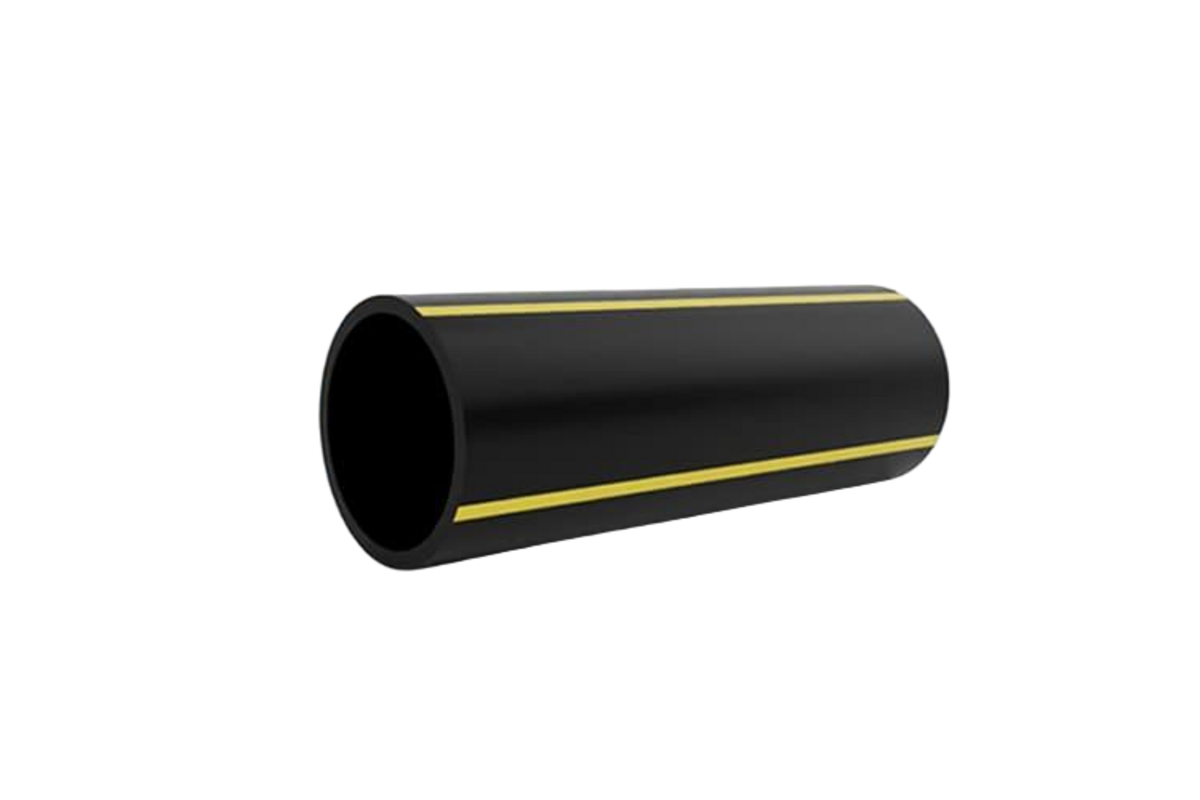
As gas networks look to decarbonise, a quiet fact has become strategically important: the buried polyethylene gas grid is largely hydrogen-ready. Unlike steel, polyethylene has no hydrogen-embrittlement mechanism — the metal failure mode that makes hydrogen so troublesome for steel pipelines simply doesn't exist in PE. Live trials (HyDeploy in the UK) and peer-reviewed studies have confirmed PE carrying hydrogen blends, and even 100% hydrogen at distribution pressure. This guide gives the honest engineering: where PE is genuinely hydrogen-capable, the real caveats, and what actually limits a network.
Can PE/HDPE gas pipe carry hydrogen?
Yes — the pipe itself is. Industry reviews (the AGA's 2023 assessment, PPI TR-19, GTI's literature work) find no material compatibility problem using existing PE for hydrogen and for blends up to 20%, and peer-reviewed testing has validated PE100-RC for 100% hydrogen at distribution pressure. That's why polyethylene is central to gas-network decarbonisation plans. The important nuance, which this guide keeps returning to, is that a hydrogen-capable pipe is not the same as a hydrogen-approved network — the appliances, fittings, meters and regulation around the pipe are usually what govern.
Why steel fears hydrogen but PE doesn't
Hydrogen's headline danger in pipelines is hydrogen embrittlement — hydrogen atoms diffusing into a metal's crystal structure and reducing its toughness, promoting cracking. It is fundamentally a metal failure mode. Polyethylene is an amorphous/semi-crystalline polymer with no metallic lattice and no such mechanism: hydrogen provides no radicals that break the polymer down, so PE is simply not embrittled by it. This is the cleanest, most defensible reason PE is favoured for hydrogen — the very problem that complicates steel doesn't apply to it.
Hydrogen permeation through PE: the honest numbers
The one real difference from methane is permeation: hydrogen is a smaller molecule and passes through the PE wall faster. The multiplier is widely misquoted, so here are the honest ranges — and, just as important, the context. The absolute loss is tiny (a fraction of a thousandth of a percent of throughput), so it isn't an economic problem; the genuine consideration is that permeated hydrogen can accumulate in enclosed, unventilated spaces, which is a ventilation and risk-assessment matter, not a pipe-integrity one.
| Scenario | H2 vs methane permeation | Context |
|---|---|---|
| 20% hydrogen blend | ~1.5–2× methane | A small increase |
| 100% hydrogen | ~4–6× methane (one study ~2.3×) | Multiplier varies with %, pressure, temperature, grade |
| Absolute loss | ~0.0002% of throughput | Economically negligible |
| The real concern | Enclosed / unventilated spaces | Ventilation & risk assessment, not pipe integrity |
Does hydrogen weaken PE? Long-term performance
No — the long-term mechanical evidence is reassuring. In peer-reviewed testing, PE exposed to 100% hydrogen showed no significant differences from air-exposed pipe in its mechanical properties or integrity, and electrofusion joints passed decohesion peel tests after extended hydrogen exposure. Multi-year programmes blending hydrogen with natural gas at elevated pressure found no significant change in oxidation induction time, modulus, elongation at break or slow-crack-growth resistance for PE100. Hydrogen doesn't chemically attack or fatigue the polymer the way it cracks steel.
Low-pressure distribution: PE's comfort zone
It matters to separate distribution from transmission. PE distributes gas at low pressure — typically up to about 7 bar, often far less — which is exactly the regime it's designed for and where the hydrogen validation work has focused. High-pressure hydrogen transmission is a different problem, handled in steel and governed by embrittlement-sensitive codes; don't conflate the two. For the low-pressure buried distribution grid that PE dominates, hydrogen is well within the material's comfort zone.
Blending vs 100% hydrogen: pipe vs appliances
A common misconception is that a 20% blend limit is set by the pipe. It isn't. The UK's HyDeploy trial ran a 20%-hydrogen blend through a live PE network feeding real homes with no appliance changes and HSE approval — and the 20% ceiling was set by appliance and network tolerance, not the polyethylene. The table separates what the pipe handles from what limits the network. Historic town-gas networks (Hong Kong, Singapore, Hawaii) have carried far higher hydrogen fractions in PE for decades.
| Question | Answer |
|---|---|
| Can the PE pipe handle hydrogen? | Yes — validated for blends and 100% H2 at distribution pressure |
| What sets the 20% blend limit? | Appliances, meters and network tolerance — not the pipe |
| High-pressure transmission? | A different problem (steel, embrittlement-sensitive) — not PE distribution |
| Is the network approved? | Regulation is still evolving — verify current code (IGEM TD/21, TD/22) |
Repurposing the buried PE grid: a hydrogen-ready asset
This is the strategic payoff. Decades of replacing old iron and steel mains with polyethylene — the UK's Iron Mains Replacement Programme, and the dominance of PE in new gas main worldwide — have quietly built a buried, hydrogen-ready distribution asset. Feasibility studies treat those PE mains as suitable for repurposing to carry hydrogen at distribution pressure with little or no pipe change. In other words, a network already in the ground may be most of the way to hydrogen-ready, which is a large part of why PE matters to the energy transition.
The real limits: fittings, valves, meters & regulation
If the pipe isn't usually the constraint, what is? The honest answer is the rest of the network and the rulebook. Metering, regulators, some valves and many appliances have their own hydrogen tolerances (often capped well below 100%), certain cast or ductile-iron components are restricted, and leak detection differs because hydrogen needs odorant and burns with a near-invisible flame. And approval frameworks are still maturing. So deployment is governed by the network and current regulation as much as the pipe.
Is your PE network hydrogen-ready?
Whether a PE network can take hydrogen comes down to pressure, the non-pipe components, and approval. The path below frames the real questions.
Standards
PE gas pipe is made to ISO 4437 (international), EN 1555 (Europe) or ASTM D2513 (US), and joined by the same butt and electrofusion as natural-gas service. Hydrogen-specific guidance is emerging on top: IGEM/TD/21 for new hydrogen distribution mains and IGEM/TD/22 for repurposing existing networks (both at distribution pressure), alongside the GIS/PL2 PE-pipe specifications. Because this guidance is recent and evolving, treat the regulatory position as live and confirm it for your jurisdiction.
5 common myths & mistakes
- "Hydrogen embrittles PE" — no; embrittlement is a steel failure mode, and PE has no such mechanism.
- Over-worrying permeation loss — it's about 0.0002% of throughput; the real point is accumulation in enclosed spaces, not cost.
- Assuming the pipe is the network limit — it almost always isn't; appliances, meters and valves set the blend ceiling.
- Treating the regulation as settled — hydrogen-distribution standards (IGEM TD/21, TD/22) are recent and still evolving.
- Conflating high-pressure transmission with low-pressure distribution — the former is steel and embrittlement-sensitive; PE's domain is the latter.
Glossary
- Hydrogen embrittlement
- The loss of toughness when hydrogen enters a metal's crystal lattice and promotes cracking — a steel failure mode with no equivalent in PE.
- Permeation
- Gas passing slowly through the pipe wall; hydrogen permeates PE faster than methane, but the absolute loss is economically negligible.
- Hydrogen blending
- Mixing hydrogen (e.g. up to 20% by volume) into the natural-gas grid; the blend limit is usually set by appliances, not the pipe.
- PE100-RC
- A PE100 grade with enhanced crack resistance; testing has validated it for 100% hydrogen at distribution pressure.
- Distribution vs transmission
- Low-pressure local distribution (≤7 bar, PE's domain) versus high-pressure long-distance transmission (steel, embrittlement-sensitive).
- Hydrogen-ready
- An existing PE network considered suitable for repurposing to carry hydrogen at distribution pressure with little or no pipe change.
References & standards
- [1]American Gas Association — Impacts of hydrogen blending on gas piping materials (2023)
- [2]Kiwa Technology — Modern PE pipes enable the transport of hydrogen (Hermkens 2018)
- [3]PE100+ Association — Modern PE pipe enables the transport of hydrogen
- [4]Cadent Gas — HyDeploy — 20% hydrogen blending trial
- [5]Northern Gas Networks — H21 Leeds City Gate — executive summary
- [6]IGEM — IGEM/TD/22 — repurposing distribution mains for hydrogen
- [7]IGEM — IGEM/TD/21 — hydrogen distribution for new mains & services
- [8]ASTM International — ASTM D2513 — PE gas pressure pipe, tubing & fittings
Frequently asked questions
Need expert advice on your project?
Our engineering team helps utilities, contractors and EPCs specify the right pipe material and SDR for their project. Get a no-obligation technical consultation.
Talk to an engineerRead next
Explore further
Related applications, material comparisons and country buying guides selected for this topic.