Guide
HDPE Dual-Containment (Double-Wall) Pipe: Secondary Containment & Leak Detection (2026)
A pipe inside a pipe, monitored in between — so a leak is caught before it ever reaches the ground. The how, the why, and what actually governs the design.

Dr. Wei Liu, P.E.
Senior Engineering Manager · Primepoly
Published: Jun 8, 2026
Updated: Jun 8, 2026
13 min read
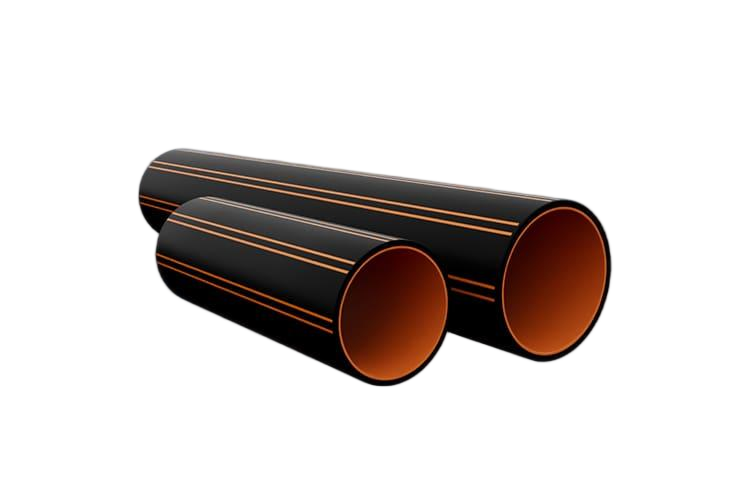
Where a leak is simply unacceptable — chemicals, fuels, acids, hazardous waste — single-wall pipe isn't enough. HDPE dual-containment piping puts a carrier pipe inside a larger containment pipe and monitors the gap between them, so if the carrier ever leaks, the containment captures the fluid and a sensor catches it before anything reaches the environment. HDPE suits both walls: broad chemical resistance, fused leak-free joints throughout, and a single weldable material system. This guide covers how it works, the monitoring that defines it, and the design points that make or break it.
What HDPE dual-containment pipe is
Dual-containment piping is, simply, a pipe within a pipe: a carrier (primary) pipe that conveys the fluid, inside a larger containment (secondary) pipe, with an annular space between them. It exists for fluids where any release is unacceptable — aggressive chemicals, fuels and aviation hydrant lines, hazardous and industrial waste, landfill leachate, and sometimes potable water routed through contaminated ground. HDPE earns both roles through its chemical resistance, its fully fused (leak-free) joints on each wall, and the fact that carrier and containment are the same weldable material.
How secondary containment works: the interstitial space
The whole concept lives in the annular gap — the interstitial space — between the two pipes. In normal service it does nothing. If the carrier develops a leak, the fluid is captured in that space and contained by the outer wall instead of escaping to soil or groundwater, and the space is arranged so the leak travels to where it can be detected. That turns a potential environmental release into a contained, monitored event — which is exactly what regulators require for hazardous fluids, and why the monitoring of that space is the system's defining feature.
Interstitial leak detection: the defining feature
A double wall with no way to know it's working is wasted money — so interstitial monitoring is the point of the whole system, and there are four common methods. They range from a continuous sensing cable that detects and locates a leak, through a low-point or level sensor and pressure/vacuum integrity monitoring, to simple manual or visual checks at sight points and sumps. Pressurised hazardous systems generally warrant automated detection; lower-risk drainage systems may allow manual inspection.
| Method | How it works |
|---|---|
| Continuous sensing cable | A cable in the annulus detects and locates a leak |
| Low-point / level sensor | A sensor at the sump or annulus low point raises an alarm |
| Pressure / vacuum monitoring | The annulus is pressurised or evacuated; loss of integrity in either wall flags |
| Manual / visual | Sight glasses, sumps and drain points for periodic inspection |
Anatomy: carrier, containment, centralizers & fused joints
Inside, the carrier is held concentric within the containment by centralizers (support discs or spacers) at intervals — without them the carrier sags, contacts the outer wall, and the annulus can't drain or be monitored. Both walls are fused: a simultaneous butt fusion can weld inner and outer in one operation (one weld replacing up to four), with electrofusion used for tie-ins or dissimilar materials. The system is completed with special dual-containment fittings (tees, elbows, reducers) and properly sealed end terminations.
Sizing: carrier/containment step-up
The containment pipe is sized a step up from the carrier, with how much depending on the construction and whether a leak-detection cable runs in the annulus. Fabricated systems typically step up two pipe sizes, co-extruded systems one, and cable detection needs a minimum annular clearance to fit the cable and allow drainage. The table gives the common rules; the exact pairing also has to leave room for the carrier's thermal expansion within the annulus.
| System type | Step-up |
|---|---|
| Fabricated / custom | Minimum two pipe sizes (e.g. 1" carrier × 3" containment) |
| Co-extruded | One pipe size (e.g. 1" × 1.5") |
| With cable leak detection | Needs a minimum annular clearance (≈ 20 mm) for the cable & drainage |
Slope, drainage & sump for leak capture
Detection only works if a leak actually reaches the sensor, which is why the annulus is sloped to a collection point or sump. Any fluid that leaks from the carrier then gravity-drains along the interstitial space to the low point, where the sensor sits and the alarm is triggered — "detect before release" depends entirely on this. The slope, the sump location and the sensor placement are design-judgment details tied to the system layout, not a single codified number, but getting them coherent is essential.
Applications
- Chemical process and transfer lines (acids, caustics, solvents).
- Fuel and aviation hydrant fueling lines.
- Hazardous and industrial waste.
- Landfill leachate transfer.
- Double-contained sewer or process waste through aquifers.
- Potable water routed through hydrocarbon-contaminated ground.
HDPE vs FRP, steel & single-wall-in-trench
HDPE isn't the only way to contain, so the honest comparison matters. Against FRP (fibreglass), HDPE wins on fused leak-free joints and impact/stress-crack resistance, though FRP offers higher stiffness and temperature. Against steel, HDPE wins on corrosion immunity and jointing, while steel wins on strength, temperature and fire. And against a single-wall pipe sitting in a lined containment trench, true double-wall pipe gives real interstitial monitoring and faster, provable leak detection. HDPE's limits are its lower temperature and pressure ceiling and the need to verify chemical compatibility for strong oxidisers.
Choosing a containment approach
The right approach follows from the fluid, the consequence of a release, and how the leak must be detected. The path below frames it.
Standards & regulations
There's an important nuance: no single product standard governs "HDPE dual-containment piping." It's a stack. The pipe and joints follow the PE material and fusion standards (ASTM D3350, F714, F2620); the requirement to contain is driven by regulation — EPA SPCC (40 CFR Part 112) for oil and fuel, RCRA for hazardous waste, and the UST rules (40 CFR Part 280) for underground tank systems — and EN 14125 is the product standard for underground fuel pipework in Europe. (ASTM F2160 is sometimes cited but is a non-pressure conduit standard, not the containment standard.) Confirm the governing regulation for your fluid and jurisdiction.
5 common mistakes
- Too few centralizers (or none added at field cuts) — the carrier sags, contacts the containment, and the annulus can't drain.
- No interstitial monitoring — defeating the purpose, since you've paid for a second wall with no way to know it's working.
- Wrong slope or no sump — leaks pool randomly and never reach the sensor, so "detect before release" fails.
- Chemical or temperature incompatibility — the carrier (and containment) material not matched to the actual fluid and temperature.
- Mismatched fittings or unsealed terminations — single-wall fittings, the wrong fusion method, or open ends that let the annulus communicate with groundwater.
Glossary
- Carrier pipe
- The inner (primary) pipe that actually conveys the fluid in a dual-containment system.
- Containment pipe
- The outer (secondary) pipe that captures any leak from the carrier and prevents environmental release.
- Interstitial space
- The annular gap between carrier and containment, monitored for leaks — the defining feature of the system.
- Centralizer
- A support disc or spacer that keeps the carrier concentric inside the containment so the annulus stays clear and drainable.
- Leak-detection cable
- A continuous sensing cable run in the annulus that detects and locates a carrier leak; needs minimum annular clearance.
- Secondary containment
- The regulatory concept of a backup barrier (here, the containment pipe + monitoring) that catches a primary-system failure.
References & standards
- [1]Pumps & Systems — Design for thermoplastic double-containment piping
- [2]Asahi/America — Double containment piping (Duo-Pro / Fluid-Lok HDPE)
- [3]IPEX — Double containment piping systems — technical manual
- [4]ISCO Industries — Sample specification — dual-contained HDPE pipe
- [5]US EPA — Secondary containment under SPCC (40 CFR 112)
- [6]Spears Mfg. — Double containment design & installation guide
- [7]ANSI / BSI — EN 14125 — thermoplastic pipework for underground fuel
- [8]ASTM International — ASTM F2160 — solid-wall HDPE conduit (related, non-pressure)
Frequently asked questions
Need expert advice on your project?
Our engineering team helps utilities, contractors and EPCs specify the right pipe material and SDR for their project. Get a no-obligation technical consultation.
Talk to an engineerRead next
Explore further
Related applications, material comparisons and country buying guides selected for this topic.