Application
HDPE Pipe for Power Plant & Industrial Cooling Water (2026)
Big, continuous cooling-water flows reward a pipe that never corrodes and keeps its bore smooth for life — and, for seawater intakes, one you can float out and sink onto the seabed.

Dr. Wei Liu, P.E.
Senior Engineering Manager · Primepoly
Published: Jun 8, 2026
Updated: Jun 8, 2026
13 min read
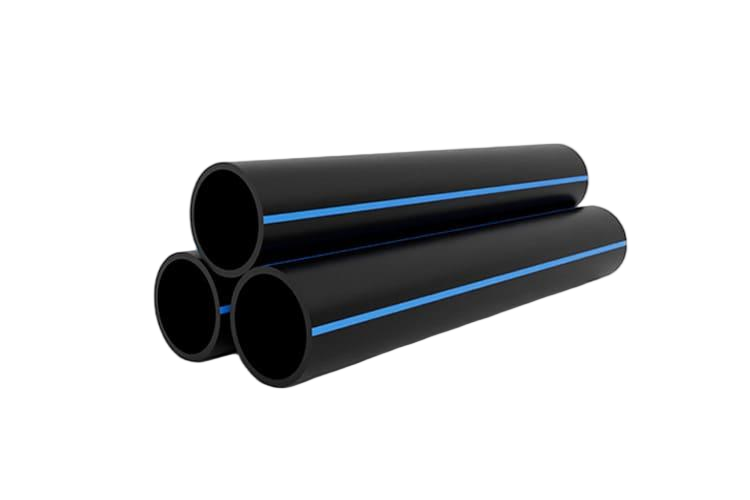
Cooling-water systems move enormous, continuous flows of water — and that makes two HDPE properties pay off hugely: it never corrodes, and its bore stays smooth for life. On a circulating-water main running around the clock for decades, a bore that doesn't tuberculate keeps pumping energy low, year after year. And for coastal plants, large HDPE seawater intake and outfall lines can be fused onshore and floated out to be sunk onto the seabed. This guide covers where HDPE fits in cooling water, why it wins, and the seawater design points — buckling, ballast and biofouling — that govern it.
Where HDPE fits in cooling-water systems
HDPE turns up across the cooling-water system, from the big circulating-water lines that feed the condenser to the seawater intake and outfall and the plant's auxiliary water. The table maps the main services. The common thread is large, continuous water flow in a corrosive (often saline) medium — exactly where corrosion immunity and lifetime-low friction matter most.
| System | Service |
|---|---|
| Circulating water (CW) | Condenser cooling supply & return — the big-flow lines |
| Cooling-tower supply & return | Recirculating loops and make-up water |
| Once-through intake & outfall | Seawater or river/lake; large-diameter marine pipelines |
| Make-up & raw water | Feed to the CW system and cooling towers |
| Auxiliary / closed cooling | Equipment cooling transferring heat to the CW system |
| Ash / FGD / screen-wash | Abrasive, corrosive plant water |
Why HDPE for cooling water: corrosion-free for life
The first reason is corrosion. Polyethylene doesn't rust, oxidise or corrode galvanically, so cooling-water HDPE needs no corrosion allowance, no internal or external coating, and no cathodic protection — even in seawater, brackish or river water. That alone removes a major maintenance and capital burden versus coated steel or reinforced concrete. Add fused leak-free joints, flexibility for ground movement and marine installation, strong surge tolerance, and a long service life, and HDPE fits the cooling-water environment naturally.
The OPEX argument: smooth bore & lifetime pumping energy
The quieter, bigger advantage is energy. HDPE's smooth, non-corroding bore keeps its Hazen-Williams C-factor around 150 and holds it there for life, because nothing tuberculates or scales the wall. Coated steel starts lower and degrades as it ages and corrodes, so its effective C-factor drops over decades. On a cooling-water main that pumps continuously, that retained smoothness means consistently lower friction and therefore lower pumping energy — a substantial operating-cost saving over the plant's life, as the chart illustrates.
Once-through seawater cooling: intake & outfall
Coastal plants draw cooling water from the sea, and large HDPE intake and outfall pipelines are installed the same way as desalination lines: fused into long strings onshore, fitted with concrete ballast, floated out, and sunk to the seabed by controlled flooding. The design point most often missed is that a submerged intake — under external water and vacuum load, especially when depressurised — is governed by ring-collapse buckling, not internal pressure. So the SDR is chosen for collapse resistance, and the ballast is sized to hold the line on the seabed against storm currents.
Biofouling & cleaning: chlorination & pigging
Seawater cooling lines foul with marine growth, and HDPE handles cleaning well rather than preventing fouling outright. Its smooth, low-surface-energy bore gives marine organisms less to adhere to than concrete or steel, and it's fully compatible with the two standard controls: chlorination (continuous low dose plus periodic shock) and pigging. HDPE tolerates shock chlorination; the honest caveat — as with potable systems — is that continuous high oxidant dosing over many years can accelerate oxidative ageing, so design the dosing and consider a resistant grade where it's heavy.
Temperature: derating warm condenser-outlet lines
Cooling water is moderate in temperature, but it isn't all cold, and HDPE derates as it warms — so be honest about the warm lines. Intake and raw water are near ambient, but the condenser outlet is warmer (a typical rise of 8–12 °C, with outlet temperatures often around 30–40 °C depending on plant and season), and the return lines should be designed at the derated rating, not the 20 °C value. The table gives indicative derating factors; treat them as approximate and confirm against the resin's datasheet.
| Water temperature | Approx. derating factor |
|---|---|
| ≤20 °C | 1.0 |
| 30 °C | ~0.87 |
| 40 °C | ~0.74 |
| 45 °C | ~0.63–0.70 |
| 50 °C | ~0.55–0.62 |
Large-diameter mains: how big can HDPE go
Cooling-water mains are large, and it's worth being honest about HDPE's range. Solid-wall PE100 is commonly available to around 1,600–2,000 mm, with up to roughly 2,500 mm from major producers, and real power-plant seawater intakes run at about 2 m diameter. Beyond that, the very largest cooling-water culverts and conduits may still be prestressed concrete or steel. HDPE leads on corrosion, leak-free joints and marine installation; the rigid materials may win purely on the largest diameters and ring stiffness.
HDPE vs coated steel, concrete & GRP
For cooling water specifically, the honest comparison favours HDPE on the things that drive lifetime cost — corrosion, leak-tightness and friction — while conceding the largest sizes to the rigid materials. The table summarises where each wins.
| Alternative | HDPE wins | Alternative may win |
|---|---|---|
| Coated / lined steel | No corrosion/coating/CP; leak-free fused joints; lower lifetime friction | Highest pressure; very large rigid spans |
| Prestressed concrete | Corrosion-free, smooth bore, lighter, flexible | Very large diameter; low cost at huge sizes |
| GRP / GRE | Fused leak-free joints; ductility & surge; marine float-sink | High ring stiffness at very large diameter |
| Rubber-lined steel | No lining to fail; simpler fused joints | Some abrasive / high-pressure services |
Standards
Cooling-water HDPE is made to ISO 4427 or EN 12201 (PE100), with AWWA C906 in North America, and PE100-RC for demanding or no-bedding service; temperature re-rating follows references such as PIPA POP013 or ISO 13761. Safety-related nuclear cooling-water HDPE is additionally governed by the ASME Boiler & Pressure Vessel Code (Section III for new build, Section XI for repair). As always, the buckling, ballast and biofouling design are project-specific and engineered for the site.
5 common mistakes
- Ignoring external-pressure buckling on a submerged or depressurised intake — sizing the SDR only for internal pressure and risking ring-collapse.
- Not derating for temperature on warm condenser-outlet and return lines — designing them at the 20 °C rating.
- Having no biofouling and cleaning plan — omitting the chlorination strategy and pig access for seawater cooling.
- Under-designing the marine ballast — wrong weight or spacing, so the line lifts or migrates in storms or high flow.
- Assuming HDPE for the very largest cooling-water culverts — without checking diameter availability and ring stiffness against concrete or steel.
References & standards
- [1]Plastics Pipe Institute (PPI) — Handbook of PE Pipe (design & applications)
- [2]Plastics Pipe Institute (PPI) — Handbook of PE Pipe, Ch. 13 — HVAC/cooling applications
- [3]PE100+ Association — Trenchless / submarine outfall design module
- [4]ISO — ISO 4427-1 — PE pipes for water supply (pressure)
- [5]AWWA / ANSI — AWWA C906 — PE pressure pipe & fittings 4–65 in.
- [6]US NRC — HDPE piping summary report (safety-related cooling)
- [7]Tata Consulting Engineers — Seawater intake & outfall for coastal power projects
- [8]PIPA — POP013 — temperature re-rating of PE pipes
Frequently asked questions
Need expert advice on your project?
Our engineering team helps utilities, contractors and EPCs specify the right pipe material and SDR for their project. Get a no-obligation technical consultation.
Talk to an engineerRead next
Explore further
Related applications, material comparisons and country buying guides selected for this topic.