Application
HDPE Pipe for District Cooling & Chilled Water Networks (2026)
Chilled water is HDPE's thermal sweet spot — corrosion-free, low-friction-for-life, leak-free fused mains for the buried networks that cool whole cities.

Dr. Wei Liu, P.E.
Senior Engineering Manager · Primepoly
Published: Jun 8, 2026
Updated: Jun 8, 2026
12 min read
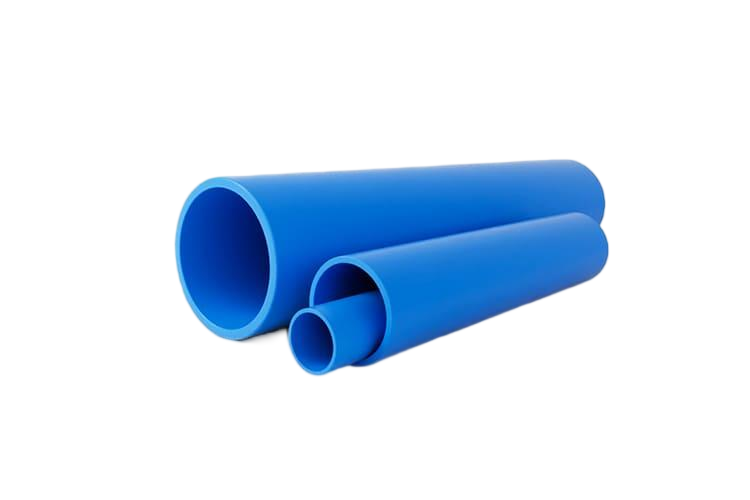
District cooling chills water at a central plant and pumps it through a buried network to cool whole districts of buildings — a model that dominates the Gulf and is growing worldwide. The distribution mains are increasingly HDPE, and for a reason that turns HDPE's usual weakness on its head: chilled water is cold, and cold is exactly where polyethylene is happiest. No temperature derating, no corrosion, no scaling, no leaks at the fused joints, and a smooth bore that keeps pumping energy low for the life of a city-scale network. This guide covers where HDPE fits and how to design it for chilled water.
What district cooling is — and where pipe fits
In a district-cooling system, a central plant produces chilled water and distributes it through buried supply and return mains to many buildings, each of which draws cooling through an energy transfer station and sends warmer water back. It's a city-scale, 24/7 operation — common across Dubai, the wider Gulf, Singapore and parts of Europe — and the buried pipe network is the backbone. Because it runs continuously and at huge scale, the pipe's corrosion behaviour and friction over decades drive both reliability and operating cost.
Why chilled water is HDPE's sweet spot
Here's the reframe that matters. The usual knock on HDPE is that its pressure rating, referenced at 20 °C, derates as temperature rises — which is why it isn't used for hot water. But chilled water runs well below 20 °C (typically 4–7 °C supply, 12–15 °C return), so there is no derating penalty at all; if anything, the material is stronger cold. The very property that limits HDPE for heating makes it ideal for cooling. Condenser water (around 30–35 °C) is warmer but still comfortably within range.
Where HDPE is used in a district cooling network
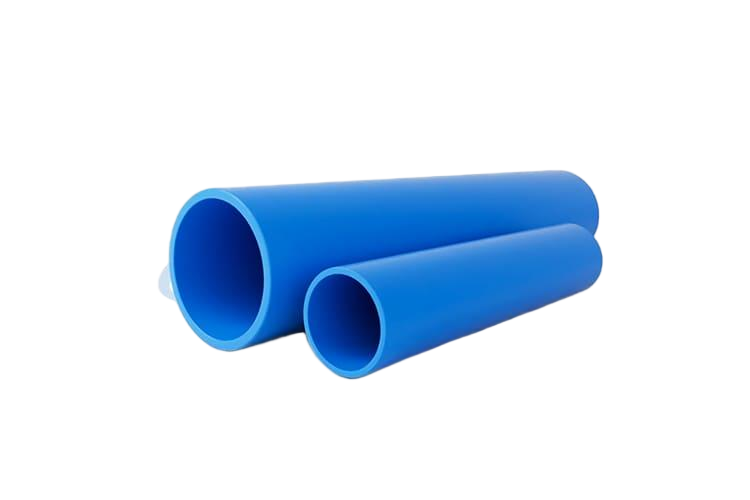
HDPE appears throughout the cold side of a district-cooling network. The table lists the main places; the core fit is the buried chilled-water distribution mains, available in large diameters and, where needed, as pre-insulated pipe.
| Location | Role |
|---|---|
| Chilled-water distribution mains | Buried supply & return — the core fit, large diameter |
| Condenser water loops | Carrying heat-rejection water (warmer, still in range) |
| Make-up water | Replacing network water losses |
| Thermal storage (TES) connections | Linking chilled-water storage tanks |
| Pre-insulated mains | Carrier + foam + HDPE jacket for cold lines |
Corrosion-free = lower lifetime pumping energy
On a network that pumps water around the clock for decades, friction is money. HDPE's smooth, non-corroding bore keeps its Hazen-Williams C-factor high (around 150 for new pipe) and, crucially, keeps it there for life — there's no tuberculation or scaling to roughen it. Steel starts lower and degrades as it corrodes, so designers knock points off its C-factor over a 20–30 year horizon. Across a city-scale chilled-water network, that retained smoothness translates into materially lower lifetime pumping energy — a large operating-cost advantage on top of the capital savings.
Pre-insulated HDPE & condensation control
Cold lines have a design concern that hot lines don't: condensation. Humid ambient air condenses on cold pipe and, if it soaks the insulation, ruins thermal performance and drips onto surrounding equipment. The answer is pre-insulated pipe — an HDPE carrier inside rigid PUR or PIR foam inside a bonded HDPE outer jacket — where the outer jacket also acts as the vapour barrier that keeps moisture out of the foam. On chilled-water lines, the vapour barrier matters as much as the insulation thickness; it's the detail competitors most often miss.
Pressure, SDR/PN & surge
Distribution mains run under pump pressure, so they're specified by PN (the maximum continuous operating pressure in bar at 20 °C), with the SDR chosen to match — ISO 4427 PE systems reach PFA 25 bar. Large pumped networks also see surge from pumps and valves, and here HDPE's ductility and low wave speed help: it absorbs water hammer better than rigid metal. Surge still has to be evaluated, but it's a strength rather than a liability for HDPE chilled-water mains.
HDPE vs steel, ductile iron & GRP
No material is perfect, so the honest comparison matters. HDPE wins on exactly what a chilled-water network needs — corrosion immunity, lifetime-low friction, leak-free fused joints, no cathodic protection, light fast installation. Steel and GRP can win at the very largest diameters and highest pressures, but they bring corrosion management (steel), weight, or jointing complexity. The table summarises it.
| Material | Pros | Cons for chilled water |
|---|---|---|
| Carbon steel | High pressure, very large diameter | Corrodes/tuberculates → fouling + rising pump energy; needs coating + CP; heavy |
| Ductile iron | Strong, large diameter | Corrosion management; heavy; jointed |
| GRP / FRP | Corrosion-free, large diameter, high pressure | Higher cost/skill; not fused-monolithic; brittle handling |
| Pre-insulated steel | Established product, high temp | Carrier corrosion; heavier |
| HDPE / PE100 | Corrosion-free, leak-free fused joints, low friction for life, no derating cold | Diameter/pressure ceiling vs steel; not for hot service |
Standards
HDPE chilled-water pipe is made to ISO 4427 or EN 12201 (PE100), with AWWA C901/C906 in North America. The district-cooling-specific standard is EN 17415, which covers bonded, pre-insulated, directly buried cold-water pipe systems up to DN 1200, with EN 15632 covering flexible pre-insulated systems. Citing EN 17415 — rather than only the older district-heating standards — is the mark of a properly specified chilled-water network. The thermal and surge design remain project-specific.
5 costly mistakes
- Skipping insulation or the vapour barrier on cold lines — condensation soaks the foam, kills performance and drips on equipment.
- Undersizing mains to save capital — higher velocity and friction mean higher pumping energy across a 24/7 network for decades.
- Ignoring surge — even though HDPE tolerates it well, pump and valve transients still need evaluating on large networks.
- Choosing the wrong SDR for the duty pressure — a wall mismatched to the required PN.
- Mis-applying the "HDPE can't take heat" rule — it's true for hot reject and heating loops, but chilled water is HDPE's sweet spot; don't reuse a chilled spec on a hot line either.
References & standards
- [1]International District Energy Association — District cooling overview
- [2]Plastics Pipe Institute (PPI) — District energy — heating & cooling
- [3]PE100+ Association — HDPE PE100 & PE100-RC — properties and types
- [4]SIS / CEN — EN 17415-1 — district cooling pipes (bonded, buried cold)
- [5]ISO — ISO 4427-1 — PE pipes for water supply (general)
- [6]Euroheat & Power — DHC market outlook 2025
- [7]IEA DHC — District heating & cooling connection handbook
- [8]Tabreed — District cooling — what we do
Frequently asked questions
Need expert advice on your project?
Our engineering team helps utilities, contractors and EPCs specify the right pipe material and SDR for their project. Get a no-obligation technical consultation.
Talk to an engineerRead next
Explore further
Related applications, material comparisons and country buying guides selected for this topic.