Guide
HDPE Pipe Color Coding & Stripe Identification: A Region-by-Region Guide (2026)
Pipe stripe colors vs the APWA locate code, why gas is yellow in the US but orange in Europe, and why only black pipe is UV-stable.
Dr. Wei Liu, P.E.
Senior Engineering Manager · Primepoly
Published: Jun 7, 2026
Updated: Jun 7, 2026
11 min read
Pipe color is supposed to make identification simple — yet it causes more confusion than almost any other spec, because two unrelated color systems share several of the same colors. One is the color of the pipe (or its co-extruded stripes), set by manufacturing standards; the other is the APWA code painted on the ground to mark buried utilities before digging. This guide separates the two, then maps HDPE pipe colors region by region so you order the right stripe for the right market.
Two color systems people confuse
System A is the pipe's own color — the color of the polyethylene wall or the longitudinal stripes co-extruded into it during manufacture, governed by pipe product standards (ISO 4427, EN 12201, AS/NZS 4130, AWWA C901/C906, GB/T 13663, GB 15558). System B is the APWA Uniform Color Code: the paint and flag colors a locator sprays on the ground to mark buried utilities before excavation — a North American locate-marking standard tied to the “call before you dig” process. They overlap on a few colors (blue for water in both), which is exactly why buyers conflate them.
Why most HDPE pipe is black: carbon black & UV
Most buried and exposed HDPE pipe is black because carbon black is its UV stabiliser — typically about 2–2.5% by weight, finely and uniformly dispersed. Carbon black screens and absorbs UV, scavenges the free radicals that degrade the polymer, and dissipates the energy as heat, cutting UV degradation dramatically and enabling decades of service in sunlight. The practical consequence: UV protection comes from the black base, so solid-color (blue, yellow, orange) pipe is not equivalently UV-stable and is meant for buried or short-exposure use. For long sun exposure, specify black pipe with colored identification stripes.
Solid color vs co-extruded stripes
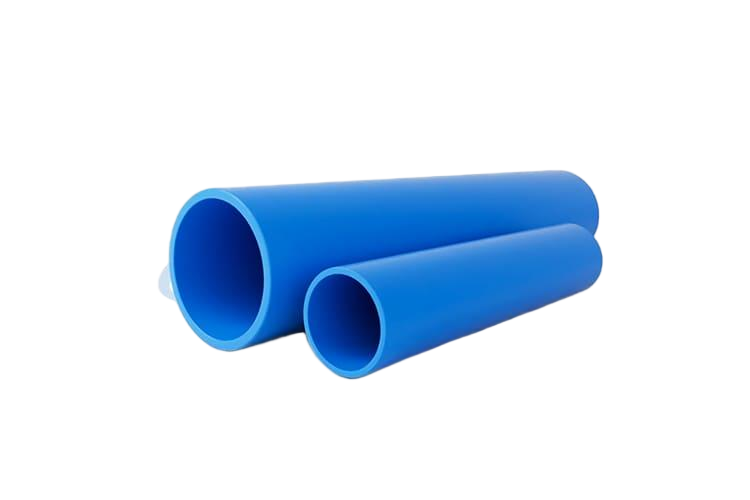
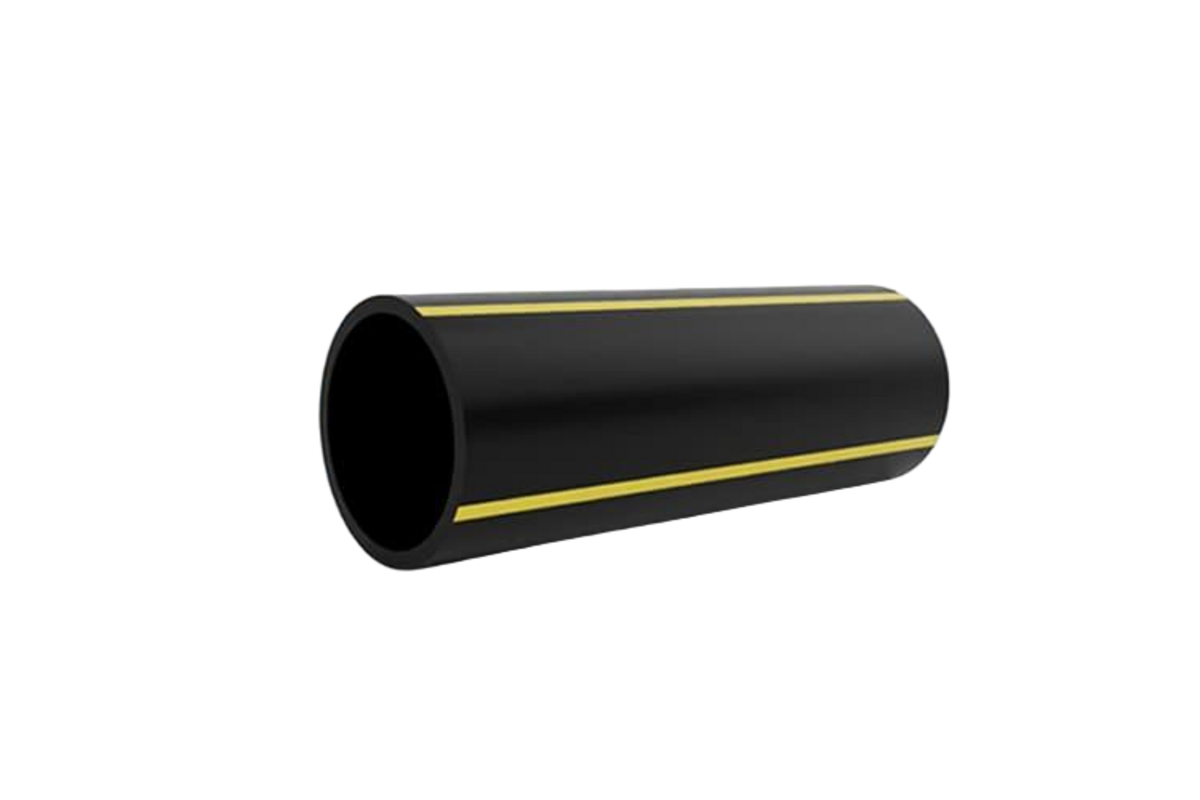
There are two ways a pipe is color-coded. Larger pressure pipe is usually black with three or four co-extruded longitudinal stripes spaced around the circumference, so the application color is visible from any angle while the black base provides UV resistance. Smaller medium-density service pipe is often solid color (solid blue water, solid yellow gas). The stripe color identifies the application — it does not by itself tell you the pressure class, material grade or potability certification, which come from the printed legend and standard marking.
Pipe color by region: the master table
The same application can be a different pipe color in different markets — the single biggest source of cross-border ordering errors. The table maps the main applications across the four major standards regions.
| Application | USA (AWWA/ASTM) | Europe (ISO/EN) | Australia/NZ & China |
|---|---|---|---|
| Potable water | Black + blue stripe (or solid blue) | Blue, or black + blue stripe | Blue (AS/NZS); blue/black+blue (China) |
| Gas | Yellow (solid or yellow stripe) | Orange (PE100); yellow (PE80) | Yellow (AS/NZS); orange PE100 (China) |
| Reclaimed / recycled water | Black + purple (lilac) stripe | Purple / lilac (where adopted) | Purple / lilac (AS/NZS) |
| Sewer / wastewater | Black + green stripe (varies) | Brown / black (varies) | Cream (AUS pressure sewer) |
| Fire protection | Black + red stripe (FM) | Red (varies) | Red (varies) |
| Telecom / fiber duct | Orange (operator-specific) | Operator-specific | Operator-specific |
| Electrical / power conduit | Red (or red stripe) | Red / orange (varies) | Orange / red (varies) |
Gas: why orange ≠ yellow across regions
Gas is the clearest example of regional divergence. In the United States, gas PE pipe is yellow — solid-yellow medium-density pipe or black with yellow stripes (ASTM D2513) — and orange means telecom/communications. In Europe and under ISO, gas PE100 is orange (older PE80 is yellow), and China's GB standard mirrors that with orange stripes for PE100 and yellow for PE80. So “orange = gas” is correct in the EU and China but wrong in the US, where it signals comms — order the stripe color for the destination market, not your own.
Reclaimed water, sewer & fire-protection colors
Beyond water and gas, reclaimed/recycled water is widely identified by purple or lilac (in the US, Australia and beyond). Fire-protection mains are commonly black with red stripes (AWWA C906, FM-listed). Sewer and wastewater are the most variable — green stripes in the US, cream for pressure sewer in Australia, and often brown or black in Europe — as are telecom and electrical ducts, which are operator-specific (often orange duct in the US). Treat sewer, fire and telecom colors as region- and spec-dependent, and always confirm against the project specification.
The APWA Uniform Color Code (locate marking)
The APWA Uniform Color Code is the North American standard for temporarily marking buried utilities on the ground before excavation — the colors a locator paints or flags after a “call 811” request. It is paint on the ground, valid for a couple of weeks, and it is not a pipe-manufacturing standard. Its overlap with US pipe stripe colors (blue water, yellow gas, green sewer, purple reclaimed) is part of why the two systems get confused.
| APWA color | Marks (buried utility located) |
|---|---|
| Red | Electric power, cables, conduit, lighting |
| Yellow | Gas, oil, steam, petroleum |
| Orange | Communications, telecom, alarm/signal |
| Blue | Potable water |
| Green | Sewers and drain lines |
| Purple | Reclaimed water, irrigation, slurry |
| White | Proposed excavation route |
| Pink | Temporary survey markings |
The standards behind the colors
Pipe color and stripes are set by the pipe product standards: ISO 4427 and EN 12201 (water — blue or black with blue stripes, blue reserved for potable), AS/NZS 4130 (Australia/NZ — blue water, purple recycled, yellow gas), AWWA C901/C906 (US — blue, green, purple, red stripes on PE4710), and China's GB/T 13663 (water) and GB/T 15558.2 (gas — orange PE100, yellow PE80). The APWA Uniform Color Code is a separate locate-marking standard. In all cases, the local utility or project specification overrides any general convention.
Which stripe color to order
5 costly color-coding mistakes
- Assuming “orange = gas” globally. Orange is gas (PE100) in the EU and China, but in the US gas is yellow and orange means telecom — order for the destination market.
- Confusing the APWA locate colors with pipe colors. The paint-on-ground code is a different system from the manufactured pipe/stripe color; they only share some colors by coincidence.
- Ordering the wrong stripe color for the destination market — a pipe striped to US convention may not satisfy an EU/ISO, AUS/NZS or China spec (yellow vs orange gas, green vs cream sewer).
- Assuming colored pipe is UV-stable. Only black, carbon-black pipe is fully UV-resistant; solid blue/yellow/orange pipe degrades in long sun exposure — specify black with stripes instead.
- Treating stripe color as the spec. Color identifies application only — not pressure class, material grade (PE80 vs PE100) or potability. The printed legend and standard, and the project spec, are authoritative.
Glossary
- Co-extruded stripe
- A colored longitudinal stripe extruded into a black pipe (usually 3–4 around the circumference) to identify the application while keeping the UV-resistant black base.
- APWA Uniform Color Code
- The North American standard for temporary paint/flag colors used to mark buried utilities before digging — a locate-marking system, not a pipe color.
- Carbon black
- The black UV stabiliser in HDPE pipe (~2–2.5% by weight); it screens UV and scavenges free radicals, giving decades of sunlight resistance.
- Reclaimed-water purple
- The purple/lilac color widely used to identify recycled/reclaimed (non-potable) water pipe in the US, Australia and elsewhere.
- Solid-color vs striped pipe
- Solid-color (often smaller MDPE service) pipe vs black pipe with colored stripes; only the black-based striped pipe is fully UV-stable.
- Potable blue
- Blue, or black with blue stripes, reserved for drinking-water pipe under ISO 4427 / EN 12201 / AWWA conventions.
References & standards
- [1]APWA — Uniform Color Code (utility locate marking)
- [2]APWA — Uniform Color Code — PDF chart
- [3]Plastics Pipe Institute (PPI) — AWWA C-906 application (PE pressure pipe & stripes)
- [4]Plastics Pipe Institute (PPI) — About HDPE conduit (power & communications, ASTM F2160)
- [5]ISO — ISO 4427-2 — PE water pipes (color/stripe requirements)
- [6]PIPA (Australia) — AS/NZS 4130 technical note (PE pressure pipe)
- [7]PIPA (Australia) — POP203 — identification of buried pipe systems
- [8]Birla Carbon — Carbon black prolongs the life of plastic pipe (UV)
Frequently asked questions
Need expert advice on your project?
Our engineering team helps utilities, contractors and EPCs specify the right pipe material and SDR for their project. Get a no-obligation technical consultation.
Talk to an engineerRead next
Explore further
Related applications, material comparisons and country buying guides selected for this topic.