Guide
Connecting HDPE Pipe: Flanges, Stub Ends & Mechanical Joints (2026)
How to connect fused HDPE to valves, pumps and metal or PVC pipe — the stub-end flange, the mandatory re-torque, internal stiffeners, and restraint at transitions.

Dr. Wei Liu, P.E.
Senior Engineering Manager · Primepoly
Published: Jun 8, 2026
Updated: Jun 8, 2026
13 min read
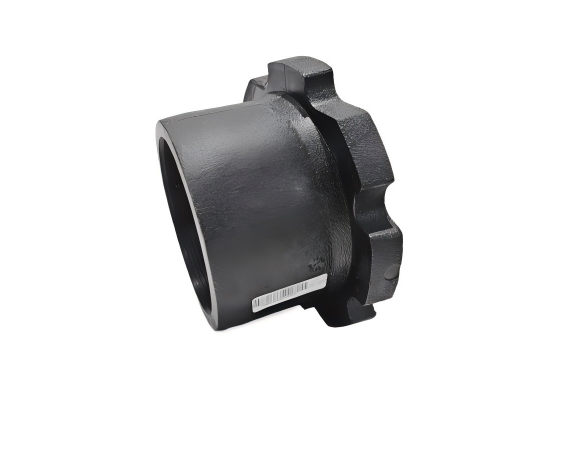
Fused HDPE makes a monolithic, leak-free pipeline — but eventually it has to meet a valve, a pump, a meter, or an existing steel or PVC line, and that's where connections get interesting. HDPE creeps, moves with temperature and is flexible, so connecting it isn't quite like connecting metal: get the restraint, the re-torque or the stiffener wrong and the joint leaks or pulls apart. This guide covers the flanged stub-end connection, mechanical joints, and the three things every competitor half-covers — end-load restraint, PE creep, and internal stiffeners.
Why connecting HDPE is different: it creeps, moves & is flexible
Three material facts shape every HDPE connection. First, PE creeps under load — so a bolted gasket relaxes over hours and must be re-torqued. Second, PE moves: it contracts under internal pressure (the Poisson effect) and with temperature, putting axial pull on joints. Third, the wall is flexible — so a mechanical coupling clamping onto bare PE can crush or slip off it. Fused and properly flanged joints handle all three by being self-restrained; mechanical connections need stiffeners and restraint to compensate.
The flanged connection: stub end + backing ring
The standard way to connect HDPE to any flanged valve, pump or metal pipe is a two-part system: a stub end (flange adapter) is butt-fused or electrofused to the HDPE, and a loose metal backing ring slips over the pipe behind it. The stub-end face provides the seal; the backing ring carries the bolt load, isolating the PE from bolt stress. It's a fully restrained joint that needs no external restraint — and the backing ring's bolt drilling must match the mating flange (ASME B16.5 in North America, EN 1092 in Europe).
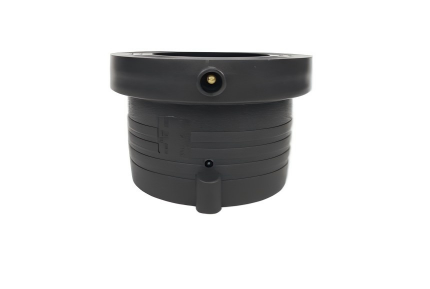
Step-by-step flange assembly
The assembly order matters — one missed step means cutting the fitting off. The sequence below follows the recognised practice.
- Slide the metal backing ring onto the pipe FIRST — before fusing the stub end (forget it and the stub must be cut off).
- Butt-fuse or electrofuse the stub end (flange adapter) to the pipe per ASTM F2620.
- Align the two flange faces square and concentric — avoid beam-bending strain on the adapter.
- Fit the gasket if used, or rely on the self-sealing PE face for a non-gasketed joint.
- Tighten the bolts in a criss-cross / star pattern over four rounds to the calculated target torque.
- Re-torque all bolts 4 to 24 hours later to compensate for PE creep-relaxation — then pressure-test.
Bolt torque & the mandatory re-torque
Bolt torque on a PE flange is calculated, not looked up — it's derived from the PE face seating stress (about 1,200–1,800 psi over the contact area), the bolt count and a nut factor, so published torque tables are illustrative only. Tighten in a star pattern over four rounds. The step everyone forgets is the re-torque: because PE creeps and relaxes, the bolts must be re-torqued 4 to 24 hours after initial tightening, before commissioning. And don't over-torque — you'll crush the stub-end face or crack a brittle PVC or fibreglass mating flange.
Mechanical connections: MJ adapters, couplings & transition fittings
Where fusion or flanging isn't the answer, several mechanical options exist. MJ (mechanical joint) adapters are fused to the HDPE and seat into a ductile-iron MJ bell — they both seal and restrain. Compression and mechanical couplings suit small sizes, service lines and repairs. Transition fittings provide a factory-made PE-to-metal joint. And sleeve-style couplings (Dresser, Gibault) handle repairs and transitions — but these are typically unrestrained, so they're unsafe on HDPE under end-load unless restraint is added.
PE stiffeners: why mechanical couplings need internal support
Because the PE wall is flexible, most mechanical and compression couplings need an internal stiffener — a support sleeve inserted into the pipe bore under the coupling's seal and grip rings. Without it, the coupling can crush or deflect the wall, losing the seal or letting the pipe pull out. Stiffeners come as fixed-diameter inserts (matched to the pipe ID, so sized to the DR) or thin stainless split rings that minimise flow obstruction. Always specify a stiffener sized to the pipe's ID and wall when using a compression connection on HDPE.
Connecting HDPE to steel, ductile iron & PVC
Connecting HDPE to another material is a routine job with a few standard routes. The most common is the flanged stub-end + backing ring, which bolts to any flanged metal or PVC component. For ductile-iron waterworks, an MJ adapter ties into the MJ bell. Transition fittings give a direct PE-to-metal joint, and compression couplings (with a stiffener) work for smaller sizes. Whichever route, the recurring issues are the same: restrain against end-load, allow for PE creep (re-torque), and don't over-torque a brittle mating flange.
End-load, the Poisson effect & restraint at transitions
Fused HDPE is self-restrained, which is why fused mains need no thrust blocks — the pipe carries its own end-load. The problem appears at transitions to gasketed or unrestrained systems: under pressure, PE contracts longitudinally (the Poisson effect), and with temperature it shrinks, and that axial pull can drag an unrestrained bell-and-spigot or sleeve joint apart. The fix is to restrain several joints in-line at the transition, or restrain the transition fitting and add an in-line anchor in the HDPE close by, accounting for pressure, Poisson and thermal forces.
Choosing the right method
Match the connection to the duty — permanent vs removable, the mating material, and whether end-load is present. The table and the path below resolve most cases.
| Method | Best for | Restrained? |
|---|---|---|
| Butt / electrofusion | Permanent buried mains | Yes — self-restrained, no thrust blocks |
| Flanged stub end + backing ring | Valves, pumps, meters; HDPE-to-metal; future disassembly | Yes |
| MJ adapter | Tie-in to ductile-iron waterworks fittings/valves | Yes |
| Compression / mechanical coupling (+ stiffener) | Small sizes, service, repairs, no fusion gear | Varies — verify |
| Sleeve / Dresser / Gibault coupling | Repairs & transitions | No — add restraint |
| Transition fitting (PE-to-metal) | HDPE-to-steel | Usually yes |
5 common connection mistakes
- No PE stiffener in a compression coupling — the flexible wall collapses or the pipe pulls out.
- Not re-torquing flange bolts after PE creep-relaxation (4–24 hours) — the joint weeps.
- Over-torquing — crushing the stub-end face, or cracking a brittle PVC or fibreglass mating flange.
- Using an unrestrained (Dresser-style) coupling where end-load (Poisson / thermal) is present — the joint pulls apart.
- Mismatched flange drilling or face — ASME B16.5 vs EN 1092, wrong bolt circle, or raised-face vs flat — so it won't mate or seal.
Glossary
- Stub end (flange adapter)
- A short fitting fused to the HDPE whose face provides the flange seal; the single-use part of a flanged joint.
- Backing ring
- A loose metal ring (back-up flange) behind the stub end that carries the bolt load and isolates the PE; reusable.
- Re-torque
- Re-tightening flange bolts 4–24 hours after assembly to compensate for PE creep-relaxation — mandatory, not optional.
- PE stiffener
- An internal support sleeve inserted in the pipe bore under a mechanical/compression coupling so the flexible wall isn't crushed or pulled out.
- Poisson effect
- Longitudinal contraction of PE under internal pressure that creates axial pull on joints — a cause of pull-out at unrestrained transitions.
- Transition fitting
- A factory-made fitting providing a restrained PE-to-metal joint without on-site fusion.
References & standards
- [1]Plastics Pipe Institute (PPI) — Handbook of PE Pipe, Ch. 9 — joining procedures
- [2]Plastics Pipe Institute (PPI) — TN-38 — bolt torque for PE flanged joints
- [3]Plastics Pipe Institute (PPI) — TN-36 — connecting HDPE to DI & PVC systems
- [4]Plastics Pipe Institute (PPI) — TN-45 — connecting PE to other piping materials
- [5]PIPA — POP007 — flanged joints for polyethylene pipe
- [6]AWWA — AWWA C906 — PE pressure pipe & fittings
- [7]Victaulic — HDPE pipe connections / mechanical joining
- [8]McWane Ductile — Connecting other materials to ductile iron pipe
Frequently asked questions
Need expert advice on your project?
Our engineering team helps utilities, contractors and EPCs specify the right pipe material and SDR for their project. Get a no-obligation technical consultation.
Talk to an engineerRead next
Explore further
Related applications, material comparisons and country buying guides selected for this topic.