Application
HDPE Pipe for Fire Protection: Underground Firewater Mains (2026)
Why a main that never corrodes keeps fire flow reliable for life — the FM 1613 / NFPA 24 / AWWA C906 standards, red-stripe ID, restraint and connections.

Dr. Wei Liu, P.E.
Senior Engineering Manager · Primepoly
Published: Jun 7, 2026
Updated: Jun 7, 2026
12 min read
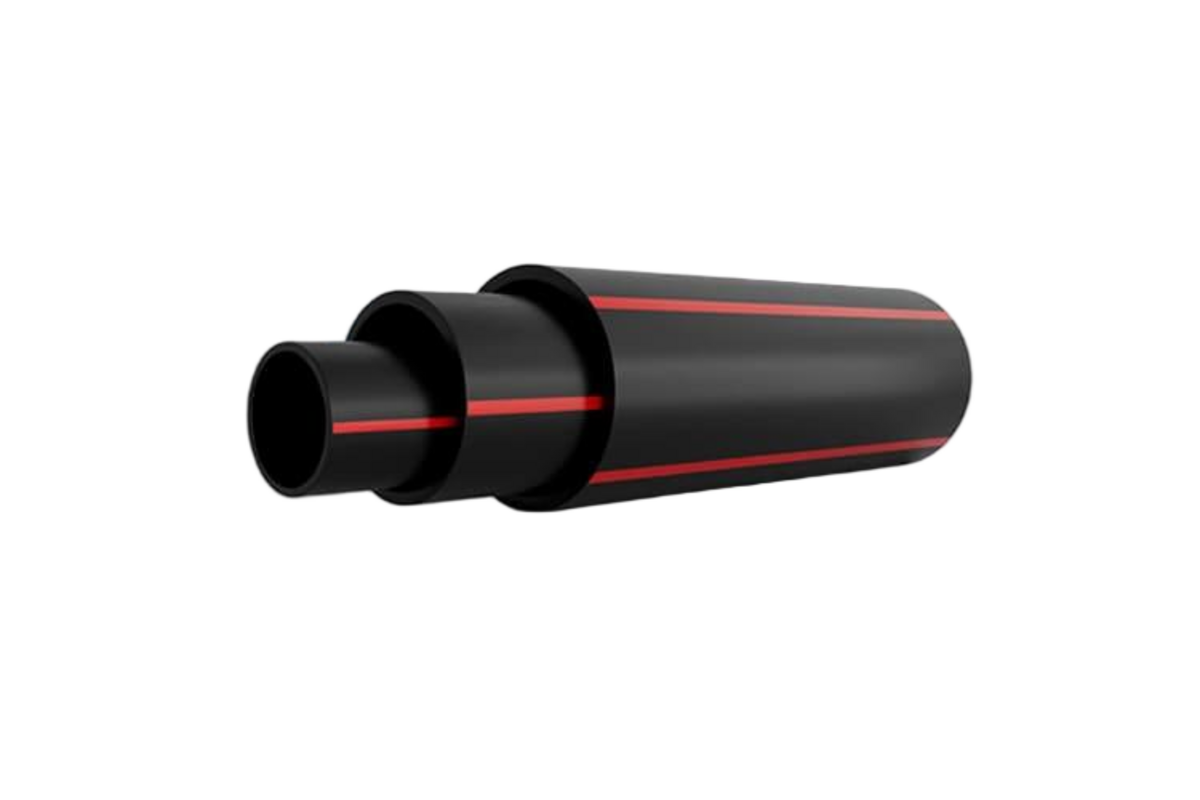
A fire main has one job: deliver the design fire flow, reliably, decades after it was installed. Metal mains struggle with that — they corrode and tuberculate, and as the bore roughens the available fire flow quietly declines. HDPE doesn't corrode, so its bore stays smooth and its fire flow stays reliable for the life of the system. This guide covers where HDPE belongs in a fire-protection system, the approvals that govern it, and how to specify, restrain and connect an underground firewater main correctly.
Where HDPE fits in a fire system (and where it doesn't)
It's essential to draw the boundary correctly. HDPE is used for the underground private fire service main — the buried pipe carrying water from the public main or tank to the building's fire appurtenances. It is not used for the aboveground interior sprinkler and standpipe piping, which is steel or listed CPVC under NFPA 13 and 14. Getting this wrong is the single most common confusion: HDPE is the buried supply main, full stop.
Standards & approvals that govern fire-main HDPE
Fire-main HDPE sits in a stack of standards: the pipe is made to AWWA C906 (with red stripes for fire), it must carry a fire-service listing — FM Approvals 1613 and/or a UL listing — and it's installed under NFPA 24 for private fire service mains. Crucially, generic red-striped AWWA C906 water pipe is not automatically accepted for fire service; the pipe must be listed/approved for fire-main use, and the local Authority Having Jurisdiction (AHJ) decides what listings are required.
| Standard | What it is | Fire-main role |
|---|---|---|
| AWWA C906 | PE pressure pipe & fittings, 4–65 in. | Base product standard; red stripes for fire |
| FM Approvals 1613 | Examination std for PE underground fire pipe | Fire-specific approval (NPS 4–36 in) |
| UL listing | Listing for fire service main use | Alternative/additional listing path |
| NFPA 24 | Installation of private fire service mains | Governs the buried main; ≥150 psi rating |
| NFPA 13 / 14 | Sprinkler / standpipe systems | Interior aboveground piping (not HDPE) |
| ISO 4427 | International PE water pipe (PE100) | Export / non-US equivalent product standard |
| Local AHJ | Authority Having Jurisdiction | Decides acceptance & required listings |
Why HDPE keeps fire flow reliable for decades
The reliability argument is what makes HDPE compelling for firewater. Because it's a non-metallic, inert material, it never corrodes, tuberculates or scales — so its Hazen-Williams C factor stays around 150 for the life of the main, and the design fire flow stays available. A metal main, by contrast, loses bore as it tuberculates, so its real fire flow declines over the decades. The table summarises the properties that underpin that reliability.
| Property | Detail |
|---|---|
| Corrosion immunity | Non-metallic; never rusts, tuberculates or scales |
| Fire flow over life | Hazen-Williams C ≈ 150 held for life vs declining metal mains |
| Leak-free joints | Fused joints stronger than the pipe; no gaskets to leak |
| Surge tolerance | ~22 psi per 2 ft/s vs ~100 psi for ductile iron |
| Seismic / ground movement | Flexible; rides out settlement and seismic events |
| Install | Lightweight; trenchless-capable; fewer joints |
Leak-free joints, surge tolerance & seismic performance
A fused HDPE main is monolithic: butt-fusion and electrofusion joints are stronger than the pipe itself, with no gaskets to leak or pull out under the pressure transients a fire system sees. HDPE also tolerates surge far better than metal — roughly 22 psi of surge per 2 ft/s velocity change versus around 100 psi for ductile iron — so pump starts and valve operations don't stress the joints. And its flexibility lets it ride out ground movement, seismic events and settlement without failing, all of which matter for a system that must work on its worst day.
Red-stripe identification & pressure ratings
Fire-main HDPE is identified by red co-extruded stripes on otherwise-black pipe (blue is potable water, yellow is gas). Pressure ratings follow the usual DR/class system — DR11 is Class 200 (200 psi), DR9 is Class 250, DR7 is Class 335 — and NFPA 24 requires the main to be rated for the maximum system working pressure including surge, and not less than 150 psi. FM 1613 covers nominal sizes from 4 in to 36 in. Select the DR for your working-plus-surge pressure, never below the 150 psi floor.
Restraint: self-restrained except at connections
A continuously fused HDPE main carries thrust within itself, so it needs no thrust blocks along the fused run — a real installation saving. The exception is the mechanical connections at the ends: where HDPE meets a hydrant, gate or post-indicator valve, a fire pump, or a ductile-iron main, the joint is not fused and must be restrained. Use restrained mechanical-joint adaptors, flange adaptors and transition fittings at those points, with proper anchorage.
Connecting to hydrants, PIVs, pumps & risers
HDPE connects to the rest of the fire system through three fitting types. Flange adaptors — a butt-fused HDPE stub with a backup ring — bolt to flanged valves, fire pumps and risers. Mechanical-joint adaptor kits (with a stainless stiffener) connect to ductile-iron mechanical-joint hydrants and valves; use the restrained versions. And mechanical transition fittings join HDPE to DI or PVC. The targets are the usual fire appurtenances: hydrants, post-indicator valves, fire-pump suction and discharge, and the base of sprinkler and standpipe risers.
HDPE vs ductile iron vs steel for fire mains
Against metal fire mains, HDPE's advantages are corrosion immunity, stable fire flow, leak-free self-restrained joints, surge tolerance, seismic resilience and lower installed cost. The table compares the three on the factors that matter for a buried fire main — with the caveat that local code and the AHJ have the final say on what's accepted.
| Factor | HDPE (PE4710) | Ductile iron | Steel |
|---|---|---|---|
| Corrosion / tuberculation | Immune | Needs lining; tuberculates | Corrodes; needs coating |
| C factor over life | ≈150, stable | Starts high, declines | Declines |
| Joints | Fused, self-restrained | Gasketed; needs restraint | Welded / grooved |
| Surge (per 2 ft/s) | ~22 psi | ~100 psi | High |
| Seismic / ground movement | Excellent | Rigid | Rigid |
| Weight / install | Light, trenchless | Heavy | Heavy |
| Installed cost | Often lower | Higher | Higher |
Fire-main spec check
5 common buyer mistakes
- Specifying HDPE for the wrong part of the system — trying to use it for aboveground interior sprinkler piping instead of the buried main (that's steel or CPVC).
- Skipping the FM 1613 / UL listing check — buying generic red-striped AWWA C906 water pipe and assuming it's accepted for fire service; NFPA 24 and the AHJ require a fire-service listing.
- Forgetting restraint at transitions — assuming "fused HDPE needs no thrust blocks" applies to the mechanical connections at hydrants, valves and DI mains too.
- Under-rating for surge — sizing to static pressure only and ignoring water hammer from fire pumps and valve operation; pick the DR for working-plus-surge, never below 150 psi.
- Not confirming AHJ acceptance early — many local fire-underground standards still default to PVC or ductile iron; confirm HDPE acceptance and required listings at plan review, not after purchase.
Glossary
- Private fire service main
- The buried pipe (NFPA 24) carrying water from the source to a property's hydrants, valves, fire pumps and riser bases — where HDPE is used.
- FM 1613
- The FM Approvals examination standard for PE pipe and fittings for underground fire protection (NPS 4–36 in).
- NFPA 24
- The standard for the installation of private fire service mains and their appurtenances.
- AWWA C906
- The PE pressure pipe & fittings product standard (4–65 in); fire pipe carries red identification stripes.
- AHJ
- Authority Having Jurisdiction — the local body that decides whether HDPE is accepted for fire service and which listings are required.
- Restrained transition
- A restrained mechanical-joint or flange adaptor used where fused HDPE connects to hydrants, valves, pumps or DI mains.
References & standards
- [1]FM Approvals — FM Approved HDPE pipe and fittings (fire protection)
- [2]FM Approvals — Standard 1613 — PE pipe & fittings for underground fire protection
- [3]AWWA (ANSI webstore) — AWWA C906 — PE pressure pipe and fittings, 4–65 in.
- [4]NFPA — NFPA 24 — installation of private fire service mains
- [5]Plastics Pipe Institute (PPI) — AWWA C-906 application overview
- [6]Plastics Pipe Institute (PPI) — TN-36 — connecting HDPE water piping
- [7]Performance Pipe (Chevron Phillips) — DriscoPlex 4000/4100 FM series — underground fire main
- [8]ISCO Industries — Underground HDPE piping guidelines for fire protection
Frequently asked questions
Need expert advice on your project?
Our engineering team helps utilities, contractors and EPCs specify the right pipe material and SDR for their project. Get a no-obligation technical consultation.
Talk to an engineerRead next
Explore further
Related applications, material comparisons and country buying guides selected for this topic.