Application
HDPE Pipe for Aquaculture: Fish Cages, Net Pens & Farm Piping (2026)
Why fish farms float on polyethylene — corrosion-free, wave-flexing cage collars, plus the standards, sizing and the rest of the farm's pipework.

Dr. Wei Liu, P.E.
Senior Engineering Manager · Primepoly
Published: Jun 8, 2026
Updated: Jun 8, 2026
12 min read
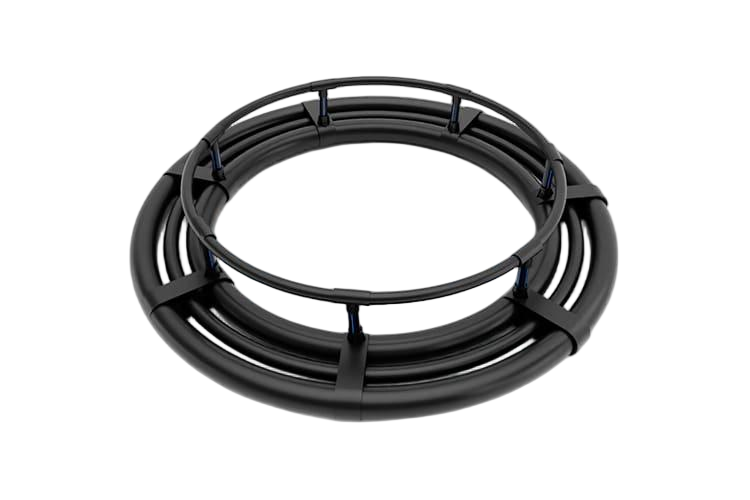
Walk any modern marine fish farm and the circular collars holding the nets are almost always polyethylene. HDPE is corrosion-proof in seawater, flexes with the waves instead of fatigue-cracking like steel, is food-safe and UV-stable, and fuses into closed, leak-free floating rings. This guide covers HDPE for aquaculture: how a floating cage is built and sized, why it survives storms, the standards that govern it, and the rest of the pipework a farm runs on — from predator nets to recirculating systems.
Why HDPE is the standard material for aquaculture
Polyethylene answers every demand of a fish farm at once. It never corrodes in seawater, so there's no coating or cathodic protection to maintain; it's UV-stable in black; it's food-safe and inert, leaching nothing into the water column; and its butt-fused joints make monolithic, leak-free closed rings. Above all it's flexible — the collar flexes with waves and swell and dissipates that energy, where a rigid steel or concrete frame concentrates stress and fatigues. That combination is why HDPE dominates exposed and offshore sites.
Anatomy of an HDPE floating fish cage
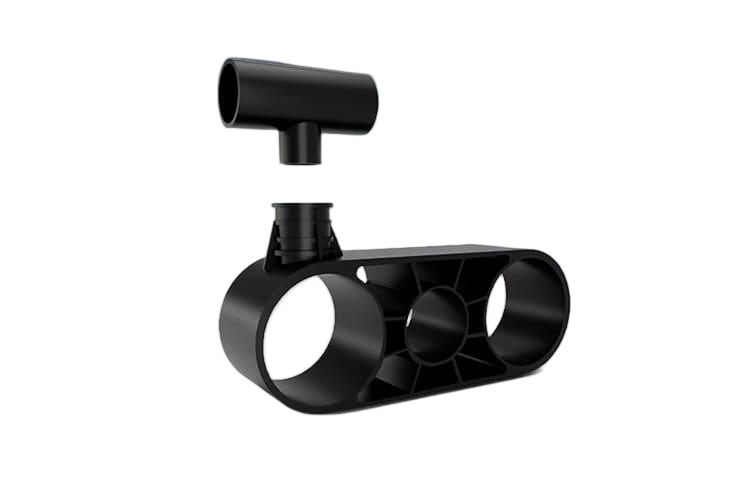
A floating cage collar is built from two (sometimes three) concentric HDPE floating pipes, each butt-fused into a fully closed circular ring. Injection-molded plastic stanchion brackets clamp the rings together at regular spacing and carry the uprights, and a smaller handrail pipe sits on those uprights above a walkway. The sealed, air-filled rings provide the buoyancy that supports and shapes the net hung beneath. Everything structural is polyethylene, joined by fusion and molded brackets — no metal to corrode.
Cage sizing: floating-pipe OD, circumference & brackets
Cages are specified by their floating-pipe diameter and circumference, with the handrail always smaller than the floating pipe and brackets spaced to set the ring stiffness. The table gives representative ranges from the leading cage systems; treat them as a guide, because the actual collar buoyancy must be engineered against the net, biofouling and wave loads for the specific site — it isn't a catalogue pick.
| Floating pipe OD | Circumference | Handrail OD | Bracket spacing |
|---|---|---|---|
| 225 / 250 mm | 40–90 m | 110 mm | 2.0 m |
| 315 mm | 60–100 m | 125 mm | 2.0 m |
| 400 mm | 90–160 m | 140 mm | 2.5 m |
| 450 mm | 120–160 m | 160 mm | 2.5 m |
| 500 mm | 130–200 m | 180 mm | 2.7 m |
| 630 mm | 160–260 m | 180 mm | 2.7 m |
Buoyancy & load: net, biofouling, waves
The floating-pipe diameter and buoyancy reserve have to balance against several loads that grow over a season: the weight of the net, the biofouling that accumulates on it and dramatically increases drag and weight, the wave and current forces on the whole structure, and the live load of crew on the walkway. Undersize the floating pipe and the cage loses freeboard and buoyancy reserve exactly when a storm needs it most. Sizing the collar buoyancy is specialist marine engineering, not a fixed number.
Storm survivability: why flexible rings outlast rigid frames
The single biggest reason HDPE dominates exposed aquaculture is its behaviour in a storm. Flexible PE rings deform under wave action and dissipate the incident wave energy, riding the swell without accumulating fatigue. A rigid frame, by contrast, concentrates cyclic stress at its joints and fatigues until it fails. That's why the most exposed and offshore farms run on polyethylene — though survivability itself is always site- and design-specific under the cage standard, not a blanket guarantee.
Standards: NS 9415 vs ISO 4427
Two standards govern aquaculture HDPE, and they cover different things. NS 9415 — the Norwegian standard for floating aquaculture farms, the global benchmark — governs the cage structure and mooring: site survey, load analysis, the floating collar and the mooring grid, with the purpose of preventing fish escape, and it sets a minimum 10-year design life for the collar. ISO 4427 governs the PE pressure pipe itself — material, dimensions, SDR and testing — and applies to the farm's intake, outfall and process piping. Don't assume an ISO 4427 pipe certificate proves cage compliance; that's NS 9415.
| Standard | What it governs |
|---|---|
| NS 9415 | The cage structure & mooring (collar, grid, escape prevention); ≥10-yr collar life |
| ISO 4427 | The PE pressure pipe itself — material, dimensions, SDR, testing |
| Applies to | NS 9415 → cage/mooring; ISO 4427 → intake/outfall/RAS pipework |
Beyond cages: other HDPE uses in aquaculture
- Predator and bird-net frames and supports around the cages.
- Walkways, jetties and pontoons for crew access.
- Mooring and grid systems — anchor lines, grid pipes and buoys (per NS 9415).
- Oxygen and aeration / diffuser lines for dissolved-oxygen control.
- Seawater intake and outfall pipelines, often weighted and submerged.
- Recirculating aquaculture system (RAS) process piping for tanks and hatcheries.
- HDPE geomembrane pond liners (sheet, not pipe) for land-based farms.
- Feed-delivery lines and dead-fish (mortality) collection pipes.
Joining: butt fusion & molded brackets
The rings are made by butt fusion, which welds the pipe into a homogeneous, full-strength closed loop with no gasket to fail. Injection-molded brackets and stanchions then mechanically connect the concentric rings, uprights and handrail into the collar. For the farm's process pipework — intakes, outfalls and RAS lines — electrofusion and standard PE fittings handle the connections, exactly as for any water system.
5 common buyer mistakes
- Undersizing the floating-pipe OD for the net, biofouling and metocean loads — losing freeboard and buoyancy reserve in a storm.
- Ignoring NS 9415 / mooring engineering — buying a collar without a site-specific, engineered mooring grid (a leading escape and failure cause).
- Confusing the two standards — assuming an ISO 4427 pressure-pipe certificate covers the cage's structural compliance (that's NS 9415).
- Specifying non-UV-stabilised or low-grade / re-ground PE — premature embrittlement; insist on virgin PE80/PE100 with carbon-black UV stabilisation.
- Poor butt-fusion or under-spec brackets — bad welds or weak brackets create fatigue points that fail under cyclic wave loading.
Glossary
- Floating collar
- The ring structure of a fish cage — concentric butt-fused HDPE floating pipes plus handrail, providing buoyancy and supporting the net.
- Floating pipe
- The main large-diameter HDPE rings (≈225–630 mm) whose sealed, air-filled volume gives the collar its buoyancy.
- Stanchion bracket
- An injection-molded plastic part that clamps the concentric rings together and carries the uprights and handrail.
- NS 9415
- The Norwegian standard for floating aquaculture farms — governs cage and mooring design to prevent fish escape; ≥10-year collar design life.
- Mooring grid
- The anchored framework of lines, grid pipes and buoys that holds the cages on station, engineered per site under NS 9415.
- Biofouling
- Marine growth on the net and structure that greatly increases drag and weight over a season — a key load in collar sizing.
References & standards
- [1]FAO — Aquaculture operations in floating HDPE cages — a field handbook
- [2]Standards Norway — NS 9415 — floating aquaculture farms (sector page)
- [3]Standards Norway — NS 9415 standard (English product page)
- [4]ISO — ISO 4427-1 — PE piping systems for water supply (general)
- [5]ISO — ISO 4427-2 — PE pipes for water supply (pipes)
- [6]AKVA group — Plastic pens — model specifications (PE100, NS 9415)
- [7]AKVA group — Plastic pens overview
- [8]Journal of Marine Science & Engineering — Offshore fish farms — review of design standards (NS 9415)
Frequently asked questions
Need expert advice on your project?
Our engineering team helps utilities, contractors and EPCs specify the right pipe material and SDR for their project. Get a no-obligation technical consultation.
Talk to an engineerRead next
Explore further
Related applications, material comparisons and country buying guides selected for this topic.