Application
HDPE Pipe for Mining Slurry & Tailings: Abrasion, Wear Life & Design (2026)
Why polyethylene became the default for tailings and slurry lines — the abrasion physics, the honest limits versus rubber-lined steel, and how to design for wear.

Dr. Wei Liu, P.E.
Senior Engineering Manager · Primepoly
Published: Jun 8, 2026
Updated: Jun 8, 2026
13 min read
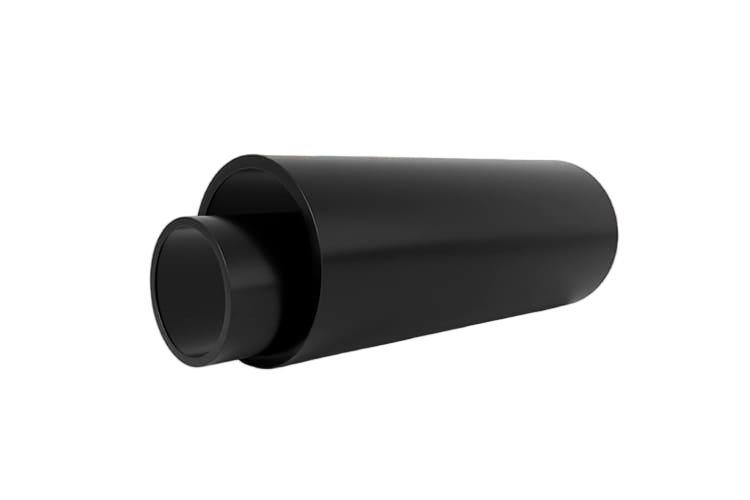
Across the world's mines, tailings, concentrate and heap-leach lines increasingly run on polyethylene — and for good reasons: HDPE resists the sliding-bed abrasion that grinds out tailings pipe, it's utterly immune to acidic mine chemistry, and its fused joints contain the slurry without leaks. But the marketing claims ("4–8× steel") and the slurry-engineering literature don't fully agree, and the honest answer matters. This guide gives both — where HDPE genuinely wins, where rubber-lined or ceramic-lined steel wins instead, and how to design the wall, velocity and joints for real wear life.
Why HDPE became the default for slurry — and where it isn't
Polyethylene answers most of what a slurry line demands. Its smooth bore lowers friction and stays smooth (no tuberculation or scaling); its resilient surface resists the sliding-bed abrasion that dominates tailings lines, often outlasting steel despite steel being "harder"; it never corrodes, which is decisive for acidic mine water and leach solutions; its butt-fused joints are monolithic and leak-free for spill containment; and it's flexible and light, tolerating settlement and laying fast over rough terrain. The honest caveat — covered below — is that this advantage is real for sliding-bed and corrosive duty, not for coarse high-velocity impact wear.
How slurry wears a pipe: four mechanisms
Slurry attacks pipe in four distinct ways, and the right material depends on which dominates. Get this framing right and the whole material choice falls into place — HDPE is excellent for two of the four and weak on one.
| Wear mechanism | What it is | Best-suited material |
|---|---|---|
| Abrasive | Low-velocity grinding of a sliding particle bed | HDPE, polyurethane, ceramic |
| Erosive | High-velocity particle impact (bends, pumps) | Rubber / elastomer linings |
| Corrosive | Chemical attack from slurry / water chemistry | HDPE and other polymers |
| Temperature | Heat softening above ~60–75 °C | Steel (HDPE & elastomers derate) |
HDPE vs steel vs rubber-lined vs ceramic: the honest comparison
No single material wins every slurry. The table lays out the trade-offs honestly. The short version: HDPE leads on corrosion, fused joints, sliding-bed abrasion, flexibility and cost; rubber-lined steel is the mining standard for impact and erosive wear; ceramic-lined wins on hard-particle abrasion but is brittle; plain steel is cheap but poor on both abrasion and corrosion.
| Material | Wins | Loses |
|---|---|---|
| HDPE (PE100/PE100-RC) | Corrosion immunity, fused leak-free joints, sliding-bed abrasion, flexible, light/fast install | Coarse high-velocity impact wear; temperature limit; lower pressure ceiling |
| Rubber-lined steel | Impact / erosive wear (the mining standard); high pressure | Heavy; ~6 m lengths (more joints); steel substrate corrodes; temp limit |
| HDPE-lined steel | Steel pressure rating + HDPE bore | Cost; lining integrity at joints; weight |
| Ceramic-lined | Best hard-particle abrasion; high temperature | Brittle under impact; cost; heavy |
| Plain carbon steel | High pressure, cheap, available | Poor abrasion AND corrosion without lining |
Abrasion & wear life: Miller number & realistic multiples
Slurry abrasivity is quantified by the Miller number (ASTM G75), and PE wear is measured in rotating-pipe tests that simulate the sliding bed. The honest position on wear-life multiples: vendor figures range widely (3–5×, 4–6×, even 4–8× steel), while the industry body states only "several times lower wear than steel or ductile iron." Treat any multiple as vendor-sourced and slurry-specific, not a guarantee — the engineering point is to design for your slurry's measured abrasivity, particle size and velocity, not a headline number.
Velocity is everything: settling vs erosion
Velocity is the central design tension. Below the critical (settling) velocity, solids drop out and form a bed that shrinks the flow area, spikes the pressure drop and risks blockage — and concentrates wear at the bottom of the pipe. Too far above it, erosive wear accelerates and can "eat through a 10-year pipe in 18 months." The rule of thumb is to run roughly 0.3–0.5 m/s above the critical velocity — typically a window around 1–3 m/s, though it's strongly slurry-specific and set by methods like the Durand equation.
Designing the wall: SDR, pressure class & sacrificial wear allowance
Slurry lines often run on positive-displacement pumps at high heads, so the wall is sized for pressure and for wear. The key concept is the sacrificial wall: deliberately specifying a thicker wall (lower SDR) as a wear allowance — the HDPE analogue of a steel corrosion allowance — so the pipe meets its design life as the bore slowly wears. HDPE also tolerates surge to roughly twice its pressure class thanks to its ductility. Choose the SDR for both the pressure duty and the wear allowance, not pressure alone.
Corrosion immunity: why HDPE dominates heap leach & acidic tailings
This is where HDPE is hardest to beat. Polyethylene is chemically inert and immune to electrochemical corrosion, so it shrugs off acidic mine water and tailings chemistry — and especially heap-leach pregnant and raffinate solutions (dilute sulphuric acid at pH around 1.2–2.0), where steel needs a corrosion allowance or a lining and still degrades. No corrosion allowance, no internal scaling, no lining to fail. For leach and acidic-tailings duty, corrosion immunity often outweighs the abrasion debate entirely.
Joining & pipe-rotation strategy
Butt fusion joins the line into continuous, fully restrained strings (joints as strong as the pipe), with flanged spools at pumps and valves and electrofusion for tie-ins. The install practice that ties joining to wear life is pipe rotation: because the sliding bed wears the bottom (6-o'clock) of the pipe first, periodically rotating flanged wear spools (say 90° or 120° at intervals) redistributes that wear around the full circumference — multiplying effective wear life. Building the line from flanged, rotatable wear spools is what makes that possible.
Applications
- Tailings disposal lines and tailings storage facility (TSF) delivery.
- Concentrate pipelines and mill discharge.
- Cyclone feed and underflow.
- Paste and hydraulic backfill.
- Heap-leach distribution and PLS / raffinate (SX-EW) solutions.
- Mine and pit dewatering and depressurisation.
- Process and return water, and dust suppression.
Standards
Slurry HDPE is made to ISO 4427 (PE100) or ASTM F714 in PE100 / PE100-RC (PE4710), with PE100-RC specified where the pipe sees point loads or abrasive duty. Slurry abrasivity is characterised by the Miller number per ASTM G75, PE mining experience is documented in PPI TR-46, and slurry pipeline design follows ASME B31.11 (slurry transportation piping). As always, the hydrotransport design — velocity, particle size, concentration — is specialist engineering for your specific slurry.
5 costly mistakes
- Wrong velocity — running below critical (settling, bed, blockage) or far above it (erosive wear); size to roughly critical + 0.3–0.5 m/s.
- No rotation plan — letting the 6-o'clock bottom wear out while the rest of the wall is pristine; use flanged, rotatable wear spools.
- Under-specifying the wall for wear — choosing SDR for pressure only, with no sacrificial wear allowance.
- Ignoring point loads — burying standard PE100 in stony native backfill instead of specifying PE100-RC (slow-crack-growth risk).
- Assuming HDPE always beats steel — using it for coarse, high-velocity, high-impact hard-rock slurry where rubber-lined or ceramic-lined steel is correct.
Glossary
- Sliding-bed abrasion
- Low-velocity grinding wear from a bed of particles sliding along the pipe bottom — the wear mode HDPE resists well.
- Erosive wear
- High-velocity particle impact wear (worst at bends and pumps) — best resisted by rubber/elastomer linings, where HDPE loses.
- Critical (settling) velocity
- The minimum flow velocity that keeps solids suspended; below it a bed forms and blocks/wears the line.
- Sacrificial wall allowance
- Extra wall thickness specified as a wear reserve (the HDPE analogue of a steel corrosion allowance).
- Miller number (ASTM G75)
- A standardised measure of a slurry's abrasivity, used to characterise wear duty instead of vendor multiples.
- PE100-RC
- A PE100 grade with enhanced resistance to slow crack growth and point loads — specified for abrasive and no-bedding installs.
References & standards
- [1]Chevron Phillips / PPI — Slurry abrasion resistance in PE pipe (PP844-TN)
- [2]Plastics Pipe Institute (PPI) — Handbook of PE Pipe (full)
- [3]Plastics Pipe Institute (PPI) — Mining applications — HDPE
- [4]PE100+ Association — Abrasion resistance of polymers in slurry transport
- [5]PE100+ Association — HDPE PE100 & PE100-RC properties and types
- [6]Beaver Process Equipment — The 4 types of slurry wear
- [7]EPCLand — Slurry piping system design guide
- [8]McElroy — HDPE pipe at a copper mine (tailings case)
Frequently asked questions
Need expert advice on your project?
Our engineering team helps utilities, contractors and EPCs specify the right pipe material and SDR for their project. Get a no-obligation technical consultation.
Talk to an engineerRead next
Explore further
Related applications, material comparisons and country buying guides selected for this topic.