Application
HDPE Pipe for Hydropower & Micro-Hydro Penstocks (2026)
Corrosion-free, light enough to carry up a mountain by hand, and able to follow the hillside underground — why polyethylene is the penstock of choice for small and micro-hydro.

Dr. Wei Liu, P.E.
Senior Engineering Manager · Primepoly
Published: Jun 8, 2026
Updated: Jun 8, 2026
12 min read
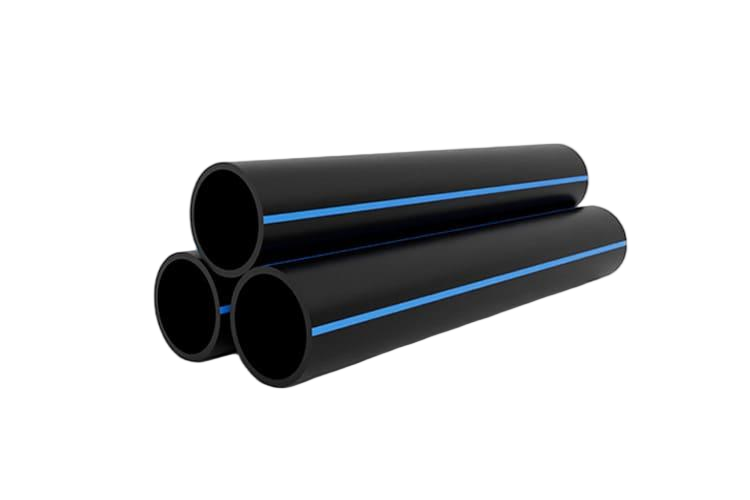
A penstock carries water from the intake down to the turbine, turning the drop in elevation into pressure — and for small, mini and micro-hydro schemes it's increasingly made of polyethylene. HDPE never corrodes (penstocks run wet for decades), it's light enough to carry and join by hand at remote mountain sites with no road or crane, it bends to follow the hillside underground with few anchors, and its low stiffness damps the water hammer of a turbine load rejection. This guide covers HDPE penstocks — where they win, how to size them, and where steel still belongs.
What a penstock does
The penstock is the pressure pipe between the intake or forebay and the turbine. As the water drops in elevation, that head converts to pressure and velocity at the turbine, so the penstock has to hold the static pressure of the head — plus the transient surge when the turbine's flow is suddenly cut. For small (under about 10 MW), mini and micro (under 100 kW) hydro, HDPE is widely used; only at very high head or very large diameter does steel (or GRP) dominate.
Why HDPE for penstocks
HDPE answers a penstock's demands unusually well. It's corrosion-free, so a pipe running wet for decades needs no coating or cathodic protection; its smooth bore keeps friction low (a Hazen-Williams C around 150) to preserve head and efficiency; its fused joints are leak-free and self-restrained, so a buried line needs few thrust blocks; it's flexible enough to follow the natural slope of a hillside with minimal fittings and tolerate ground movement; and it's light — decisively so at remote mountain sites with no road access, where pipe is carried and joined by hand rather than craned. It also damps surge and costs less to install at low-to-moderate head.
Head, pressure & choosing PN/SDR
Sizing starts from the head: roughly every 10.2 m of head is one bar of static pressure, and the pipe's pressure class (PN, set by the SDR and the grade) has to cover that static head plus a surge allowance. The table gives approximate static-head ceilings by PN for PE100 at 20 °C — but treat them as nominal, because the usable head is lower once you derate for temperature, the 50-year design basis and surge. Add a surge allowance (commonly 1.5–2× static) and confirm with a transient analysis.
| Pressure class (PE100) | Approx. static head |
|---|---|
| PN10 (SDR17) | ~100 m |
| PN16 (SDR11) | ~160 m |
| PN20 (SDR9) | ~200 m |
| PN25 (SDR7.4) | ~250 m |
| Note | Derate for temperature, 50-yr design & surge — usable head is lower; add a surge allowance |
Surge & water hammer on load rejection
The case that often governs a penstock's wall isn't the static head — it's the surge. When a turbine sheds load and its valve closes quickly, the moving water column slams to a stop and sends a water-hammer transient up the penstock. Here HDPE helps: its low elastic modulus gives a low wave speed (around 300 m/s, versus roughly 1,100 m/s in steel) and viscoelastic damping, so the surge peaks are markedly lower than in a rigid steel penstock. But a proper transient analysis still governs the design — don't size on static head alone.
Buried vs above-ground penstock
A buried HDPE penstock follows the natural slope of the hillside, and because its fused joints are self-restrained it needs few thrust blocks or anchors — a big saving over an exposed steel penstock on saddles and anchor blocks. Burial also protects the pipe from UV, freeze and vandalism, restrains its high thermal expansion, and lowers the visual and environmental impact. If a section must run above ground, use UV-stabilised black pipe and allow for its thermal movement; otherwise, burying it is usually the simpler, cheaper and more durable choice.
Sizing for efficiency: velocity & head loss
A penstock is sized to deliver the flow without wasting head to friction. Designers typically target a velocity around 2.5–3.5 m/s — fast enough to keep the pipe (and cost) reasonable, slow enough to keep friction loss down — and budget the total friction loss to roughly 5–10% of the gross head. HDPE's smooth bore (C ≈ 150, held for life because it doesn't corrode or tuberculate) helps keep that loss low, which directly protects the scheme's energy yield over its whole life.
HDPE vs steel, GRP & ductile iron
No penstock material is universally best, so the honest comparison matters. HDPE wins on corrosion, fused self-restrained joints, terrain-following burial, lightness for remote sites, surge-damping and cost — for low-to-moderate head and small-to-medium diameter. Steel takes the very high head and very large diameter; GRP offers corrosion-free large diameter but is brittle and jointed. A common solution is a hybrid: HDPE upstream where head is lower, steel downstream where it's highest.
| Material | Wins | Loses |
|---|---|---|
| HDPE (PE100) | Corrosion-free, fused self-restrained, terrain-following, light for remote sites, surge-damping, lower cost | Head & diameter ceiling — not for very high head / large diameter |
| Steel | Very high head, very large diameter, high surge | Corrodes (coating/maintenance); heavy (cranes); needs anchors; welded joints |
| GRP | Corrosion-free, large diameter, stiff | Brittle; jointed (not fused); careful bedding & handling |
| Ductile iron | Robust, high pressure | Heavy; corrosion & coating needs |
HDPE head & diameter limits — when to switch to steel
It's worth being honest about HDPE's ceiling. HDPE penstocks are common up to roughly 100–200 m of head and up to about 1,200–1,600 mm in diameter — real schemes have used HDPE to 1,220 mm at multi-megawatt scale — but beyond that head or diameter, steel (or the HDPE-upstream/steel-downstream hybrid) is the right call. The exact limit depends on the available PN, the diameter and the surge, so treat these as practical ranges rather than hard lines, and let the head-plus-surge design decide.
Standards
Penstock HDPE is made to ISO 4427 or EN 12201 (PE100, with PE100-RC for buried or no-sand-bed conditions), or AWWA C906 in North America, where PE4710 is the equivalent grade. Small-hydro design itself is guided by references such as the ESHA guide on developing a small hydropower plant. As always, the head-plus-surge pressure design, the velocity and friction-loss sizing, and the anchoring are project-specific engineering for the particular scheme and terrain.
5 costly mistakes
- Under-rating the PN/SDR for the head plus surge — sizing only to static head.
- Skipping the load-rejection transient analysis — water hammer often governs the wall.
- No air/vacuum valves at high points — risking vacuum collapse on drain-down or air-lock.
- Leaving HDPE above ground unprotected — UV degradation and unmanaged thermal movement (use black pipe, bury or cover, allow expansion).
- Forcing HDPE onto very high head or very large diameter where steel (or an HDPE-upstream/steel-downstream hybrid) is the right choice.
References & standards
- [1]ESHA — Guide on how to develop a small hydropower plant (Part 1)
- [2]ESHA — Guide on how to develop a small hydropower plant (Part 2)
- [3]Pico Hydro UK — The penstock (implementation manual, Ch. 11)
- [4]PE100+ Association — Polyethylene pipe and hydroelectric development
- [5]Plastics Pipe Institute (PPI) — PE pressure pipe resources
- [6]AWWA / ANSI — AWWA C906 — PE pressure pipe & fittings 4–65 in.
- [7]ScienceDirect — Penstock material selection in small hydropower (MADM)
- [8]MDPI Water — Water hammer in steel–plastic pipes (surge damping data)
Frequently asked questions
Need expert advice on your project?
Our engineering team helps utilities, contractors and EPCs specify the right pipe material and SDR for their project. Get a no-obligation technical consultation.
Talk to an engineerRead next
Explore further
Related applications, material comparisons and country buying guides selected for this topic.