Guide
HDPE Pipe Grades Explained: PE80 vs PE100 vs PE4710 (and PE100-RC) (2026)
The number isn't a pressure — it's the 50-year strength. Decode PE80, PE100, PE4710 and PE100-RC, the ISO and ASTM systems, and how grade becomes pressure.

Dr. Wei Liu, P.E.
Senior Engineering Manager · Primepoly
Published: Jun 8, 2026
Updated: Jun 8, 2026
13 min read
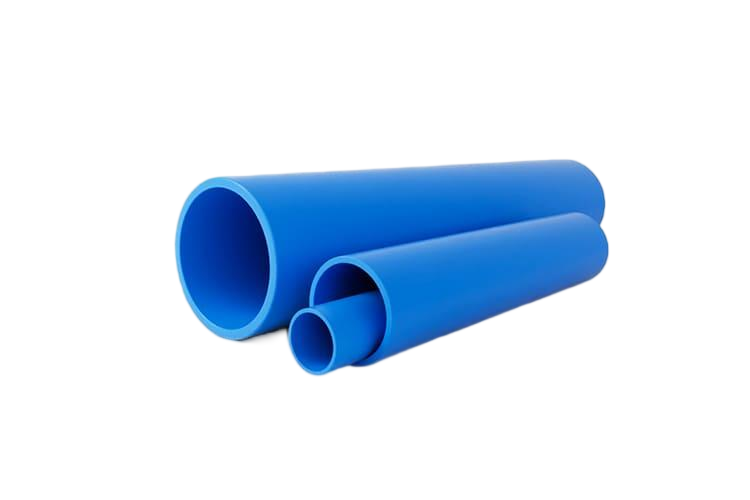
"PE100" sounds like it should mean 100 bar, or 100 something — and that single misreading causes more confusion than any other point about HDPE pipe. It doesn't. The grade number is the material's 50-year strength, not its pressure rating. This guide decodes the grades — PE80, PE100, PE4710 and PE100-RC — across the two parallel systems (ISO and ASTM) that name them, explains why PE100 lets you use a thinner wall than PE80, why PE4710 is the North American near-equivalent of PE100, and how a grade and an SDR together give you a pressure.
What PE80, PE100, PE4710 & PE100-RC actually mean
There are four grades you'll meet, named in two systems. PE80 and PE100 are the ISO/European names, where the number is the material's minimum required strength. PE4710 (and the older PE3608) are the North American/ASTM names, classified a different way. And PE100-RC is PE100 with an added property — crack resistance. They're not random codes: each tells you something specific about the resin's long-term strength and, in the RC case, its toughness against cracks.
The #1 misconception: the number is strength (MRS), not pressure
The grade number is the Minimum Required Strength (MRS) — the hoop strength the material is guaranteed to retain over a 50-year design life, in megapascals, multiplied by ten. So PE80 has an MRS of 8.0 MPa and PE100 has an MRS of 10.0 MPa. It says nothing on its own about the pressure the pipe can hold: a thick-walled PE80 pipe can be rated for more pressure than a thin-walled PE100 one. Pressure depends on the grade and the wall thickness (the SDR) together — which is the formula at the end of this guide.
The ISO/European system: PE63, PE80, PE100 & MRS
In the ISO world, the grade number is the MRS. The strength is found by pressure-testing pipe over a long time and extrapolating the regression to 50 years at 20 °C (ISO 9080), then classifying the result into a grade (ISO 12162): PE63 at 6.3 MPa, PE80 at 8.0 MPa, PE100 at 10.0 MPa. PE63 is largely obsolete and PE80 is now mostly confined to gas, small-bore and legacy work; PE100 is the modern standard for new pressure pipe.
The North American/ASTM system: PE4710 & PE3608
North America uses a different code: a four-character designation (per ASTM D3350's cell classification) plus a Hydrostatic Design Basis. In PE4710, the "4" is the density cell, the "7" the slow-crack-growth cell, and the "10" the design-stress code (a hydrostatic design stress around 1,000 psi, from an HDB of 1,600 psi at a 0.63 design factor). PE4710 is the high-performance grade and is the North American near-equivalent of PE100; the older PE3608 sits roughly where PE80 does. The systems describe the same kind of property — long-term strength — just by different methods and at slightly different test temperatures.
PE80 vs PE100: thinner walls, more flow
Because PE100's MRS (10) is 25% higher than PE80's (8), a PE100 pipe carries 25% more strength — which you can spend two ways: a thinner wall for the same pressure (giving a larger bore and more flow, and using less resin), or a higher pressure rating at the same SDR. That's why PE100 has become the default for new pressure pipe and PE80 lingers only in gas, small-diameter and legacy use. The chart shows the MRS ladder; the higher the bar, the more strength you have to work with.
Bimodal vs unimodal: why PE100 outperforms PE80
PE100's higher strength isn't just a recipe tweak — it comes from a bimodal molecular structure. Modern PE100 blends a high-molecular-weight fraction (which gives strength and slow-crack-growth resistance, through more "tie molecules" bridging the crystalline regions) with a low-molecular-weight fraction (which keeps the resin processable). That combination delivers stiffness, crack resistance and rapid-crack-propagation resistance at once — a balance that the older unimodal PE80 resins can't strike, which is the underlying reason PE100 outperforms PE80.
PE4710 vs PE100: equivalent grades, different rating methods
PE4710 and PE100 are, in practice, equivalent high-performance grades — modern PE4710 also meets the ISO PE100 requirements (though not every PE100 qualifies as PE4710). They're just rated by different methods: PE4710 via the ASTM HDB/HDS approach tested at 23 °C, PE100 via the ISO MRS approach at 20 °C. That difference, plus the design-factor methodology, produces a small (often cited around 7–15%, DR-dependent) gap in the pressure rating for the same SDR — for example a DR9 PE4710 line rates a little higher than an SDR9 PE100 one. Treat the percentage as approximate and compare specific PN values rather than a blanket figure.
PE100-RC: crack resistance, not higher pressure
PE100-RC is the grade most often misunderstood. It has the same MRS (10), the same design stress and the same wall and pressure rating as ordinary PE100 — it is not a higher-pressure grade. The "RC" stands for resistance to crack growth: it's a PE100 with greatly enhanced resistance to slow crack growth and point loads, qualified to a much longer notched-pipe test (per PAS 1075). That makes it the grade for no-sand-bed bedding, direct burial in stony native backfill, trenchless installation and point-loaded conditions — situations about toughness, not pressure.
From grade to pressure: design stress & the SDR formula
Here's how a grade becomes a pressure. First, the design stress (σs) is the MRS divided by a safety coefficient C (1.25 for water), so PE100's design stress is 10 / 1.25 = 8.0 MPa. Then the pressure rating follows P = 2·σs / (SDR − 1) — the grade sets σs, the SDR sets the wall. For PE100 at SDR 7.4, that's 2 × 8 / (7.4 − 1) = 25 bar (PN25); at SDR 11, PN16. Run the same SDR with PE80's lower design stress and you get a lower PN — which is exactly why grade and SDR must always be quoted together.
Grade comparison
The table puts the grades side by side — their strength basis, design stress, whether they're bimodal, and where each is used. Read it as the at-a-glance summary of everything above.
| Grade | Strength basis | Design stress | Bimodal? | Typical use |
|---|---|---|---|---|
| PE80 | MRS 8.0 MPa | 6.4 MPa | Often unimodal | Gas, small-bore, legacy |
| PE100 | MRS 10.0 MPa | 8.0 MPa | Yes (modern) | The standard for new pressure pipe |
| PE100-RC | MRS 10.0 MPa (+ SCG) | 8.0 MPa | Yes | No-sand-bed, trenchless, point loads |
| PE4710 (ASTM) | HDB 1,600 psi / HDS ~1,000 psi | ~1,000 psi | Yes | North-American near-equivalent of PE100 |
5 common confusions
- Thinking the grade number is a pressure rating — "PE100" means MRS 10.0 MPa (50-year strength), not 100 bar.
- Mixing the ISO and ASTM designations as if they're identical spec lines — same SDR doesn't give an identical PN.
- Assuming PE100-RC is a higher-pressure grade — it has the same MRS, wall and PN as PE100; the upgrade is crack resistance.
- Specifying PE80 where PE100 would cut the wall and cost — thinner wall, larger bore, less resin for the same pressure.
- Ignoring that the same SDR gives a different PN for different grades — e.g. SDR11 is PN16 in PE100 but lower in PE80.
Glossary
- MRS (minimum required strength)
- The 50-year extrapolated hoop strength (per ISO 9080), in MPa — the basis of the PE63/80/100 grade numbers.
- HDB (hydrostatic design basis)
- The ASTM long-term strength basis (per ASTM D2837) used to rate PE4710/PE3608 in North America.
- Design stress (σs)
- The allowable working stress: MRS divided by a safety coefficient C (1.25 for water) — 8.0 MPa for PE100.
- SDR
- Standard Dimension Ratio = OD ÷ wall thickness; the lower the SDR, the thicker the wall and the higher the pressure rating.
- Bimodal resin
- A blend of high- and low-molecular-weight fractions that gives PE100 both strength/crack resistance and processability.
- PE100-RC
- PE100 with enhanced resistance to slow crack growth and point loads (per PAS 1075) — same pressure rating, more toughness.
References & standards
- [1]PE100+ Association — Meaning of the designations PE80, PE100, PE100-RC
- [2]Plastics Pipe Institute (PPI) — TN-68 — how PE4710 compares to PE100-RC
- [3]Chevron Phillips Chemical — PP-816-TN — PE3608 & PE4710 designation & pressure rating
- [4]AGRU America — Polyethylene pipe material designations
- [5]ISO — ISO 4427-1 — PE pipes for water supply (general)
- [6]ASTM International — ASTM D3350 — PE plastics pipe materials (cell classification)
- [7]ASTM International — ASTM D2837 — obtaining the hydrostatic design basis (HDB)
- [8]Uni-Bell — Things to know before specifying PE4710 (rating critique)
Frequently asked questions
Need expert advice on your project?
Our engineering team helps utilities, contractors and EPCs specify the right pipe material and SDR for their project. Get a no-obligation technical consultation.
Talk to an engineerRead next
Explore further
Related applications, material comparisons and country buying guides selected for this topic.