Application
HDPE Pipe for Geothermal Ground Loops: GSHP Heat Exchangers (2026)
The buried heat exchanger behind a ground-source heat pump — why it's fused HDPE, the loop types, the materials, and the one rule you can never break.

Dr. Wei Liu, P.E.
Senior Engineering Manager · Primepoly
Published: Jun 8, 2026
Updated: Jun 8, 2026
12 min read
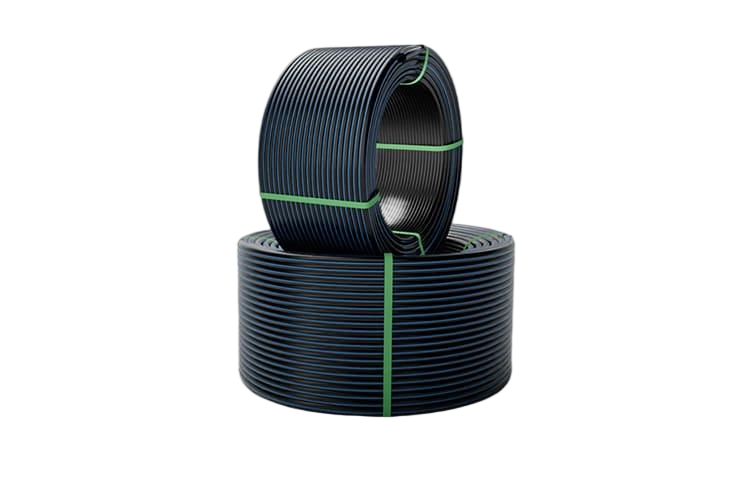
A ground-source heat pump draws heat from the earth through a buried loop of pipe — a heat exchanger that has to last the life of the building, sealed underground where no one can reach it. That single requirement is why ground loops are made of heat-fused HDPE: corrosion-free for 50-plus years, and joined so the entire loop is one monolithic, jointless run. This guide covers the closed-loop types, why HDPE is the standard, the pipe grades, what's inside a vertical borehole, and the rule that can never be broken — no mechanical joints in the ground.
What a ground loop is: the buried heat exchanger
A ground-source (geothermal) heat pump moves heat between a building and the ground, which stays at a stable temperature year-round. The ground loop is the buried pipe heat exchanger that makes that exchange: a water or antifreeze fluid circulates through it, picking up heat from the earth in winter and rejecting heat to it in summer. Because the loop is buried for the life of the building, its pipe and — above all — its joints have to be permanent and leak-free, which dictates both the material and how it's joined.
Closed-loop types: vertical, horizontal, pond/lake
Closed-loop systems circulate the fluid through a sealed HDPE loop (distinct from open-loop systems, which pump actual well water). The loop geometry is chosen by site and land: vertical loops drop U-tubes into boreholes where land is limited, horizontal loops lay pipe in trenches where land is available, and pond/lake loops submerge coils in a water body. The table summarises them.
| Loop type | Configuration | Notes |
|---|---|---|
| Closed — vertical | U-tube (2 pipes + factory U-bend) in a grouted borehole | Commercial, schools, limited land |
| Closed — horizontal | Trenches; straight pipe or slinky / coil | Most cost-effective where land is available |
| Closed — pond / lake | Coiled pipe submerged in a water body | Kept deep enough to avoid freezing |
| Open loop (for contrast) | Pumps well / ground water through a heat exchanger | Not the closed PE loop — out of scope |
Why HDPE/PE is the standard for ground loops
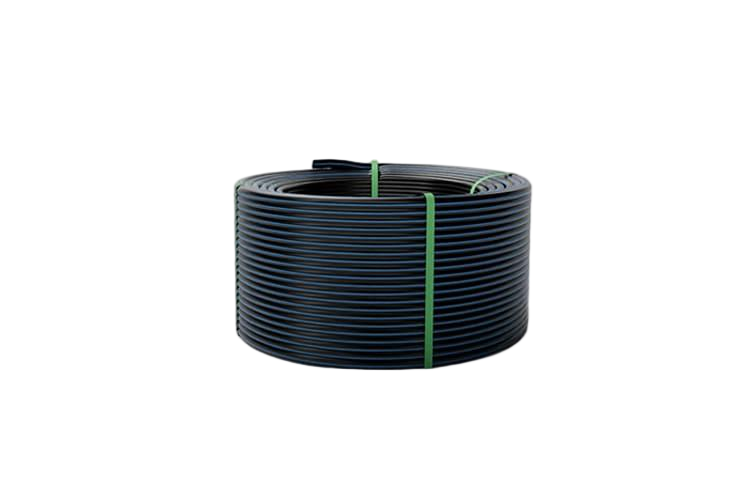
HDPE is the standard ground-loop material because it matches every demand of a buried-for-life heat exchanger. It's corrosion-free, lasting 50 years and more underground; it's heat-fusible, so joints become as strong as the pipe with nothing to leak; it's flexible enough to coil into long horizontal runs and tough enough (bimodal PE4710) to resist slow crack growth; it has adequate thermal conductivity for a plastic, bridged to the bore by thermally enhanced grout; and it's chemically compatible with the glycol, methanol or other heat-transfer fluids that circulate through it.
The non-negotiable rule: a fully fused loop — no mechanical joints in the ground
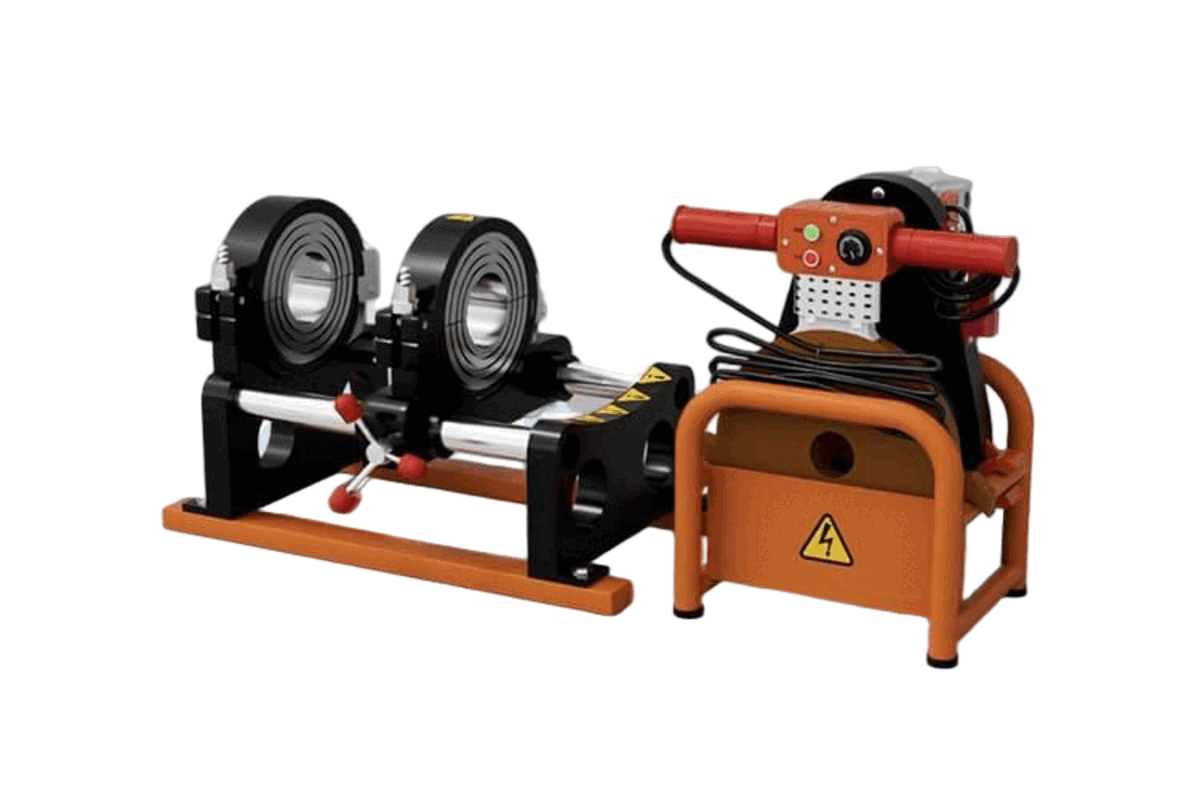
This is the headline that governs everything: the entire ground loop is heat-fused into one monolithic, jointless run, because a buried mechanical joint that leaks is essentially impossible to find and repair — it would ruin the loop and the borehole. So every connection in the ground is made by butt, socket or electrofusion (the U-bend at the bottom of a vertical loop is itself a fused fitting); clamps, glued joints and compression fittings are never used underground. Fusion isn't a preference here, it's the rule.
Pipe materials & grades: PE4710, PE-RT, PEXa
HDPE in the PE4710 grade is the dominant, industry-standard ground-loop material, typically supplied as DR11 (about a 200 psi rating). Where higher temperature capability is wanted, PE-RT (raised-temperature polyethylene) is increasingly used, and PEXa is also approved for closed loops. All three are covered by the NSF/ANSI 358 geothermal-pipe family. Metal is disqualified — it would corrode underground and can't be heat-fused into a monolithic loop. The table compares the three plastics.
| Material | Designation | Temp capability | Standards |
|---|---|---|---|
| HDPE (the standard) | PE4710 | Standard loop temperatures | NSF/ANSI 358-1; ASTM D3035/F714 |
| PE-RT | Raised-temperature PE | To ~82 °C | NSF/ANSI 358-4; ASTM F2769 |
| PEXa | PEX1206 | To ~82–93 °C | NSF/ANSI 358-3; ASTM F876 |
Inside a vertical borehole: U-tube, grout & header
A vertical loop is a borehole — commonly around 30 to 150 m deep, though it's design-dependent — holding a U-tube: two parallel HDPE pipes joined at the bottom by a factory-fused 180° U-bend fitting. After the U-tube is lowered (sometimes weighted to run straight), the bore is filled bottom-to-top with thermally enhanced bentonite grout, which does double duty: it puts the pipe in good thermal contact with the earth and seals the bore from aquifers. Multiple bores tie into a header, often reverse-return piped for hydraulic balance, at a manifold or vault.
Pressure testing, air purge & commissioning
Commissioning order is critical, and one step is non-negotiable: pressure-test and flush the loop before grouting, so any defect is caught while it can still be fixed — once a bore is grouted, a fault is locked in permanently. After installation the loop is flushed and the air purged (an airlock will kill circulation and heat transfer), then flow-tested and given a field hydrostatic leak test to the designer-specified pressure for a set hold period. Get the test-before-grout sequence wrong and no amount of later work can recover it.
Standards & qualifications
Ground-loop work is governed by the CSA/ANSI/IGSHPA C448 code and by IGSHPA's design, installation and fusion-qualification standards; the pipe and fittings are certified to the NSF/ANSI 358 family (358-1 HDPE, 358-3 PEX, 358-4 PE-RT); fusion follows ASTM F2620; and field leak testing follows ASTM F2164, with PPI TN-55 covering geothermal piping materials. Loop sizing itself — bore length against ground thermal conductivity and building load — is specialist GSHP engineering, separate from the pipe specification.
5 common ground-loop mistakes
- Any mechanical joint in the ground — never; a buried leak is essentially unrepairable, so every joint must be fused.
- Poor grout or poor thermal contact (voids, low-conductivity grout) — which throttles heat transfer.
- Undersizing the loop or bore length — the loop under-performs and can freeze or overheat.
- Not pressure-testing before grouting — a defect is then locked in permanently.
- Not purging the air — an airlock kills circulation and heat transfer.
References & standards
- [1]US DOE / Energy Saver — Geothermal heat pumps
- [2]DOE / PNNL — Ground-source heat pumps (Building America)
- [3]IGSHPA — Standards (C448 and installation)
- [4]Water Well Journal (PPI) — Plastic piping materials for geothermal applications
- [5]Plastics Pipe Institute (PPI) — TN-55 — plastic piping for ground-source geothermal
- [6]CSA Group / ANSI — CSA/ANSI/IGSHPA C448 series
- [7]WL Plastics — HDPE pipes for geothermal systems
- [8]Dandelion Energy — Geothermal ground loop FAQs
Frequently asked questions
Need expert advice on your project?
Our engineering team helps utilities, contractors and EPCs specify the right pipe material and SDR for their project. Get a no-obligation technical consultation.
Talk to an engineerRead next
Explore further
Related applications, material comparisons and country buying guides selected for this topic.